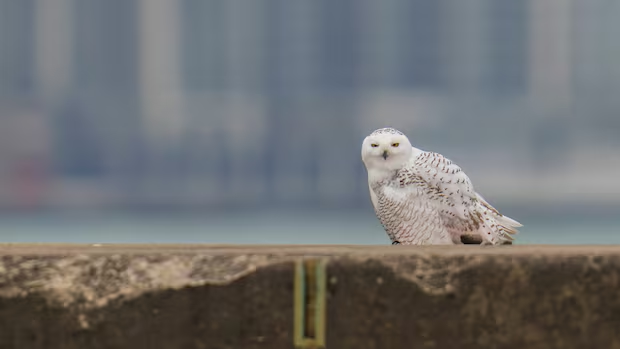
This could be an unusually good year to spot snowy owls in southern Canada.
This past weekend, the The Owl Foundation, an owl rehabilitation centre based in Ontario’s Niagara region, reported in a Facebook post that it had already admitted two young snowy owls so far this year, suggesting that it’s “shaping up to be a snowy owl irruption year!”
An irruption is a surge in the local population of a species, for example, an unusual number of snowy owls coming south from the Arctic. So far this year, more young snowy owls have been reported earlier than usual in southern Canada and the northern U.S., and researchers say this it might mean an opportunity to see a relatively rare visitor from the North that was recently labelled threatened by the Committee on the Status of Endangered Wildlife in Canada.
Brian Hayhoe, a wildlife biologist and rehabilitator at The Owl Foundation, wrote the post. He says in the past few winters, the centre has received zero to two snowy owls each year, often not until December or January.
He’s heard from other wildlife centres in other parts of Ontario that are also reporting higher numbers earlier than usual, and said they’re often the first to notice trends like this: “Rehabbers are kind of like the canary in the coal mine.”
Meanwhile, two snowy owls have recently drawn crowds near Chicago, also prompting suggestions of an irruption year.
Scott Weidensaul, a researcher involved with the snowy owl GPS tracking program Project SNOWstorm, says most southern snowy owl sightings so far have been in the central and western Great Lakes and in the Prairies. But there have been a few spotted as far west as B.C., where they’ve rarely been seen in recent years.
“Maybe it’s going to shape up to be a decent year out there as well,” Weidensaul said.
What’s behind a possible snowy owl ‘irruption’
An irruption is a large movement of birds that happens periodically — unlike a migration, which happens regularly, such as from a northern region to a southern region every fall.
With snowy owls, an irruption often brings them south in large numbers about every six years, says Guy Fitzgérald, a veterinarian who specializes in wild birds of prey at the Faculty of Veterinary Medicine at the Université de Montréal and is part of the Project SNOWstorm team.
There are reports of irruptions in 2017-2018 and 2020-2021. But Weidensaul says the biggest in recent history was in 2013-2014 when “there were literally thousands of snowy owls that came down from the subarctic.”
Snowy owls can often be found in winter in agricultural fields and in coastal areas in southern Canada and the northern U.S. (Jean Hall/Project SNOWstorm)
Fitzgérald says that in the past decade, peaks in snowy owl numbers haven’t been as obvious as in the past. “This may be a sign that something is wrong in their breeding area in the north.”
Nicolas Lecomte is a Université de Moncton professor who’s part of a team that’s been tracking and studying snowy owls for 25 years and collaborates with Project SNOWstorm.
He says irruptions tend to happen in years when lemmings — an important food for snowy owls — are abundant in the Arctic. In those years, snowy owls produce many more chicks than usual and there can be hundreds of nests in a very small area.
“It’s quite marvelous to see,” Lecomte said.
Snowy owls raise chicks like this one in Arctic nests. They produce more chicks when lemmings are abundant. (Submitted by Nicolas Lecomte)
In the fall, those owls must spread out to find food, often heading south in large numbers.
Some snowy owls do come south to look for food every winter — just not as many.
Most winters, they can be found consistently in the Prairies, with its tundra-like landscape, relatively shallow snow cover and agricultural fields where voles, mice and other prey are abundant.
Jody Allaire, who lives in Drumheller, Alta., says there are a couple of snowy owls near his place right now, and he often sees them in his travels.
“I can, you know, drive to Calgary and back and you’re pretty much guaranteed to see a snowy owl in like December, January, which is just amazing,” said Allair, who is the director of communications for Birds Canada.
They are also found along coastlines in the Great Lakes region and further east, where they hunt for waterfowl trapped in the ice — something Allair says he witnessed while living in Long Point, Ont., on Lake Erie.
This map shows the tracks of snowy owls tagged by Project SNOWstorm as they travelled to the Arctic in summer, and southern Canada and the northern U.S. in winter between 2013 and 2024. (Project SNOWstorm)
Fitzgérald says the owls are also often found at airports, including both airports in the Montreal area — one of his jobs is to relocate them so they don’t interfere with aircraft.
In a typical year, small numbers of both adult and juvenile snowy owls are found in southeastern Canada. But in irruption years, a much higher proportion are juveniles, Lecomte said.
So is this year an irruption year?
Lecomte says researchers were not aware of particularly good snowy owl breeding areas in the Arctic this year, although Fitzgérald notes that the owls may simply have been somewhere that wasn’t surveyed.
Snowy owl sightings do seem to be high early in the season this year, but Lecomte says they won’t know if this is a true irruption until January when more of the birds head south.
Ontario raptor specialists Charlotte England and Malcolm Wilson put a GPS tag on a snowy owl named Newton for Project SNOWstorm. (Maria Mak/Project SNOWstorm)
How to see snowy owls
Snowy owls are most often found in agricultural fields and coastal areas.
Allair advises people to visit snowy owls if they’re near you. “Go see, take the family … it’s such a great treat to see.”
He believes it’s a great way to connect with nature, but he recommends taking care to view the birds from a distance and not lingering too long. “If the bird changes its behaviour because of your proximity, it’s time to go,” he said.
Birds Canada has a list of recommendations to minimize the chance of disturbing owls while observing them.
A snowy owl in flight (Nicolas Lecomte)
Fitzgérald recommends contacting bird watchers who are knowledgeable about where to find the birds and bird-watching etiquette.
While snowy owls were previously considered diurnal because they hunt during Arctic summers with long hours of daylight, Fitzgérald says GPS tracking data shows they prefer to hunt after dark and need to rest during the day.
“If you disrupt this resting behaviour, you may have an impact on the bird’s health.”
He says he gets calls every winter from people who believe they’ve seen an injured snowy owl, because it’s sitting on the ground with its eyes closed. Sometimes, by the time he explains that this is how snowy owls rest because there are no trees to perch on in the Arctic tundra, they have already approached the bird and caused it to fly off.
Another issue is photographers who bait owls with mice they have bought from pet stores, a practice conservationists have condemned. Fitzgérald says this causes birds to associate cars and humans with food, leading snowy owls to fly toward and collide with cars.
He says with all the technology available now, including telescopes and long camera lenses, there’s no reason to go near the birds, especially given all the challenges they already face.
WATCH | Snowy owl listed as threatened species:
The snowy owl, Quebec’s official bird, labelled a threatened species by expert group
The Committee on the Status of Endangered Wildlife in Canada says the snowy owl population has gone down by more than 40 per cent in 24 years.
Snowy owls are disappearing
Birds Canada tracks bird populations through an annual citizen science project called the Christmas Bird Count. It has recorded a 56 per cent decline in snowy owls since 1970.
Allair says climate change is probably a big factor. Snowy owls are adapted to hunting for rodents in soft snow, so ice and warming temperatures “create really, really tough conditions,” he said.
Habitat loss in the more southern areas where the birds winter, along with collisions with vehicles, are also contributors, he says.
Due to the species’ steep decline, scientists on Canada’s Committee on the Status of Endangered Wildlife in Canada recommended in May that snowy owls be added to Canada’s list of threatened species. The governments of Canada and Quebec have yet to officially recognize this status.
Weidensaul hopes seeing snowy owls will connect people to the Arctic and make them think about the threats facing the animals that live there.
“You’re not going to see a polar bear walking down the streets of Chicago,” he said. “But these snowy owls bring a piece of the Arctic south with them.”