Hundreds of Chicago residents sign petition to pause robot delivery pilot program over safety concerns

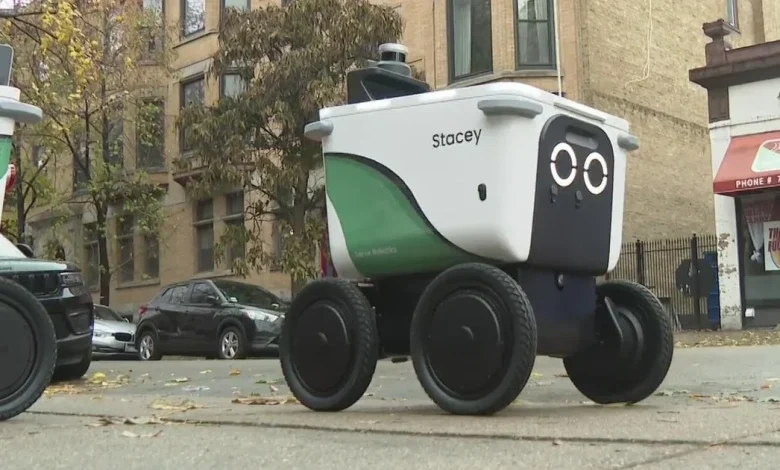
Roland, Sully, and Stacey stroll the sidewalks of the Lakeview neighborhood in Chicago — except they aren’t people, they’re robots.
They are a part of a pilot program the city has with Serve and Coco Robotics, companies that have fleets of food delivery robots.
Not everyone wants to share the sidewalks with remotely controlled, four-wheeled machines.
Over 800 Chicago residents have signed a petition to pause the pilot program over safety and accessibility concerns.
Josh Robertson, who created the petition, said he didn’t mind the robots at first.
“I’m a Star Wars fan. My initial reaction was, ‘Finally, droids are here,'” he said.
But once he encountered one in person on a walk with his family, he realized they aren’t exactly R2-D2.
“This was a vehicle coming toward us. It has cameras, its bright headlights were shining in full force, and we instinctively got out of its way,” Robertson said. “That’s what people reflexively do when vehicles are coming in the same lane toward them, but this was pedestrians in the pedestrian space.”
He began to feel uneasy and wondered what would happen as thousands more are set to be deployed by the end of this year.
“Sidewalks have to be accessible for everyone; they have to be safe. Those aren’t negotiable,” he said.
He started the campaign on foot, passing out flyers across Lakeview, calling for “CDOT & BACP release safety & ADA findings, evaluate that data and local job impacts in a public hearing, and set clear rules.”
The Personal Delivery Device (PDD) Pilot Program was first introduced to the Chicago City Council by former Mayor Lori Lightfoot in 2022. Under the pilot program, companies like Coco and Serve partner with restaurants as a courier service to deliver food orders to customers using robots.
In November 2024, Coco was licensed by the Chicago Department of Business Affairs & Consumer Protection (BACP), with the terms jointly managed with the Chicago Department of Transportation (CDOT). Serve launched in September 2025. BACP & CDOT say the pilot program is designed to assess both the “benefits and risks.”
In the initial release, CDOT said they are “assessing whether these delivery robots can be used to safely replace vehicle trips without inconveniencing other sidewalk users.”
According to the BACP, the pilot program will not continue past May 2027 without action by the City Council.
But hundreds of people want it paused now, according to Roberston’s petition. Most complaints are from the North Side, but span 30 different zip codes.
The biggest theme in the feedback so far is obstruction, such as the robots stopping in the middle of the sidewalk or crosswalk.
Accessibility is also a concern.
“It’s affected people who use wheelchairs, walkers, crutches, we’ve seen all of that in the responses,” Robertson said. “Some of the incidents that have been reported involve physical collisions.”
Anthony Jonas left his apartment one morning, turned the corner, and collided with a robot, leaving him with a scar by his eye.
“It’s doing a lot better today. I do have a little bit of a scar still there,” Jonas said. “And I stumbled over it, and I whacked my eyelid against the visibility flag that’s attached to the robot … blood and urgent care, stitches. the whole thing.”
He’s seeking legal action and has already signed Robertson’s petition.
“We’re asking the city to publish safety and accessibility data on the robots. We’re asking the city to hold a public hearing discussing that data,” Robertson said.
Several alders said they’re working to gather resident opinions on the issue, but Robertson’s mind is made up — saying sidewalks are for people, and on his walk, there’s no room for robots.
Other cities, such as San Francisco, have placed restrictions on delivery sidewalk robots. Toronto banned delivery robots from all sidewalks and bike lanes in 2021.
Surveillance is another concern. Each Coco robot has five cameras that are constantly on and recording “vast amounts of data every day from…full 360-degree perception,” which a human “pilot” can use to help guide the robot.
According to its website, Coco has a “massive and growing” video collection to help create a model for autonomous navigation.
Serve robots are also equipped with cameras and other technology to help “navigate safely on busy city sidewalks.” Unlike Coco, Serve robots already routinely operate autonomously.
Serve and Coco both say their teams review “all evidence”, including video footage, when a safety issue is reported.
Serve and Coco both said that they track safety issues and follow the city’s regulations for sidewalk delivery robots. They also told CBS News Chicago that the robots cannot go faster than 5 miles per hour and slow down near pedestrians.
According to BACP, the companies are required to report injuries related to the robots, per the terms and conditions of the permit.
Coco said they are willing to meet with the petition organizer. The city’s pilot program is set to run through at least May 2026.
More from CBS News