Open this photo in gallery:
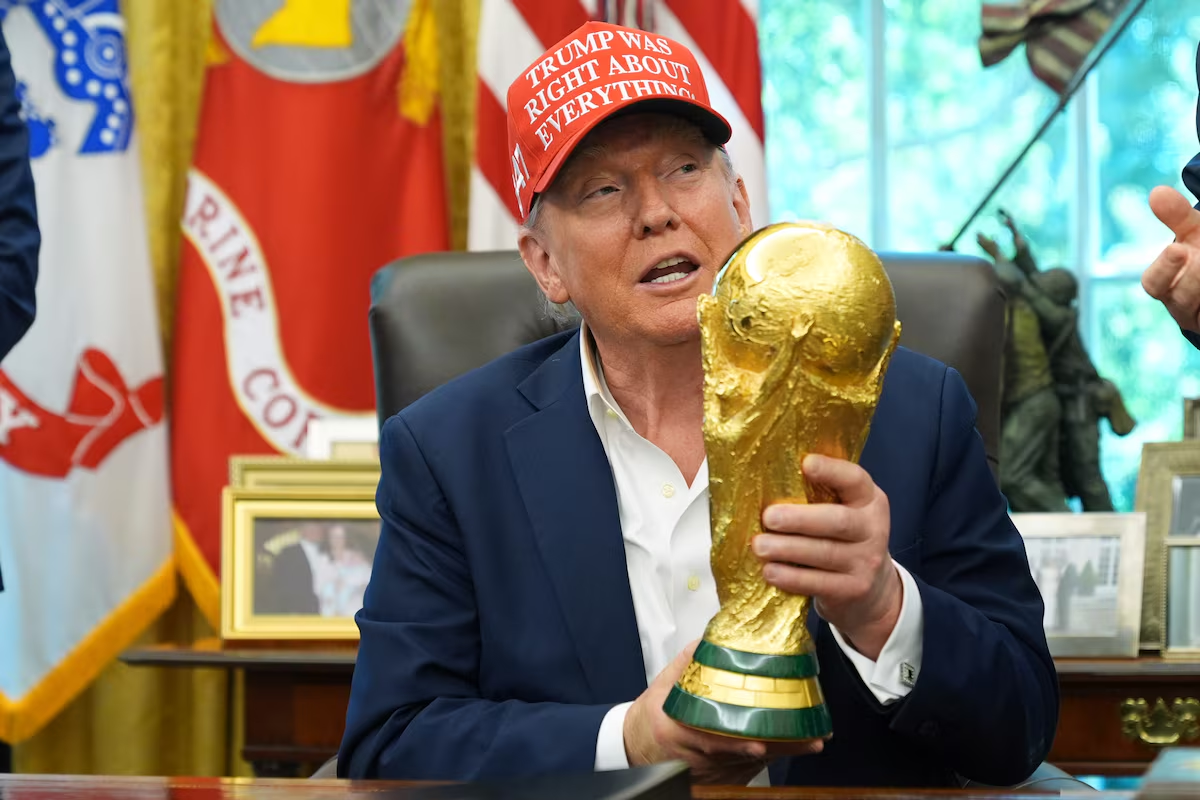
U.S. President Donald Trump holds the FIFA World Cup Winners Trophy in the Oval Office of the White House in August.Jacquelyn Martin/The Associated Press
Prime Minister Mark Carney will join Donald Trump at next week’s FIFA World Cup draw in Washington, an opportunity for the two leaders to discuss resuming shelved trade talks.
Canada, the U.S. and Mexico are co-hosting the 2026 World Cup. The Dec. 5 draw by the International Association Football Federation, known by its French initials FIFA, will determine the groups that competing countries are placed in.
The Prime Minister played down expectations of a breakthrough during the public event, which is scheduled to last about two hours.
“I don’t want to over-signal things,” he told reporters Wednesday. “What matters is the negotiations when they re-engage,” Mr. Carney said.
Opinion: Trump’s recent troubles are a blessing for Canada
“They haven’t re-engaged yet – that’s the fundamental point.”
The Prime Minister also revealed that he’d spoken to the U.S. President Tuesday but when pressed for details, he said he felt this exchange “was not newsworthy.”
Canada and the United States have not held formal trade negotiations since Mr. Trump broke off talks on Oct. 23, citing an Ontario government TV ad that criticized protectionist tariffs of the kind his administration has imposed on Canada.
Next week’s FIFA ceremony takes place at Washington’s John F. Kennedy Center for the Performing Arts.
There are no plans for Mr. Trump and Mr. Carney to meet at the White House either before or after the event, sources familiar with arrangements said. The Globe and Mail is not identifying the sources because they were not authorized to discuss the matter publicly.
However, the length of time that the two men are within earshot during the FIFA ceremony leaves open the possibility of a one-on-one discussion at the Kennedy Centre.
Lawrence Martin: Carney’s push for new trading partners shows progress
The last time Mr. Carney and Mr. Trump met face to face was at a private dinner in South Korea before the Asia-Pacific Economic Co-operation summit in late October. Little materialized, however. The two men acknowledged each other, made finger guns at one other and smiled, appearing to exchange pleasantries.
Mr. Carney this week minimized the urgency of sitting down with Mr. Trump.
“I look forward to speaking with the President soon, but I don’t have a burning issue to speak with the President about right now,” the Prime Minister told media in Johannesburg Sunday.
On Wednesday, asked by journalists whether he planned to restart trade talks with Mr. Trump, Mr. Carney said the ball is in the U.S.’s court.
“We are ready to re-engage on those talks when the United States wants to re-engage.”
Notably, Mr. Trump has not followed through on a threat last month – after he shelved trade talks – to hike tariffs on Canada by another 10 percentage points.
It’s been eight months since the U.S. President began imposing tariffs on Canadian imports, and negotiations between Ottawa and Washington have so far failed to strike a deal that would reduce the levies.
The clock is ticking down on a scheduled 2026 review of the United States-Mexico-Canada trade agreement where the U.S. is expected to seek renegotiation of parts of the pact. If Canada doesn’t manage to reach a deal with Mr. Trump before this review, it’s likely that the disputed tariffs could be folded into the USMCA renegotiations.
As the Canadian government has repeatedly said publicly, it does not want to wait for this. It wants to cut a deal on one group of the Trump tariffs: those imposed under Section 232 of the Trade Expansion Act in the name of national security. These include the 50-per-cent tariffs on Canadian steel and aluminum, which do not receive an exemption under USMCA rules that otherwise shields most Canadian imports from current Trump levies.
The review and possible renegotiation of the USMCA would last for many months and possibly past the 2026 midterm congressional elections next November. That would mean the Section 232 tariffs could remain in place for at least another year.
Mr. Trump’s anger over the Ontario government TV ad effectively closed a negotiating window of opportunity for Mr. Carney to reach a tariff deal. It’s not clear whether the Prime Minister will find another opportunity with the U.S. President, including the FIFA draw Dec. 5.