In Congress, He Said Tariffs Were Bad for Business. As Trump’s Ambassador to Canada, He’s Reversed Course.

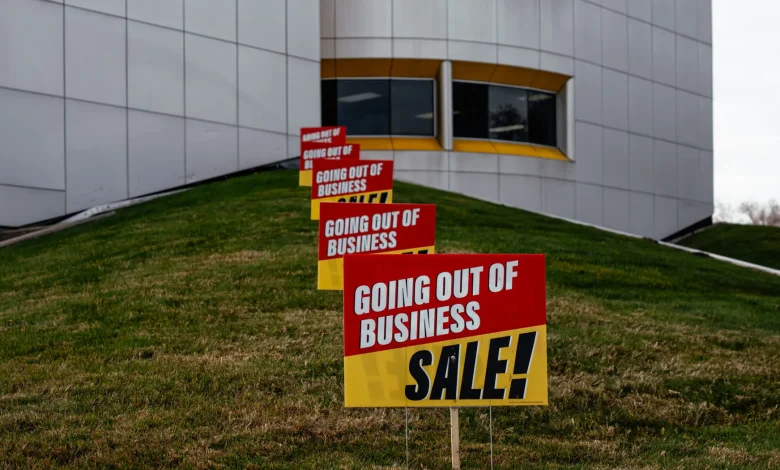
Time is winding down for Howard Miller, the storied furniture company and clockmaker in western Michigan that said this summer it will close after 99 years. It identified the Trump administration’s tariffs as a main culprit.
Howard Miller’s closure will cost about 195 people their jobs, most in Michigan. “Our hopes for a market recovery early in the year were quickly dashed as tariffs rattled the supply chain, sparked recession fears and pushed mortgage rates higher,” the company’s president and CEO said in a July press release.
In November, the company hosted a factory closeout sale. Locals shuffled through makeshift aisles bounded by curio cabinets, wardrobes and home bars styled with faux cocktails for an imaginary party.
And there were, of course, the signature grandfather clocks that made Howard Miller famous, both traditional designs of fluted hardwood and contemporary deconstructions with visible gears. Some sported a red, white and blue “Made in Michigan” sticker on their glassy faces.
For nearly a century, Howard Miller was an American success story. But it struggled when President Donald Trump unleashed aggressive and fast-changing tariffs this year on both specific countries and business sectors. Some countries responded with retaliatory tariffs. Along the way, there were pauses, escalations and reports of progress toward some 14 trade agreements, falling short of the administration’s prediction of 90 deals in 90 days.
Companies like Howard Miller — a domestic manufacturer that imports certain goods and products — were caught in the middle. Tariffs led to rising costs on essential components that were unavailable domestically, according to the company.
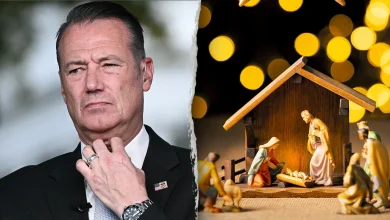
Pete Hoekstra saw it coming. Now the U.S. ambassador to Canada, Hoekstra was a nine-term congressman until 2011, representing the Michigan community where Howard Miller is based. He also was a vice president at the modern furnishings company now known as MillerKnoll that was co-founded by Howard Miller’s father, Herman.
In Congress, Hoekstra said tariffs were bad for business and consumers.
“The market should dictate the price of steel, not the government,” Hoekstra testified before the House Ways and Means Committee in 2003 on President George W. Bush’s temporary steel tariffs.
Tariffs drive up costs for furniture-makers and other manufacturers in his district, Hoekstra said at the time, leading to dramatically higher prices, longer lead times for production and lost jobs. “Once lost, the jobs will not come back,” he testified.
Today, though, as ambassador, Hoekstra has been a top defender of the president’s approach — a shift that’s mirrored in the changing attitudes of other Michigan Republican leaders on trade.
Hoekstra’s social media posts as ambassador applaud Trump’s efforts to achieve “balanced and reciprocal trade relationships.” And in October, after Ontario’s government commissioned an ad that aired during the World Series using former President Ronald Reagan’s words to champion free trade, Hoekstra reportedly chastised the province’s trade representative in an “expletive-laced tirade.”
Pete Hoekstra, the U.S. ambassador to Canada Darren Calabrese/The Canadian Press/AP
A spokesperson at the U.S. Embassy in Ottawa declined requests for an interview with Hoekstra and to comment for this story.
A White House spokesperson said in an email to ProPublica that the Trump administration “has consistently maintained that the cost of tariffs will ultimately be paid by the foreign exporters who rely on access to the American economy.”
Canada is Michigan’s largest international trading partner. In fact, the state sells more goods to Canada than to Michigan’s next four largest foreign markets combined, according to the Canadian consulate general in Detroit.
But Hoekstra seems to have followed Trump’s lead in engaging with Canada. When Trump repeatedly called for it to become “the 51st state,” Hoekstra said the country’s prime minister might see it as a term of endearment.
Meanwhile, other Michigan enterprises are making hard choices. The Michigan Retailers Association, a trade group, found that two-thirds of retailers surveyed in May said they had to raise prices because of tariffs. Agriculture, the state’s second-largest industry, is also taking a hit. Michigan’s agriculture department reported in late August that tariffs, including retaliatory tariffs, led to big drops in exports. Wheat exports fell by 89% compared to last year, fresh cherries by 62% and fresh apples by 58%.
And MillerKnoll, Hoekstra’s former employer, said in a business filing that its first quarter gross margin — a measure of profitability — decreased compared to the same quarter of the prior year, which it attributed primarily to “net tariff-related costs.” MillerKnoll issued a tariff surcharge and increased prices to mitigate costs “based on the current tariff environment,” a company executive said on an earnings call.
At Howard Miller, while demand isn’t what it once was for its clocks, the company had diversified its product line, which helped, said James O’Keefe, vice president of sales and marketing. But a subdued housing market limited sales to the people most likely to buy new furnishings, he said, and tariffs dialed up the cost of certain imported products.
It seemed like the family-owned company was put in a difficult position, said Nelson Vandermeer, a product development engineer. “If the federal government had said, ‘Oh, it’s a 10% tariff, constant, this is what it is,’ they might’ve been able to play the game, adjust margins, set pricing,” he said. “They might’ve worked things out. It might’ve been OK.
“But no. It’s just chaos.”
Vandermeer, who’s been with the company for more than 30 years, is grieving as Howard Miller enters its final days. “I loved my job,” he said. “I love the people I work with. When you love something, it’s tormenting to lose it.”
People look through rows of clocks at a factory sale at Howard Miller. Jamie Kelter Davis for ProPublica
Intertwined Economies
The tall teal pillars of the Ambassador Bridge linking Detroit and Windsor, Ontario, mark one of the busiest land borders in North America, symbolizing a profitable and once-dependable partnership. To expand capacity for the two-way flow of trade and traffic, a new span is slated to open next year: the Gordie Howe International Bridge, named for the Canadian hockey legend who spent 25 years with the Detroit Red Wings.
Michigan exports $23.3 billion in goods to Canada annually, according to the Canadian consulate in Detroit. That includes cars and trucks, vehicle parts and furniture, agricultural goods and more. Canada is also the largest source of imports into Michigan.
The standing trade agreement between Canada, the U.S. and Mexico was negotiated in Trump’s first term. The president later described it as “the best agreement we’ve ever made.”
Trump pursued some tariffs in his first term, but in his second, he played hardball, championing them as a way to grow American manufacturing while bringing a windfall of tariff revenue into the U.S.
Gordon Giffin, who served as the U.S. ambassador to Canada under former President Bill Clinton, said Trump has “fallen in love” with tariffs. And if there’s already a trade agreement in place, Trump will argue that “whatever president that put the agreement in place was an idiot.”
In the case of Canada and Mexico, Giffin said: “The agreement that’s in place is the one he put in place. And somebody needs to remind him of that.”
When Hoekstra landed at the Ottawa embassy in April, tensions were already high. In order to justify new tariffs on Canada, Trump had declared a national emergency over fentanyl trafficking, though the northern border is not a major source of the drug. Trump’s authority to use such emergency declarations to impose tariffs is now pending before the U.S. Supreme Court.
The president also questioned Canada’s sovereignty. “To be honest with you, Canada only works as a state,” he said in March. “We don’t need anything they have. As a state, it would be one of the great states.”
Canada responded with “elbows up,” a reference to a defensive posture hockey players take to ward off opponents. Certain stores emptied their shelves of American alcohol. Hockey fans booed during the American anthem. The national and some provincial governments issued retaliatory trade actions. (Many have since been lifted.) Canadian travel to the U.S. cratered. Data from Canada’s statistics office shows 10 consecutive months of reduced travel to its southern neighbor.
Colin Bird, the consul general of Canada in Detroit, told ProPublica that he’s hearing from companies on both sides of the border that are in “wait-and-see” mode or are pulling back on investment, “certainly from Canadian companies investing into Michigan that are being heavily impacted by tariffs.”
“As soon as we’re back onto a steady state relationship, there’s a huge reservoir of goodwill for the United States in Canada, but it’s having a really significant short-term impact,” Bird said.
Hoekstra, a former ambassador to the Netherlands and head of the Michigan Republican Party, made some friendly overtures. In a May video, he discussed his family connection to Canada, as someone born in the Netherlands to parents liberated by Canadian troops during World War II.
“As a Michigander,” Hoekstra said, “you know, a border state, we recognize the close relationship that we have to bring safety, security and prosperity to both of our nations.”
But Hoekstra was also critical of “anti-American” attitudes in Canada and the delay in hammering out a new trade agreement.
Negotiations stalled after Ontario’s ad that featured Reagan saying in 1987 that, in the long term, tariffs “hurt every American worker and consumer.”
An outburst by Hoekstra targeting Ontario’s trade representative at a “state of the relationship” event hosted by the Canadian American Business Council appears to have been provoked by the ad, according to the CBC, Canada’s public broadcaster. At a press conference, Ontario Premier Doug Ford urged Hoekstra to apologize.
The Ronald Reagan Presidential Foundation and Institute said the ad campaign used “selective audio and video” to misrepresent the former president’s address. But while some remarks aired in a different order than in the original speech, the meaning didn’t change. Reagan often championed free trade, including the 1988 U.S.-Canada Free Trade Agreement.
Trump called the ad “FAKE” and threatened to raise Canada’s tariff rate from 35% to 45%.
“Canada burnt the bridges with America,” Hoekstra said on a CTV newscast. “Donald Trump did not slam the door. … Canada slammed that door shut all by itself.”
Canadian Prime Minister Mark Carney apologized to Trump. While Ford defended the ad — “What do they expect me to do? Sit back and roll over like every other person in the world?” he said at the presser — Ontario pulled it from the air.
But trade talks have yet to resume. And Hoekstra has signaled that there is still an abundance of ill will.
“Targeting the president of the United States and his policies 10 days before an election, and a couple weeks before a Supreme Court case is heard before the Supreme Court — I’m sorry, that does not happen in the United States of America,” Hoekstra said of the ad campaign at a recent appearance in Canada.
He added: “I would suggest that you seriously consider whether that is the best way to try to achieve your objectives.”
Landmark clocks stand in downtown Zeeland, part of a congressional district that borders Lake Michigan. They were donated to the community in 1980 by Howard Miller. Jamie Kelter Davis for ProPublica
A New Political Reality
Hoekstra isn’t the only politician who has adjusted his approach to trade. U.S. Rep. Bill Huizenga, representing the district that’s losing Howard Miller, issued a newsletter in 2018 that pushed back on the first Trump administration’s tariff efforts, particularly tariffs on steel from Canada.
“Any perceived short-term gain from these overly broad tariffs may be quickly blunted by hardworking men and women losing their jobs in West Michigan and communities where manufacturing plays a significant role in the local economy,” he wrote.
This year, Huizenga supported Trump’s tariffs. “Is there going to be some adjustments to that? Absolutely,” he told reporters in March. “Is it going to be easy? Not necessarily. Is it the right thing to do? Absolutely it is.”
In response to ProPublica, a spokesperson for Huizenga said in an email that economic realities before and after the COVID-19 pandemic are dramatically different. The pandemic “exposed the dire need to reshore American manufacturing,” the spokesperson wrote.
“President Trump and Congressman Huizenga are fighting to reshore American jobs, restore affordability, and rebuild Michigan’s economy.”
Some companies and labor organizations have applauded the tariffs or found ways to live with them.
An executive with MillerKnoll said on an earnings call that the company raised prices and that it believes this will offset the impact of tariffs in the second half of the fiscal year. Whirlpool, the appliance manufacturer, recently announced a $300 million investment in U.S. laundry operations. While the company said it’s navigating “the near-term unfavorable effects of tariffs,” it also said that it expects to benefit in the end as it competes against companies that depend more on imports.
The United Auto Workers credited auto tariffs, along with union pressure, for Netherlands-based automaker Stellantis’ October announcement of a massive investment at plants in Michigan, Illinois, Ohio and Indiana. Brands made by Stellantis, one of the world’s largest carmakers, include Chrysler, Dodge and Jeep.
“Wall Street and supposed industry experts said this was impossible,” UAW president Shawn Fain said in a press release. But the “race to the bottom created by free trade is finally coming to an end.”
This move by Stellantis involves shifting production away from Ontario.
Michigan Gov. Gretchen Whitmer celebrated Stellantis “for betting on Michigan once again.” Her statement didn’t mention Trump’s trade policies.
Whitmer isn’t categorically against tariffs, but she’s said that Trump’s approach hasn’t properly calibrated the costs and consequences. After asking state agencies about the effect of tariffs, she announced that they led to higher grocery prices and housing costs. At a business forum in Canada, Whitmer said: “Swinging the tariff hammer hurts us both, damaging supply chains, slowing production lines, and cutting jobs on both sides of the border.”
Over in western Michigan, Vandermeer, the Howard Miller veteran, is among those who are looking for work. “I got 10 more years,” he said, before he’s ready to retire. “I can work, if I find something.”
Browsers at the Howard Miller factory sale in November came with a lot of questions, said O’Keefe, the vice president of sales and marketing, as he surveyed the improvised sales floor stacked with clocks. Many locals had just learned of the closure of the company, which held a special place in community life. At the public library that’s named for Howard Miller, two majestic grandfather clocks stand watch.
“It is sad,” O’Keefe said. “Especially when you walk through the quiet factory floor. They used to be running three shifts.”
O’Keefe said he doesn’t have his next job lined up yet. But for now, he said, he’s got work to do. There’s the last of the inventory to sell.
A “Made in Michigan” sticker on a clock at the Howard Miller plant Jamie Kelter Davis for ProPublica