Letters to the editor: ‘I’ll eat my toque if this pipeline ever breaks ground.’ Letters to the editor for Dec. 1

Open this photo in gallery:
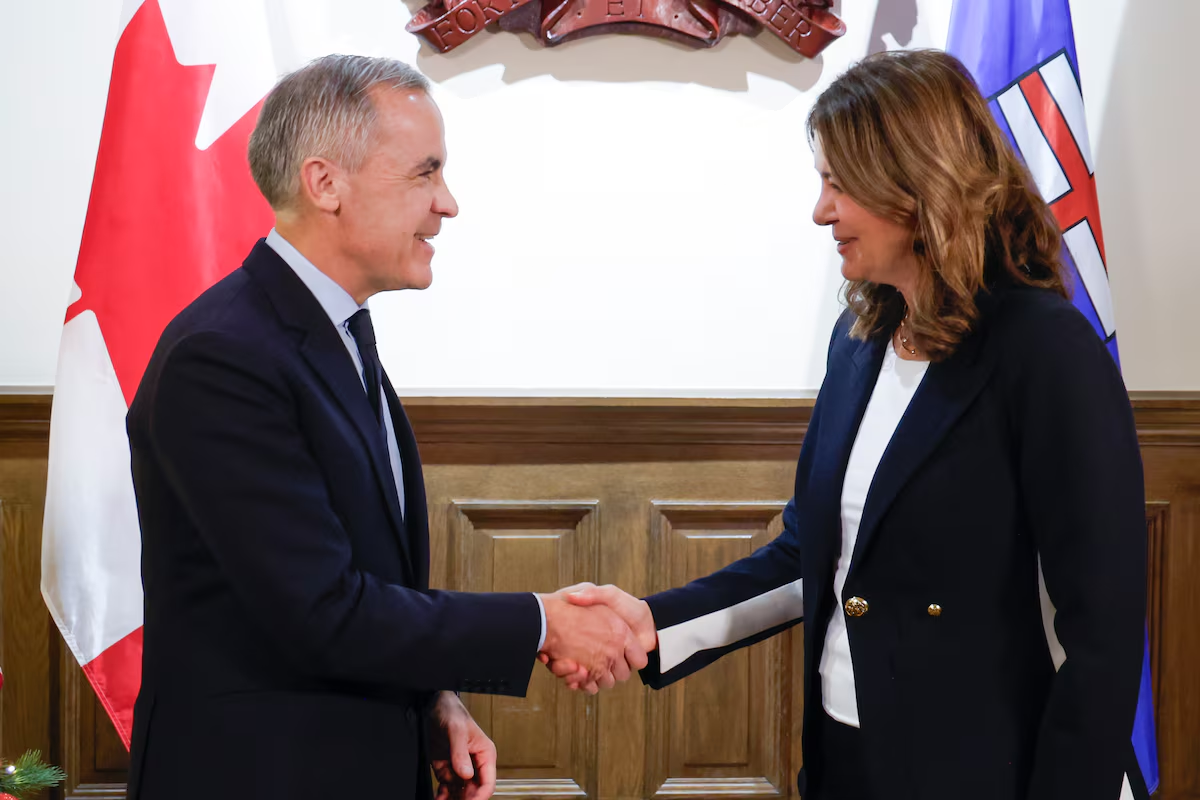
Prime Minister Mark Carney meets with Alberta Premier Danielle Smith in Calgary, on Nov. 27.Jeff McIntosh/The Canadian Press
On principle
Re “Steven Guilbeault resigns from cabinet in protest against Carney’s Alberta energy deal” (Nov. 28): I’ve always respected Steven Guilbeault for his dedication to the issue of climate change and continue to do so. I share his concerns.
Though his resignation is hardly surprising given his level of commitment to the issue, I do not believe the federal government has any choice but to pursue economic growth along whatever avenues are available, given the threats posed by the policies of the climate-change-denying government to our south.
I am at least relieved Mr. Guilbeault will remain on as an MP, as I believe voices such as his still need to be heard.
Leonard Baak Ottawa
Far from it
Re “A blockbuster not-yet-agreement with the devil in the politics” (Nov. 28): I’m convinced there are many Canadians who view this “grand bargain” as all about placating a mercurial Alberta Premier and little more.
With any future negotiations, regardless of the resource project, if the hope is to have adult discussions with either an understandably exasperated David Eby or an easily unhinged Danielle Smith, Mark Carney would, I think, always choose the former. Likewise, I think he appreciates that in the precarious (Sisyphean?) labour of nation-building, the best strategy is, at times, to rag the puck.
It is frustrating, however, that Ottawa’s game plan, in this early round at least, resulted in unnecessarily alienating both Mr. Eby and First Nations in British Columbia. Regardless, in light of the myriad hurdles ahead, I’ll eat my toque if this pipeline ever breaks ground.
Tom Bergen Squamish, B.C.
Tipping point
Re “Freedom of expression must not become a right to harass or intimidate” (Nov. 24): We can always explain away this once-again emerging scourge by relating it to societal shifts both near and far.
Lack of education, lack of mutual respect, fear of the different, rising unemployment and inequality and yes, just plain stupidity. Add in political leaders who freely encourage and stoke behaviour and language that pits one group against another.
It is no wonder this makes for the dangerous empowerment of professional disruptors. History is the witness that shows this is not a passive nor passing fad. Freedom of expression has come to chain us.
Where radical and escalating unto the dangerous, it should be stopped by enforceable laws and, where possible, defused in peaceful personal exchanges that set examples for others and set us free.
Marianna Kingsmill Hamilton
Years ago, when I was CEO of Canadian Jewish Congress, there were unwritten but widely respected rules that kept the peace: The Jewish community did not stage demonstrations in Muslim neighbourhoods, and they did not bring their protests into ours. If anyone wished to voice anger or concern about Israel, there was an appropriate place to do so: the Israeli consulate.
What we are witnessing today breaks that understanding. I see protesters deliberately targeting residential Jewish areas, and the message is unmistakable: This is not about policy or geopolitics, but making a vulnerable minority feel unsafe in their own city.
This can be stopped. Municipal leaders and police services have both the authority and responsibility to act before intimidation becomes something even more dangerous.
I feared we would eventually reach this point. I never wanted to believe it. But here we are and it is time to do something.
Bernie Farber Thornhill, Ont.
Utmost care
Re “For 43 years, my wife and I have cared for our daughter” (Nov. 24): Contributor Tom Sherwood’s impassioned opinion clearly demonstrates Canada’s urgent need for a national caregiving strategy.
According to the Canadian Centre for Caregiving Excellence, 1 in 4 Canadians is a caregiver today. Unpaid caregivers provide an average of more than 30 hours a week of help. Many understandably feel fatigued, anxious and overwhelmed by these responsibilities, which they often balance with careers and other family demands.
As we know, even paid care workers receive inadequate compensation for the work they do with skills, empathy and patience that we vastly undervalue as a society. A national strategy is critical for Canada’s caregivers to receive the support and respect they so greatly deserve.
Wendy MacIntyre Carleton Place, Ont.
As a parent of an adult son with developmental disabilities and a member of the board for Total Communication Environment, I see every day how fragile our caregiving system has become.
Families are exhausted, navigating complex medical and behavioural needs with little support, and many are forced to reduce work hours or leave jobs entirely. Despite this, caregivers remain the foundation that allows others to participate fully in the work force and in their communities.
Caregiving is not a private struggle; it is part of the country’s economic and social infrastructure. Without meaningful investment in disability supports, respite and sustainable paid-care work, more families will reach breaking points.
Canada cannot afford to overlook caregivers any longer.
Andrew MacDonald Ottawa
Sadly, contributor Tom Sherwood’s life experience as a caregiver is too common. But he is among the lucky few with support from an organization.
I have neighbours who are seniors and caring for developmentally disabled adult children at home, worried about who will provide care when they can’t. When they can’t, it may be because they, too, need a caregiver.
I regularly visit friends living with disabilities. They range in age from 71 to 101; three are in long-term care and two are widows continuing to live alone in their family homes with 24/7 caregiving.
The professional caregivers I meet are remarkable people working long hours for poor wages, yet caring sensitively and with respect for my friends. They play essential roles. It’s time to support them in any way we can.
Anne Saunders Toronto
Final end
Re “Colleen Jones, champion curler and CBC broadcaster, dies at 65″ (Sports, Nov. 26): My dad was a big curler and watcher of curling.
In retirement, he and mom moved to Kitchener, Ont., and signed up to volunteer when the Scotties Tournament of Hearts was in town. This was quite a few years back.
The week of the tournament, dad suffered a major stroke and wound up in hospital. He would never really recover.
Anyway, I was working for NBC at the time, but had previously met Colleen Jones in her role at the CBC. I called to ask the organizers if Colleen could possibly send a get-well wish as dad was a big fan.
That afternoon, I received a harried call from mom at the hospital: Colleen and her entire team had shown up out of the blue to wish him well, give him a hug and boost everyone’s spirits.
She was a helluva curler. She was also genuine and a great Canadian.
Kevin Tibbles Chicago
………………………………………………………………………………………………………………….
Letters to the Editor should be exclusive to The Globe and Mail. Include your name, address and daytime phone number. Keep letters to 150 words or fewer. Letters may be edited for length and clarity. To submit a letter by e-mail, click here: letters@globeandmail.com