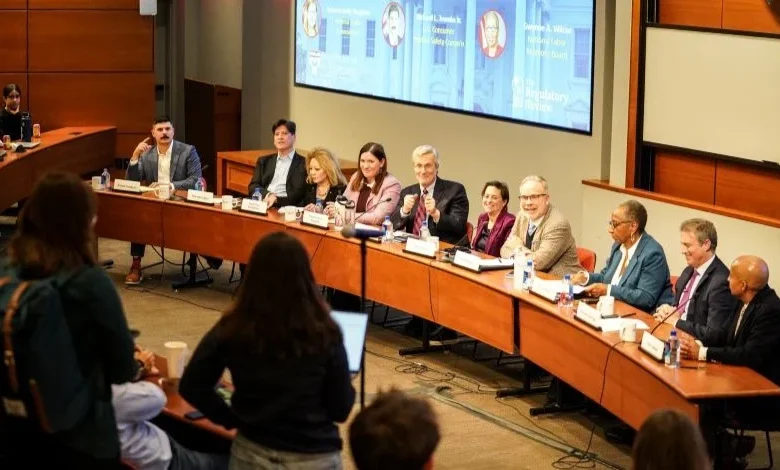
A Penn Program on Regulation panel brings together leaders from independent agencies to discuss the implications of presidential actions taken to remove them.
Since President Donald J. Trump took office, he and his Administration have taken unprecedented actions aimed at eroding the defining characteristic of certain regulatory agencies: independence from the White House.
Beginning almost immediately after assuming office, President Trump has taken steps to remove or to attempt to remove dozens of public servants working in federal agencies, including the commissioners and board members of numerous independent regulatory agencies.
During a recent panel hosted by The Regulatory Review and the Penn Program on Regulation, nine leaders from a diverse array of independent regulatory agencies shared the stories of their removal and addressed a central question in the national debate: What is at stake for the public?
Independent regulatory agencies have for years been authorized by the U.S. Congress to regulate in specific areas through multi-member boards or commissions. According to the statutes creating these boards and commissions, their members may not be removed from office without some legal cause—a limitation on the President’s removal power upheld by the U.S. Supreme Court as constitutional in its 1935 decision in Humphrey’s Executor v. United States.
The Court is now, in a case called Trump v. Slaughter, considering whether to overturn Humphrey’s Executor. If it does so, leaders of independent regulatory agencies would lose the for-cause removal protections that have long supported their institutional independence.
The members of the recent PPR panel agreed that, at each of the regulatory agencies they led, independence is integral to fulfilling these agencies’ public missions.
For example, the U.S. Office of Special Counsel that Hampton Dellinger led was created by Congress to promote merit system principles in the federal workforce. Dellinger explained that the Office aims to protect federal employee whistleblowers from retaliation and that it serves as the sole enforcer of the Hatch Act. This Act limits the political activities of federal employees to ensure “that federal programs are administered in a nonpartisan fashion,” Dellinger noted. He said that, “if you’re controlled by the White House, you can’t enforce the Hatch Act against the White House.”
The Federal Trade Commission (FTC), on which panel member Rebecca Kelly Slaughter served as a commissioner, performs consumer protection functions and polices against fraud in the marketplace. Slaughter, who is the named defendant in the Trump v. Slaughter case currently before the Supreme Court, described the FTC’s role as one of “a market watch dog looking out for everyday Americans.”
In her remarks on the panel, Slaughter recalled an image from President Trump’s second inauguration where he was surrounded by CEOs of the largest corporations in the United States. At the time, the FTC was engaged in active litigation with several of these same companies whose top executives were welcoming President Trump into office. Slaughter characterized agency independence as the ability to uphold the rule of law “without fear or favor”—including the fear of getting removed for failure to do a favor for a President or the President’s supporters.
Although the leaders of independent regulatory agencies are appointed by the President and confirmed by the U.S. Senate, these leaders typically serve staggered, overlapping terms that extend beyond any individual President’s term.
Less publicly understood than the way that agency leaders receive and serve their appointed positions is how President Trump’s White House sought to remove these independent agency heads.
Panel member Todd M. Harper, who served as chair of the National Credit Union Administration, only learned of the President’s action to dismiss him by word-of-mouth—and only then while Harper was sitting in a hospital room during the final days of his partner’s life. That is how the Administration informed Harper that his service was “no longer in the President’s interest.”
Harper’s experience was not entirely unique. Alex Hoehn-Saric was simply locked out of his office at the Consumer Product Safety Commission.
At the National Labor Relations Board, Gwynne A. Wilcox received her termination notice in an email at about 10:30 p.m., seven days after President Trump took office. Although her termination letter cited “malfeasance and neglect of duty,” Wilcox explained that the real reason behind her removal was her failure to “share the same objectives” as the President’s Administration.
On the first business day after President Trump’s inauguration, Travis LeBlanc, who served as a member of the Privacy and Civil Liberties Oversight Board, received an email from the White House asking for his resignation within 48 hours. LeBlanc was warned that he would be fired if he refused—unless the President changed his mind. LeBlanc later learned of actions that he said a Republican member of the Board had taken to help coordinate his removal, such as by helping White House staff disable his email access.
The panel discussion, held at the University of Pennsylvania Carey Law School on November 12, marked the first time the stories of the removal actions taken against most of these nine independent agency leaders had been revealed.
The panel overall “addressed an important question that is too often lost in today’s lofty constitutional debates about independent agencies,” explained Matthew Lee Wiener, a visiting distinguished lecturer at the University of Pennsylvania Carey Law School and a co-faculty advisor to The Regulatory Review. That key question, Wiener explained, is whether independent agencies “serve the public interest, and, if they do, how exactly?”
“The panel discussion provided a truly distinctive opportunity to learn more about what the Trump Administration has been doing to assert White House control over independent agencies,” noted Cary Coglianese, the director of the Penn Program on Regulation and a co-faculty advisor to The Regulatory Review.
“By bringing together nine agency leaders who have faced removal actions, the panel allowed students, lawyers, and the public to consider the perspectives of those who headed those agencies as they assess what’s at stake in the Administration’s actions and the impending Supreme Court decision in Trump v. Slaughter,” said Coglianese, who moderated the panel discussion.
The panelists agreed that the stakes of Trump v. Slaughter are likely to be profound, with the future of agency independence hanging in the balance.
The Penn dialogue was “a very serious event, reflecting the unprecedented situation and high stakes of the underlying legal dispute,” noted law professor Michael Herz, who is currently a distinguished visiting faculty affiliate of the PPR. “The independent regulatory commission—which began with the Interstate Commerce Commission in 1887, blossomed during the New Deal, and has been a fixture of the administrative state ever since—will almost certainly go the way of the dodo.”
Panel member Susan Tsui Grundmann, who served as chair of the Federal Labor Relations Authority, observed that, while it is currently a Republican President taking actions against the leaders of independent agencies, undermining agency independence can harm future Republican administrations when a member of the Democratic party enters the White House in the future. She emphasized that many of the votes on actions taken during her tenure did not fall along partisan lines and that she often reached agreements with colleagues even if they were not in her party.
In addition to its potential to undermine bipartisan decision-making, eliminating agency independence might also undermine a neutral civil service, noted Cathy Harris, who served as chair of the Merit Systems Protection Board (MSPB). Harris warned that eliminating agency independence would “destroy the merit system of the civil service” that has been in place for much of the last century. She argued that eliminating the independence of the MSPB would transform the civil service into a “spoils system,” in which positions would become rewards for political loyalty rather filled based on merit.
Harris also noted that attacks on independent agencies are also attacks on Congress, subverting its will by putting power that was delegated to agencies into the hands of the President.
In addition to putting a spotlight on how the loss of agency independence will reconfigure the balance of powers in the federal government, several panelists explained how the loss of agency independence could also have direct and tangible consequences for the public.
For example, in reflecting on the importance of independence at the U.S. Consumer Product Safety Commission (CPSC), Alex Hoehn-Saric and Richard L. Trumka, Jr., cautioned that safety outcomes will worsen if the Commission cannot act independently. Hoehn-Saric stressed that the CPSC’s public health role depends on its leadership having a balance of views and being able “to step away from the politics.”
Trumka put the point still more starkly, stating that, without the CPSC’s independence, “people will die.”
Before removal actions had been taken against both Trumka and Hoehn-Saric, the CPSC had several lifesaving rules nearing completion that have now been shelved, including one rule aimed at regulating carbon monoxide emissions from generators that was expected to save over 100 lives annually.
Overall, the panelists concluded that weakening agencies’ independence will likely create far-reaching consequences for the efficacy of these agencies’ work and the degree to which the public can have confidence that the federal government will uphold the rule of law.
A video of the panel discussion can be found at the Penn Program on Regulation’s YouTube channel.