Good morning. A mechanism that was introduced to improve the justice system is now being criticized for potentially denying justice to victims. More on that below, plus Ukraine peace talks and updates on the trade war. Let’s get to it.
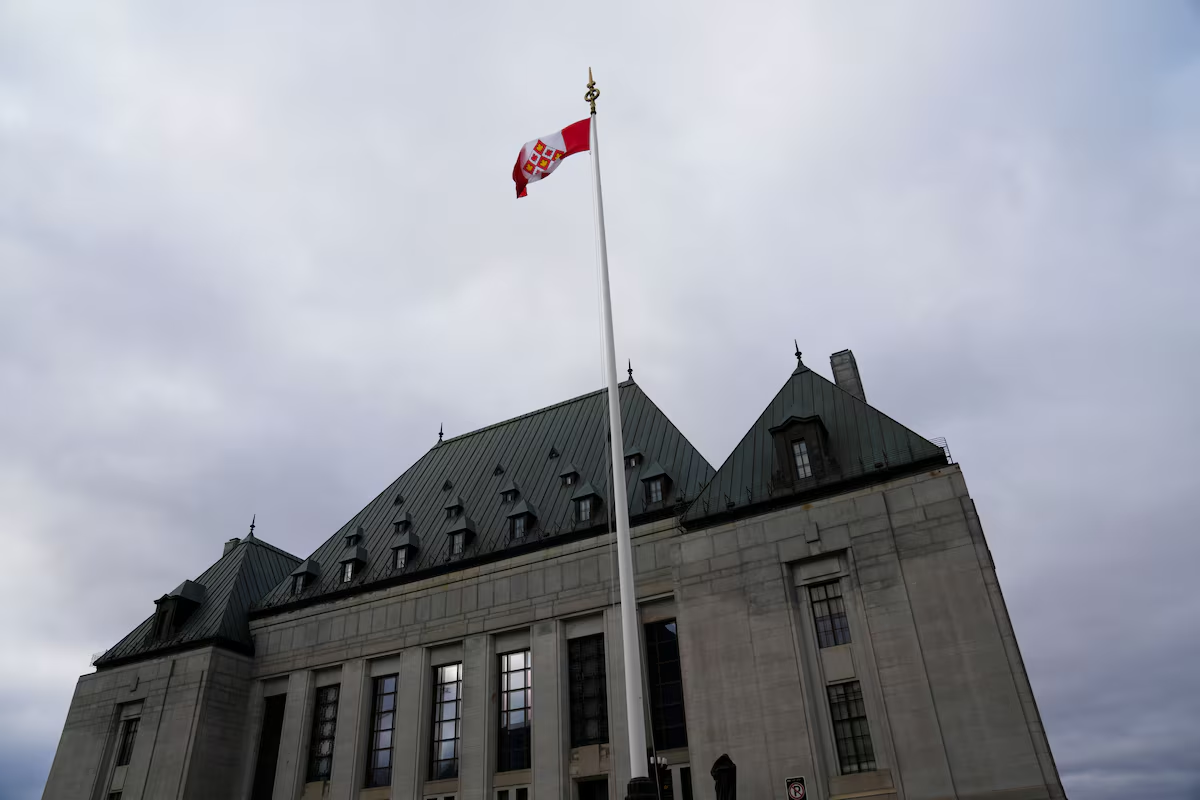
Open this photo in gallery:
The flag of the Supreme Court of Canada flies in Ottawa.Sean Kilpatrick/The Canadian Press
TOP STORY
Ottawa to table legislative changes for court delays
The latest: Strict criminal trial deadlines, known as Jordan deadlines, are derailing about 10,000 cases a year, according to the latest Statistics Canada data. Among them are hundreds of sexual assaults and eight homicide cases. Especially in such cases, stays or withdrawn charges can cause anguish for victims.
Context: Canada’s justice system has been plagued by delays for decades. In the landmark 2016 Jordan decision, the top court created make-or-break deadlines for criminal trials. Unless there are exceptional circumstances, criminal trials must be completed in provincial courts within 18 months from the day a person is charged, and within 30 months in superior courts.
What’s next: The federal government and the three biggest provinces are calling on the Supreme Court to provide some leeway on Jordan deadlines. The case is to be heard in Ottawa on Thursday. Ottawa is also planning to table legislative changes by mid-December to address serious cases tossed because of unreasonable delays.
Open this photo in gallery:
U.S. Secretary of State Marco Rubio speaks during a meeting with Ukrainian officials headed by Rustem Umerov in Hallandale Beach, Florida.CHANDAN KHANNA/AFP/Getty Images
World
U.S.-Ukraine talks have been ‘productive’
The latest: U.S. and Ukrainian negotiators met in Florida as President Donald Trump seeks to broker peace deal. Officials from both countries spoke on Sunday aiming to find an endgame to the war between Russia and Ukraine. Diplomats have focused on revisions to a proposed U.S.-authored plan that was developed in negotiations between Washington and Moscow.
Context: Right before the weekend, Ukrainian President Volodymyr Zelensky announced the resignation of his chief of staff, Andrii Yermak, after Yermak’s residence was searched by anti-corruption investigators. Yermak was also the country’s lead negotiator in talks with the U.S.
What’s next: The high-level negotiations in Florida came days before Trump’s special envoy, Steve Witkoff, will be in Moscow to meet with Russian leader Vladimir Putin.
Open this photo in gallery:
Reject perfection to alleviate hosting worries this holiday season.Printstock/Getty Images
How We Live
An argument for doing less
The latest: Multitasking is bad for our brains and our work. The constant overwhelm can lead to cardiovascular stress and even a state of a high-functioning depression. The Globe spoke with Israa Nasir, a New York-based therapist and author of Toxic Productivity, about the cultural pressure to multitask and a newer shift toward “mono-tasking” instead.
What’s next: Sometimes the performance pressure of the holidays can outweigh the pleasure. But writer Tara O’Brady has some ideas to shed the worry of entertaining while keeping its glow by subtracting before you add. Here’s why you shouldn’t host like a pro this season.
Did you achieve your 2025 New Years resolution?
Did you crush it or completely forget about it? The Globe wants to know – and no judgement here! It’s the perfect time to reflect on the journey that was your 2025 New Years resolution and set yourself up for next year. Share your story with us.
Alberta
Canada reacts to energy deal
The latest: Over the weekend, Alberta Premier Danielle Smith walked a thin line at the annual United Conservative Party convention trying to appease pro-independence sentiment in the room while also touting a new energy deal with Ottawa. She also leaned on ideas using the Alberta Sovereignty Within a United Canada Act, which has not been tested in court.
What’s next: Ottawa says it is “not impossible” to maintain a tanker ban in Northern B.C. waters while building a new oil pipeline to its coast from Alberta, and that talks are being prepared to discuss a potential way forward.
Economy
Trump’s tariffs are squeezing Canadian factories
The latest: Broadly speaking, the Canadian economy has avoided the worst-case scenario from the U.S. trade war. But Trump has targeted several industries, including steel, aluminum, automobiles and lumber, with punishing tariffs – creating the latest tough chapter for Canadian manufacturing. Four manufacturers reflect on the brutal realities of navigating a trade war.
What else: Canada’s GDP rebounds in the third quarter, although much of the upside surprise was driven by a swing in imports and exports that masked underlying weakness in domestic demand.
What’s next: Canada’s six largest lenders release their fiscal year-end earnings this week. The biggest banks are expected to post a boost in earnings even as the trade war and economic uncertainty weigh on borrowing among consumers.
Bookmarked
- ICYMI: Who is Sam Mraiche? Inside Alberta’s health care controversy.
- At home: A weight restriction for mobility aids is causing tension and stress for some WestJet customers, who face yet another barrier to free movement.
- Middle East: Israeli Prime Minister Benjamin Netanyahu asked the country’s president for a pardon in his years-long corruption trial.
- For your finances: Priced out of housing, younger Canadians turn to the stock market.
- Conversation starter: Violence in Canadian schools is reaching a tipping point. What needs to change?
The Quote
I guess we’ll just have to say ‘football is being played here.’
— Richard Lambert, co-owner of the Dog and Bear pub
As host cities for the 2026 World Cup, Toronto and Vancouver are obligated to enforce FIFA’s trademark rights. For example, FIFA’s iconic golden trophy emblem is off-limits in the cities’ advertising around the tournament. Municipal bylaw officers and volunteer brand protection agents will be patrolling the streets. And no, don’t call it a “World Cup” watch party.
The Shot
Open this photo in gallery:
A Russian soldier part of Akhmat Spetsnaz launches an observation drone before a drone attack on Ukrainian soldiers, in Russia’s Belgorod region near the Ukrainian border in Oct., 2025.GORAN TOMASEVIC/The Globe and Mail
Photographer Goran Tomasevic provides a rare glimpse of Russian troops in combat. This photo essay is part of a series. Learn more about the special forces unit The Globe travelled with, and their field hospital in Donbas.