Despite the veil of silence surrounding the
longtime persecution of Christians in Nigeria lifting in recent weeks,
oppressive bandits and militant groups continue their rampage of terror.
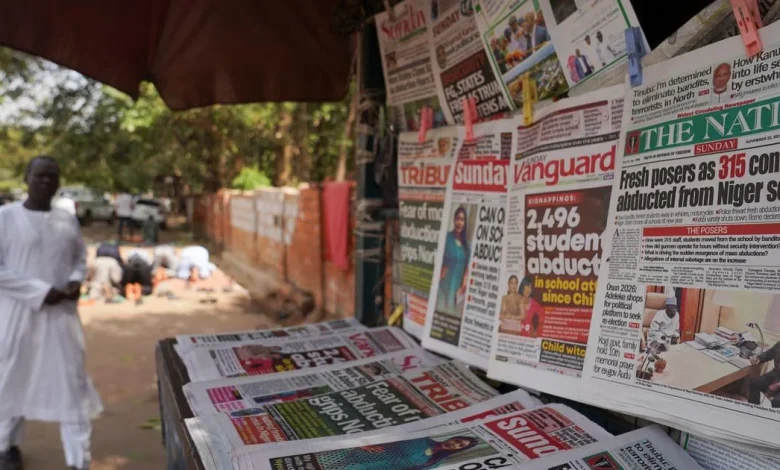
On Nov. 22, 315 students and staff were
kidnapped from St. Mary’s School in Niger state. As of Dec. 1, 265 remained captive. No group has yet claimed responsibility.
Fr. Gordian Okpuruka, the pastor of St. John
Brebeuf Church in Erin, Ont., told The Catholic Register that what is
transpiring in his homeland on a virtually daily basis “is horrifying and very
troubling.”
Advertisement
According to the NGO Intersociety, an average
of 32 Christians have been killed daily in Nigeria this year. Millions have also
been displaced from their homeland, parishes have closed due to the spectre of
violence and clergy and laypersons are at risk of kidnapping.
Okpuruka is urging the Canadian Catholic
community to no longer remain silent amid this tyranny.
“What happens in any part of the world
affecting Christians happens to all of us because we are united by one faith,
which is shared in Christ,” said Okpuruka.
He advocates disciples of Christ tap
into the power of prayer for the sake of Nigerians who are imperilled for
practising their faith, both in private and in public. He also endorses
Canadian Catholic leadership exhibiting solidarity by forging partnerships with
Nigerian Church authorities.
Supporting the relief work by agencies active
on the ground, including Aid to the Church in Need, the Justice, Development
and Peace Commission (JDPC) and Caritas Nigeria, is another course
of action Okpuruka recommends.
Okpuruka urged “outreach to our representatives and Global Affairs
Canada to see what could be done, if possible, through diplomatic means and
channels, to get the Nigerian government to stop and prevent these killings.”
Advertisement
While Okpuruka awaits to see how the Canadian Church and federal government might mobilize, the wider world is
fixated on how the United States will respond.
On Oct. 31, President Donald Trump designated
Nigeria as a Country of Particular Concern (CPC) for its religious freedom
violations. One day later, Trump floated on Truth Social the U.S. military “may very well go into that now disgraced country,
‘guns-a-blazing,’ to completely wipe out the Islamic Terrorists who are
committing these horrible atrocities.” He also suggested that an immediate aid
withdrawal is on the table.
A ground offensive has not yet been executed. Secretary of War Pete Hegseth did meet with a
delegation of security leaders from Nigeria on Nov. 20 to discuss ways that
immediate, tangible progress could be made to cease the violence against
Christians and repel jihadist terrorist groups like Boko Haram and the Fulani
militants.
Okpuruka appraised the notion of a
U.S.-conducted military operation.
“The (Nigerian) government is overwhelmed,”
said Okpuruka. “This has been going on for too long. They can’t manage it. They
need external help. This (may involve) partnering with foreign authorities to
see how this could be stopped. I mean, it is a sovereign nation, so I am not
going to say this would be the right way, but there is a need for an
intervention.”
Bishop Wilfred Anagbe of the Makurdi Diocese
in Benue State, who helped set the stage for the CPC designation with his
testimony in front of Congress on March 12, appeared virtually, on Nov. 20,
before the U.S. House Foreign Affairs Subcommittee on Africa. He called for
urgency, declaring that “inaction emboldens the extremists even more.” Anagbe
specifically advocated for targeted sanctions against President Bola Tinubu and
Vice-President Kashim Shettima’s regime and increased humanitarian support for displaced
families.
Regarding Tinubu and Shettima, Okpuruka noted
that the current government, in place since 2023, marks the first time that
both the president and vice-president are Muslims. Traditionally, given that
the country is nearly evenly divided between Christians and Muslims, there
would be a split ticket to “foster national unity and inclusivity even though
it was sort of a gentleman’s arrangement over the years.”
Much ire has been directed towards the Tinubu
government for enabling the extremist groups to conduct large massacres without
facing serious consequences.
Advertisement
Okpuruka echoed the need for Christians to
pray for the government and the persecutors.
“Scripture says we should pray for those who
persecute us, and those who attack us,” said Okpuruka. “We have to use prayer
because prayer can change situations and even touch hearts to repent and do the
right thing.”
(Amundson is a staff writer for The Catholic Register.)