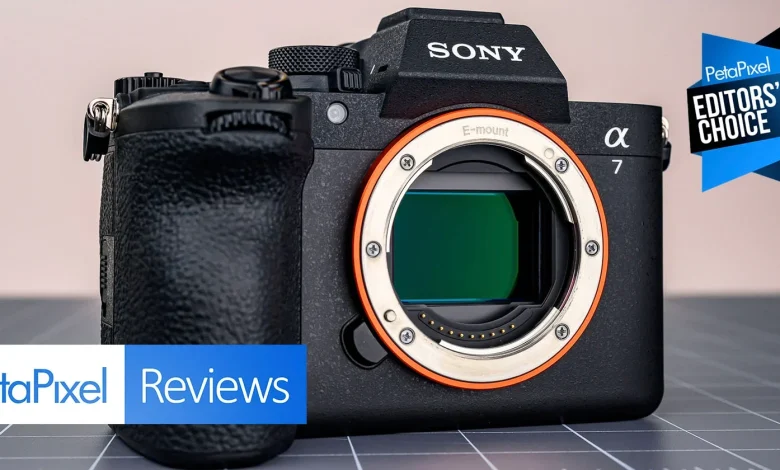
Canon recently made a huge stir with its excellent do-it-all R6 III and for a while, it looked like the year was going to end with a big win for Canon. But with the Sony a7 V coming seemingly out of nowhere, we have a serious contender for the best all-round camera on the market.
The Sony a7 IV came out in 2021, at the height of the technical dominance that Sony is famous for. It was a versatile and full-featured camera, but much has changed since its debut. Canon and Nikon have both advanced in terms of autofocus performance and sensor technology in a big way, and any competition now is incredibly close.
The Sony a7 V is finally here, and it looks almost physically unchanged from its predecessor.
Sony a7 V Review: How It Feels
What hasn’t changed is the chassis which the Sony a7 V is built from. It is almost identical to the previous version, right down to the single UHS-II SD card slot coupled with a hybrid CF Express type A and SD card slot. All dials, controls, and custom buttons are brought over from the a7 IV, which isn’t a bad thing considering how functional it is. The weight comes in at around 24.5 ounces (695 grams) with a battery and card.
The ports are largely the same, though we now have a dedicated USB-C port for charging.
Curiously, we still don’t get the dual hybrid CF Express/SD ports from the other cameras.
We get the same 3.69-million dot EVF as before, which is par for the course at this price. The 2.1-million dot rear LCD is a design change, borrowed from the excellent fully articulating design in the a7R V. There is an autofocusing joystick present, and the same Z-type battery that we’ve seen before. However, thanks to a brand new Bionz XR2 processor, the battery life is vastly improved to about 630 CIPA-rated shots with the EVF. You also get an improved IBIS unit that can provide about seven and a half stops.
The EVF is the same as before, but we do get the excellent articulating back panel design from the more expensive cameras.
Whether you find Sony bodies appealing or not, there is no arguing that the menus and control scheme are serviceable and reliably quick to adjust. You will now find twin USB-C ports on the side of the camera to handle both PD-rated charging and USB transferring, respectively. The camera is reliably well-sealed and should protect the interior from most dust and bad weather.
Nothing wrong with the Sony control scheme, although there is always room for improvement. We get the same battery as always, but the processor is way less power hungry.
The real change in the Sony a7 V comes down to the aforementioned Bionz XR2 processor and the brand-new partially stacked 33-megapixel full-frame chip. So far, the only partially stacked sensors used by both Nikon and Panasonic Lumix are limited to 24 megapixels, and although the Canon does hit the 33-megapixel mark in this price tier, it is not a partially stacked sensor.
Normally, there is some loss of dynamic range when using stacked sensor of any kind; however, the a7 V bucks this trend by bringing a noticeable improvement over the older a7 IV. How it fares against the competition will be the subject of a discussion.
The magic of this camera is really down to the excellent new sensor, which combines speed and resolution into one unit. The only way to differentiate the a7 V from the rest of the line is this tiny badge.
Sony a7 V Review: How It Shoots
The autofocusing experience of the a7 V benefits from the upgrades to the subject detection modes that we have gotten in the latest Sony cameras leading up to this point. What is different and, right now, uniqut to the a7 V is that the processing unit uses an integrated AI chip that does more than just autofocus calculations, but also improves white balancing, exposure, and more. Previously, Sony had two chips where AI processing was handled separately, but now it is a single unit — a first for Sony Alpha cameras.
I found the AF performance to be reliable, simple to use, and highly effective at tracking subjects. We tested its ability to follow human subjects even with trees and obstacles coming in between the field of view and it maintained proper focus and consistent results.
The subject detection modes are always reliable on Sony bodies. Face detection and tracking work as consistently as ever.
Of course, the a7 V takes advantage of all the subject detection modes Sony photographers have seen recently. However, the face and eye detection is further enhanced by allowing the camera to detect and track torsos and limbs of your subjects, which assists the camera when shooting sports and action events. You also get animals, insects, planes, trains, and automobiles. There is an option to switch between detection modes automatically, but I found better consistency when forcing an appropriate mode myself.
Precapture mode and 30 fps burst rates make sports and action easy. All the advanced modes from the flagship cameras are now present here.
The mechanical shutter still provides a decent 10 FPS, or frames-per-second, burst rate, although this lags a bit behind the competition. You can shoot up to 30 FPS bursts when using the electronic shutter, though, which is nice. The buffer in the camera will basically shoot without issues if you stick to the mechanical shutter speeds, granting you constant shooting until your card fills. However, if you do faster bursts in electronic shutter mode, expect about 75 shots or so (Whether this is shooting RAW files or JPEGs) before the camera has to slow down due to a filled buffer. You can also do this with lossless compressed RAW files now, and there is a Sony pre-capture mode, which can be found in other modern Sony cameras. This pre-capture mode can record up to a second of action that takes place before the moment the shutter is pressed.
Pre-capture modes make it simple to hit the decisive moment. You can boost up to 30 fps if you use the electronic shutter.
We definitely notice a difference in image quality when looking at photos taken with the mechanical shutter versus the electronic shutter. If you need the faster burst speeds, by all means, use the electronic shutter. However, there is a distinct improvement in shadow detail and clarity when using the mechanical shutter instead.
There is a slight difference between the detail and noise depending on what shutter you use. Compared to the older Sony a7 IV, the new camera has better detail and less noise.
Sony a7 V Review: Video Capabilities
Jordan Drake thoroughly tested the a7 V and had the following to say about its video capabilities. The Sony a7 IV was an excellent photo camera, but the slow sensor really limited its abilities as a video camera. 4K/60p no longer has a crop, and 4K/120p is available with an APS-C Crop. Importantly, the full-width 4K modes are much more usable now than with the previous a7 IV, as readout speeds are nearly three times faster with the partially stacked sensor. We’re seeing around a 10ms readout speed, which is a similar performance to the video-optimized sensor in the a7S III and FX3, but with 33 megapixel photo capability.
One odd omission is the inability to record video higher than 4K. While the 4K video is derived from the full sensor resolution, there is no option to record the 7K video feed. Also, while the sensor is definitely fast enough to permit open gate recording using the full 3:2 aspect ratio, this feature is also absent. Every other competitor in this class offers a higher resolution video option, with the Z6 III and S1 II capable of 6K recording, and the Canon R6 III giving a 7K option. We are pretty sure the a7 V doesn’t support this because of the codec Sony uses in the Alpha series, which means for it to offer open gate, it would have to do a lot of re-configuring on the software side.
It is also worth noting that while all three of those competing cameras can record internal RAW video, the a7 V cannot. In fact, RAW video isn’t supported at all: not even through an external recorder.
An odd quirk of the a7 V is a new menu option: “4K Angle Of View Priority”. This requires that you choose full-width 4K/60P or APS-C Region 4K/120P; otherwise, there will be an additional crop in each mode. The downside to this option is that it disables noise reduction in exchange for reading out a larger region of the sensor. If you don’t intend to apply noise reduction in post, it may be worth leaving this feature disabled and enduring a small crop in these two modes.
Video autofocus is an area where Sony excels, and the a7 V keeps that streak alive, and the new processor makes this a huge improvement over the a7 IV, which did not have their dedicated AI chip. I love that you rarely need to tweak the autofocus settings for reliable results. Just initiate tracking on your chosen subject, and the a7V does a fantastic job of keeping them in focus and responding naturally.
The autofocusing does a much better job tracking subjects, even when obscured by other barriers.
An area where Sony has historically struggled is in video stabilization. Using IBIS only, without digital assistance, does not show great results. Switching to Active Mode helps quite a bit, but it’s still bouncy. This has the latest Dynamic Active mode, but you can see there is a massive crop to use it. As well, unless you shoot at faster-than-normal shutter speeds, you will see some blurry frames. Video stabilization is an area where Panasonic still has a significant advantage over the other brands — Sony included.
But with all these impressive video specs and no fan, how does the a7 V handle longer recordings in its most demanding modes?
The answer is, extremely well.
At room temperature indoors, every flavor of XAVC-HS, 24,60 and 120p could be recorded for around two hours without an overheat warning; the battery just ran out. Even when switching to 4K/60p using All-I compression at 600 Mbps with a CFexpress card, there were no overheating issues for the life of the battery. While I can’t speak to how the a7 V will do in very warm conditions or in direct sunlight, in indoor settings, overheating does not seem like it will ever be a concern.
While I was disappointed with the lack of high resolution and open gate recording options, the a7 V is undoubtedly one of the most impressive 4K cameras on the market. With its fast readout, fantastic video autofocus and excellent handling, this may not have the most impressive video specs, but it performs admirably in the most important areas.
One sidebar, though: this camera makes the recently released FX2 look almost completely irrelevant. Unless you absolutely require the fan, the a7 V is a better video camera in every way.
Sony a7 V Review: A Strong Contender
Before this camera’s announcement, I would have given the best camera of the year to the Canon EOS R6 III. I still might, but the Sony a7 V is easily a contender for this prestigious title.
From a purely photographic standpoint, I think it has minor advantages over the Canon in terms of image quality and focus performance. However, I believe that the Canon is slightly more compelling as a hybrid photo/video product.
The actual difference, though, is minuscule, and both cameras represent the most well-rounded products we’ve seen from the manufacturers yet. If you are tempted by the larger lens ecosystem that E-mount has to offer, and want a camera that can do almost any kind of project well, the a7 V would certainly please you in almost every way.
Are There Alternatives?
The Canon EOS R6 III would be the obvious competitor, assuming that you were free to choose whichever brand of camera you wanted. The Nikon Z6 III has a lot to offer as well, and it also proves to be a powerful hybrid tool.
The Panasonic S1 II would also be an alternative worth considering and while slightly lagging in the photo-taking capabilities department, it is a superior video tool.
Should You Buy It?
Yes. We’ve waited almost four years for the $2,899 a7 V but Sony rewarded our patience with an outstanding mid-range option.