Sony a7 V Announced – 33MP Partially-Stacked Sensor, 30fps Blackout-Free Shooting, 4K120p Video in APS-C

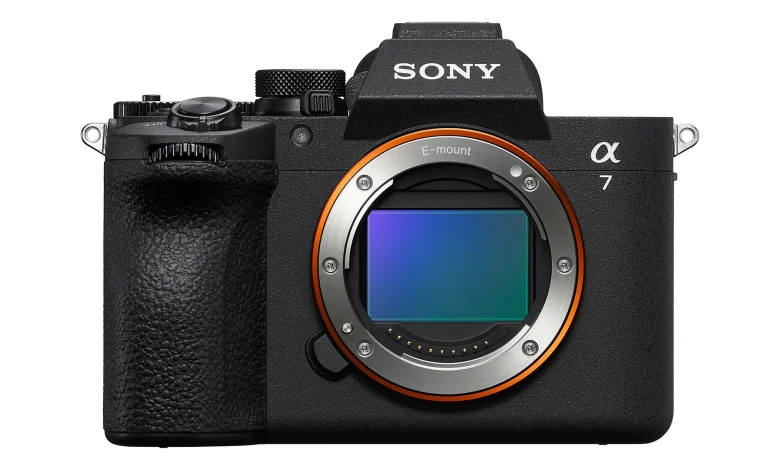
Sony has unveiled the Sony a7 V, the long-awaited successor to the popular a7 IV. This fifth-generation full-frame mirrorless camera introduces a new 33MP partially-stacked CMOS sensor, the BIONZ XR2 processor with integrated AI, blackout-free 30fps continuous shooting (stills), 16 stops of dynamic range, and 4K120p video recording with dramatically improved heat management.
The Alpha 7 series has been Sony’s workhorse full-frame mirrorless lineup since the original a7 launched in 2013 as the world’s first full-frame mirrorless camera. The a7 IV, released in 2021, became one of the most popular hybrid cameras on the market, earning its “Standards Redefined” tagline. Now Sony is pushing further with what they call a “Breakthrough Evolution Powered by AI and Speed.”
New sensor and processor combination
At the heart of the Sony a7 V is a new 33MP partially-stacked CMOS sensor paired with the BIONZ XR2 image processor featuring an integrated AI processing unit. This combination enables significant performance improvements across the board while maintaining the same effective resolution as the a7 IV.
The partially-stacked sensor architecture allows for dramatically faster readout speeds, enabling blackout-free shooting at up to 30fps with electronic shutter. This represents a threefold increase over the a7 IV’s 10fps electronic shutter capability. The mechanical shutter remains at 10fps for those who prefer it.
Dynamic range has been expanded to 16 stops, up from 15 stops on the a7 IV. Sony demonstrated this with comparison shots showing improved shadow recovery in high-contrast tunnel scenes. The camera also shoots 14-bit RAW files even when using the electronic shutter, eliminating a common compromise found in many cameras.
AI-powered autofocus and recognition
The new AI processing unit enables what Sony calls “Latest AF technology” with real-time recognition capabilities. Subject detection categories have expanded significantly beyond the a7 IV’s Human/Animal/Bird recognition to include human pose estimation, face memory, selectable eye/head/body tracking for animals and birds, plus recognition for airplanes, cars, trains, and insects.
The AF/AE system performs calculations 60 times per second, ensuring responsive tracking even during high-speed 30fps bursts. Pre-Capture functionality allows photographers to buffer frames before fully pressing the shutter, with customizable recording times from 0.03 to 1.0 seconds at up to 30fps with full AF/AE tracking.
A new “Continuous Shoot Speed Boost” feature helps capture decisive moments by optimizing burst performance based on subject movement.
Sony a7 V with the new kit lens. Image credit: Sony
Image stabilization improvements
In-body image stabilization has received a substantial upgrade. The a7 V delivers 7.5 stops of stabilization at the sensor center and 6.5 stops at the periphery, compared to 5.5 stops on the a7 IV. This should make a meaningful difference for handheld shooting in low light and when using longer focal lengths.
Video capabilities of Sony a7 V
Video shooters gain access to 4K120p recording for the first time in the standard Alpha 7 line, but only in APS-C mode. The camera also offers 4K60p with 7K oversampling from full-pixel readout without binning, available in both full-frame and Super 35mm crop modes. A “4K angle of view Priority” setting can be toggled to maintain full-frame coverage at 4K60p.
Perhaps more importantly for working videographers, Sony has dramatically improved thermal performance. At 25°C ambient temperature, the a7 V can record 4K60p XAVC S 150M 4:2:0 8-bit for approximately 90 minutes continuously. At 40°C, the camera still manages around 60 minutes, which represents a sixfold improvement over the a7 IV’s approximately 10 minutes at the same temperature. This addresses one of the most common complaints about hybrid mirrorless cameras.
Additional video features include S-Cinetone for ready-to-use cinematic color, Auto-Framing for automatic composition adjustment, LUT import for monitoring preview, Dynamic Active stabilization, and flexible ISO/LUT import options. An integrated noise-reduction system handles both wind noise and constant background noise for the internal and external microphones.
Livestreaming capabilities have been upgraded to 4K30p UVC/UAC, doubling the resolution compared to the a7 IV’s 4K15p.
Sony a7 V articulating screen. Image credit: Sony
Professional operability features
The rear LCD has been upgraded to a 3.2-inch 2.1 million-dot panel with 4-axis articulation, up from the 3.0-inch 1.037 million-dot vari-angle screen on the a7 IV. The grip has been improved for better ergonomics, and the shutter sound is now adjustable with seven levels (0-6).
Connectivity receives significant attention. The a7 V features two USB-C ports: Port 1 offers USB 3.2 Gen2 speeds at 10Gbps for data transfer, while Port 2 provides USB 2.0 at 480Mbps for power supply and low-speed signals. This dual-port setup enables workflows like simultaneous streaming and power delivery, or file transfer while maintaining camera control.
Wireless connectivity has been upgraded to support 6 GHz Wi-Fi (802.11ax) with 2×2 MIMO antennas, compared to the a7 IV’s 802.11ac on 2.4/5 GHz with a single antenna. This should significantly reduce transfer times for high-resolution video and RAW files.
Full size HDMI on the Sony a7 V. Image credit: Sony
Battery efficiency and dimensions
The a7 V uses the same NP-FZ100 battery as its predecessor but extracts more efficiency thanks to the BIONZ XR2 processor. Viewfinder shooting yields approximately 630 shots (up 21% from 520), while LCD monitor shooting reaches 750 shots (up 29% from 580). A new Low Brightness mode automatically dims the monitor when the camera has been idle, configurable from 2 to 20 seconds.
The body measures 130.3 x 96.4 x 72.3mm and weighs 695g with battery and memory card, making it slightly thicker and heavier than the a7 IV (131.0 x 96.4 x 69.7mm, 658g). The card slot configuration remains CFexpress Type A/SD (UHS-II) dual slots.
Familiar view: Top shot of the Sony a7 V. Image credit: Sony
AI-enhanced RAW stills processing
Sony is introducing two AI-powered RAW stills processing features through Imaging Edge Desktop software. Composite RAW shooting, inherited from the a1 II, combines multiple exposures into a single high-quality RAW file, suited for landscapes and nighttime photography. New to the a7 V is Extended RAW processing, which uses neural networks to generate high-resolution images from a single input, making it suitable for fast-moving subjects like wildlife where multi-frame capture isn’t practical.
New kit lens for the Sony a7 V
Alongside the a7 V, Sony is introducing an updated FE 28-70mm F3.5-5.6 kit lens. While the optical formula remains identical to the previous version (8 elements in 9 groups, 55mm filter thread, 72.5 x 83mm dimensions), the new lens adds body and lens coordinated control, breathing compensation, and supports continuous shooting at up to 120fps with AE/AF tracking.
The updated Sony FE 28-70mm F3.5-5.6 kit lens. Image credit: Sony
Notably, Sony states that 30fps AE/AF tracking is only fully supported with the new kit lens and is not available with third-party lenses. Conventional kit lenses limit the camera’s maximum burst speed, while the new lens unlocks the body’s full potential.
Pricing and availability
Sony has not yet announced pricing for the Alpha 7 V body or the new kit lens bundle. Availability is expected following the official announcement.
The Sony a7 V appears positioned to set a new standard for hybrid full-frame cameras, combining professional-grade still photography capabilities with significantly improved video performance.
How do you think the thermal improvements and 30fps blackout-free shooting will impact your workflow? Are the AI-powered features compelling enough to upgrade from the a7 IV? Don’t hesitate to let us know in the comments below!