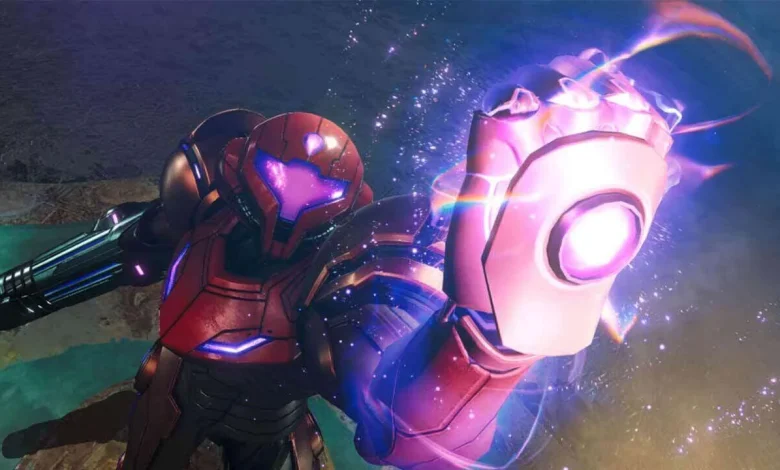
Metroid Prime 4: Beyond opens upon a massive battle as Samus comes to the aid of Federation troops. The action-packed sci-fi spectacle wouldn’t be out of place in a Halo game, signaling a very different take on the Metroid series. But while it accurately signals some degree of departure from traditional Metroid Prime games–particularly with a greater emphasis on interactions with Federation characters and combat–the vast majority of Prime 4 is a well-crafted sequel that delivers on what Prime does best. The result is a satisfying long-awaited return that is excellent at capturing the Prime fundamentals, but hit-or-miss when it experiments with new ideas.
The massive battle that serves as the opening tutorial is between the Federation and a loose assemblage of Space Pirates, under the leadership of Sylux–a rival of protagonist Samus Aran who has been seen before, but not featured so prominently. Sylux is controlling Metroids somehow, but for the moment, the Federation’s main concern is securing an ancient artifact before it’s taken by Sylux’s forces. When things go extremely wrong in that mission, the artifact transports Samus to Viewros–a dying planet whose sentient beings, the Lamorn, passed away untold years ago. Samus quickly finds a Psychic Crystal that imbues her with the ability to interface with Lamorn technology. It becomes apparent that Samus isn’t alone–Sylux appears to have been transported here too, along with pieces of Federation tech and personnel. You’re all trapped on this dying rock together, unless you find a way out.
However, recordings reveal that the Lamorn see the bearer of the Psychic Crystal as a “Chosen One,” a savior for their people, in a sense. It’s too late to rescue the Lamorn, but they wish to preserve their history and culture, and so they’ve prepared a Memory Fruit for the Chosen One to carry off-planet with the aid of their Master Teleporter. This aspect of the story is appropriately melancholic: You can’t save the Lamorn people, but you can preserve what mattered most to them. So your mission is twofold: Carry the Memory Fruit to another world, and in doing so, get access to their teleporting technology that can save you and the other stranded Federation troops. Commence video game adventure.
The Lamorn’s psychic-linked tech is similar to Samus’s regular suite of upgrades, albeit often with a psychic twist. You quickly get access to the Control Beam, a psychic version of your usual charged shot that lets you steer it in mid-air to clear corners, as well as a Psychic Bomb, which lets you create a psychic mote from a bomb and use it to power psychic devices. These are neat twists, but some can be just a little too fiddly. The Psychic Bomb, for example, requires you to go into Morph Ball mode, hold A to generate the mote, then switch back out of Morph Ball mode, switch to the Psychic Visor, and then grab the mote. It feels natural enough after you’ve had some time with your new abilities, but there could have been a simpler solution.
You also obtain another piece of Lamorn tech, the Vi-O-La, a Tron-like motorcycle that lets you quickly traverse the vast landscape that separates the main mission hubs. At the start of the game I didn’t much like the Vi-O-La. It felt like a means to an end–a way to get across the desert of Viewros–but it grew on me over time. At first I thought it felt too stiff and unnatural compared to native racing games, but once I got a feel for its handling, I liked it much better. Pulling off hairpin turns eventually felt natural and satisfying, albeit a little wasted on an open world that’s largely empty. Alas, this is another example of Prime 4’s odd controls. By default Vi-O-La is mapped to the Switch’s +/Start button, while pulling up your map and other menu options is mapped to -/Select. This seems to be a concession to letting you quickly jump on and off Vi-O-La on a dime, which actually does feel great. But the trade-off is that when you instinctively press Start to pause the game, you often summon Vi-O-La accidentally–or more often, see a prompt telling you it’s unavailable, because you’re in the depths of an exploration area.
Samus come in contact with a Lamorn artifact in Metroid Prime 4: Beyond
The presence of Federation soldiers means Prime 4 is much more filled with characters than Samus’s usual outings, and that will be a divisive choice. The first such companion, Myles MacKenzie, helps guide you through some of the earliest stages, but after that he largely recedes into the background. I never found him too obnoxious to begin with, but to the extent that fans were anxious about the chatty nerd interrupting the Metroid experience, he serves mostly an optional hint system that you can hail over the radio. At the same time, you are frequently meeting new allies, and they often fit into military archetypes: the loner sniper, the gruff sergeant, the enthusiastic private. The story often revolves around these characters, and while their performances were decent and they grew on me like Vi-O-La, they are fairly broad characters. Plus, Samus’s absolute silence stood out, forcing her to interact with them almost exclusively by answering yes-or-no questions.
For the most part, the emphasis on these characters doesn’t come at the expense of the Metroid’s signature isolation. The world opens up after you’ve found the first two Master Teleporter keys; the three others are essentially located in stages at the corners of the open world. When you delve into those it often feels like classic Prime, as you explore and discover secrets on your own. The Ice Belt is an especially potent example of this: lonely, eerie, and almost completely silent, but with a lingering sense of menace. It’s one of the most story-rich of the stages, as you slowly learn disturbing details about the world and what happened to the Lamorn. The Flare Pool, by comparison, is more combat-focused and even uses squad-like combat elements with multiple other characters. Your Federation squadmates can even die, leading to a game-over, if you don’t heal them fast enough with a quick Psychic pick-me-up. This didn’t come into play very often, but it was frustrating when a mission would suddenly end only to realize I hadn’t reached them in time–particularly in the case of a drastically sharp difficulty spike near the very end.
This approach makes the stages feel episodic, but not in a disjointed way. I was reminded of how it felt to delve deep into Brinstar in Super Metroid, poking at its depths and almost exhausting it, only emerging hours later to find my way to the next biome. The more combat-heavy segments are breaks in the tension and tone, and helped pace the ebb and flow of the exploration.
It was always interesting, and frankly a little gross, to see where a creature’s biology had grown a Metroid like a boil on its body.
That said, there is some handholding, for better and worse. Sometimes it’s a welcome way to gently help you out. Near the beginning, I had Myles telling me to make sure I didn’t miss anything in one area, which irritated me because I thought he was just referring to typical hidden items the genre is known for. But after some time, I realized I was missing a mission-critical item, and he was trying to let me know. The prodding had just been an attempt to keep me from wasting time, and I should have listened. Other times, though, it can be grating. The first time I found an elemental chip that allowed me to install a new weapon type, the prompt to report back to base camp to install it was fine. By the time I found a third such chip, I had gotten the idea, and I didn’t need Myles chirping in my ear or setting a waypoint on my map. I was already heading in that direction before he even said it.
While exploring the open world, you often come across and crash into green crystals, filling a meta-goal meter in your mission log to restore the Memory Fruit. This meter fills extremely slowly, and simply collecting crystals en route to my various mission hubs was not enough to fill it by the time I was ready for the endgame. So I instead had to spend time roaming around the desert hunting for crystals. It felt like level-grinding in an RPG–not altogether unpleasant, but dull and not what I look for in a Metroid game.
I’m of two minds about the vast desert separating the main mission hubs. In one way, the desolate landscape helps accent the feeling that this is a dying world, and that you’re a tiny speck of sand in a vast planet that is very remote. It’s also very intuitive to find your way around, with massive structures on all sides serving as waypoints that you naturally learn as you go. On the other hand, the sheer size of the open world doesn’t quite justify its own existence, and the minutes spent trudging between mission hubs can feel tedious. Even after growing to enjoy riding on Vi-O-La, I wished for a fast-travel option. This is especially noticeable with the semi-frequent trips back to base camp. First you must ride back to the entrance manually, and then you need to launch out of a cannon back to the Fury Green area, with an animation that hides a lengthy load.
Samus gets a set of wheels in Metroid Prime 4: Beyond
Gallery
The game also sapped some of my enthusiasm to go back to Prime 4 post-completion due to a confusing choice with its save system. When I was ready to proceed to the endgame, I got the usual warnings about a point of no return, but I had figured I could always load an older save to go back and do more exploring to pick up power-ups that I missed. But the auto-save now has me locked into the final area with no such apparent option, and my regular save slot–the one that activates when Samus steps into a save station–has been overwritten with a Mission Complete, so loading it prompts me to start a new game. If I had known that the point of no return would actually overwrite all of my saves I would have made a copy before proceeding, but that wasn’t made clear. So now I have no late-game save to use if I want to go back and explore more.
On the fundamentals of Metroid Prime, though, Beyond excels. The classic “metroidvania” exploration design is top-notch, consisting of a clear critical path that never lets you feel hopelessly lost for too long but hides loads of secrets everywhere to reward exploration and curiosity. I would frequently spot a small crevice or notice something slightly amiss, and my curiosity was always rewarded. That includes the desert, which is too sparse to feel full of life and activity like the recent Zelda games, but still hides pockets of optional puzzles, and those hide some of the best power-ups in the game. The emphasis on the Psychic abilities doubles as a clever way to encourage you to constantly scan your surroundings, which helps aid in exploration and secret-gathering. Whereas previous Prime games made your scanning visor feel like a separate function from regular play, this marriage of the two makes exploration more cohesive.
Combat feels smooth and responsive thanks in part to a buttery-smooth 60fps in “Quality Mode” on Switch 2. The ability to lock onto targets could be a crutch, but here instead it’s a layer of skill, as enemies will often dash from the center of your lock and you’ll need to slightly adjust your aim to account for leading in the direction they’re going, even as the lock still follows their broad movements. The ability to switch from Joy-Con remote to mouse mode freely, without selecting from a menu, is incredibly impressive as a whizbang hardware trick that also has important gameplay functionality. And all of this also comes into play in boss battles, which are some of the best and most memorable in the series. They’re challenging and differentiated, and each boss design incorporates the Metroids as an invasive species that has grown on the native fauna like cysts. It was always interesting, and frankly a little gross, to see where a creature’s biology had grown a Metroid like a boil on its body.
All of this is delivered with a visual fidelity on Switch 2 that is among the best we’ve seen on a Nintendo system. Sometimes particular details can look a little rough–some of the flora in Fury Green, or the industrial mesh grating of the Volt Forge, for instance–but other times it’s stunning. The frozen-over laboratory of the Ice Belt, or the futuristic beauty of Lamorn architecture in its artifacts, are particularly strong. It won’t match the best we’ve seen on PC or higher-powered consoles, but it’s a beautiful game regardless. Plus, I just love the look of Samus’ new suit, and in cutscene close-ups, the fidelity did it a lot of favors by showing the layers of its textures and materials.
Metroid Prime 4: Beyond sometimes feels like a product of its notoriously long and troubled development. At moments it serves as a time capsule for gaming trends that have come and gone over the last decade, like a sparse open world and a squad shooter with AI teammates. Those elements are decently made, but not as expertly crafted as the more traditional Metroid Prime exploration and storytelling. Metroid Prime 4: Beyond is uneven and messy in some respects, but at its best it meets or exceeds the best moments the series has to offer.