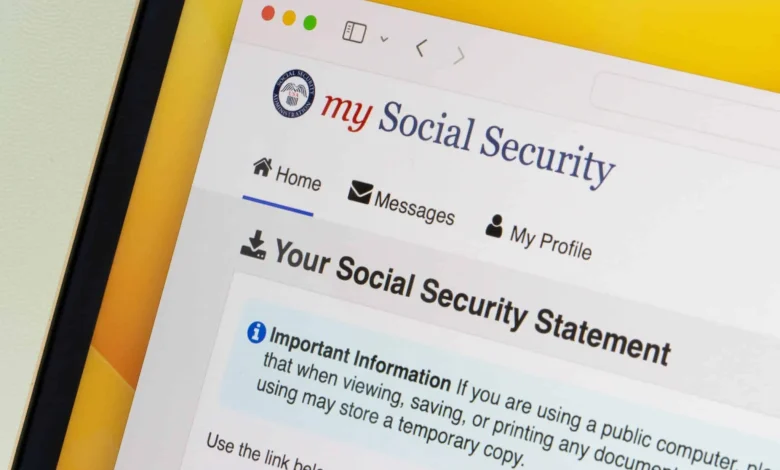
The Social Security Administration (SSA) is remaking itself around a digital identity system that tens of millions of its beneficiaries cannot use – while simultaneously dismantling the in-person safety valve that has long allowed people to navigate the system when digital verification fails.
It is a transformation driven by staffing cuts, budget constraints, and operational redesign, and one that raises an urgent question at the core of federal benefits administration: can the agency legally and operationally require digital and financial authentication steps that its user base is structurally unable to satisfy, while removing the in-person alternatives that make the program accessible at all?
More than 71 million people depend on Social Security benefits each month. The overwhelming majority are older adults, disabled workers, or low-income individuals – precisely the populations that fare worst in credit-based identity systems, digital authentication tools, and online verification workflows.
Yet SSA is now shifting its service model so dramatically that digital access isn’t merely an option; it is becoming, through policy and attrition, the primary gateway into the system.
Internal planning documents obtained by Nextgov/FCW show the agency intends to cut field-office visits by half – from 31 million per year to no more than 15 million beginning in fiscal year 2026.
SSA Commissioner Frank Bisignano calls the shift modernization. But the structural forces behind the move tell a more sobering story.
After Donald Trump returned to office, the White House directed SSA to reduce its workforce by roughly 7,000 positions – the largest single staffing contraction in the agency’s modern history.
Field offices lost nearly 2,000 employees. Another 1,000 were reassigned to the national phone line. Congress has, to date, passed no legislation restoring staffing for FY2026 or beyond.
For an agency already strained by a decade of attrition, the result has been predictable: shrinking in-person capacity, longer waits, and mounting pressure to push the public toward digital services whether they can use them or not.
These conditions have now shaped SSA’s entire modernization plan. The agency is reorganizing its 1,250 field offices – long the backbone of public access – into narrowly focused points of last-resort service, while shifting most claims processing into national hubs built for centralized, standardized digital workflows.
In the redesign, national automation and online identity verification are not auxiliary tools; they are essential, because the local infrastructure that used to support walk-in assistance is evaporating.
But that digital system is built on identity-proofing mechanisms that millions of Social Security beneficiaries cannot satisfy.
To access many of SSA’s online services – including creating a my Social Security account, resetting credentials, obtaining replacement documents, checking claims, or managing benefits – individuals must authenticate their identity using commercial data sources.
Those identity checks can include credit histories, mobile carrier records, address histories, and financial account data. They generate “soft inquiries” on credit files and hinge on the existence of a stable and verifiable financial footprint.
The problem is straightforward: millions of Social Security beneficiaries do not have the data these systems require.
Seniors, who make up more than 54 million beneficiaries when counting retirees and their dependents, have the lowest broadband adoption rates in the United States, the highest rates of “thin file” credit histories, and disproportionate reliance on prepaid mobile phones or shared family plans that fail mobile carrier verification checks.
Many have changed addresses repeatedly over decades through marriages, divorces, or housing moves, creating mismatches in commercial data brokers’ address histories. Others lack the financial record continuity that digital verification demands.
SSI recipients – roughly 7.4 million low-income elderly, blind, or disabled Americans – face even greater systemic barriers. SSI is means tested, and SSA is legally permitted to access bank-account information through the Access to Financial Institutions program once applicants grant permission.
But the digital identity verification that precedes and accompanies the SSI process often requires the existence of stable financial records that many applicants simply do not have.
Individuals experiencing homelessness, living in unstable housing, lacking traditional bank accounts, or relying on nontraditional financial tools routinely fail both identity proofing and financial-permission workflows.
SSDI beneficiaries – 8.6 million disabled workers and 2.2 million dependents – include large populations with cognitive impairments, mental health conditions, or limited literacy. Many rely on family members for technology management.
Numerous disability claimants operate with inconsistent documentation due to frequent address changes, medical crises, or disruptions tied to long periods out of the workforce. For these beneficiaries, digital identity verification is not simply difficult. It is often impossible.
Under SSA’s new operational model, that impossibility now carries far-reaching consequences. When digital verification fails, the fallback is a field office – but the agency is cutting field office traffic by 50 percent and reducing staffing across local offices.
Many claimants who cannot clear digital identity checks will find that the in-person alternatives are shrinking faster than their need for help is rising.
This dynamic recasts SSA’s modernization not as a technological upgrade but as the construction of a two-tiered system – one for beneficiaries with strong credit files, stable addresses, broadband access, and technological competence – and another for those without such resources, who will increasingly face longer waits, reduced access, and the escalating possibility of being unable to access benefits at all.
In the past two years, SSA attempted to strengthen phone line identity verification, proposing new authentication steps that relied heavily on financial documentation matching. The plan sparked public outcry from legal aid organizations, disability rights groups, and lawmakers who warned that the changes would lock out older adults, rural residents, disabled claimants, and people with limited documentation.
The agency withdrew and revised the proposal several times, but the underlying identity proofing mechanisms remain core components of the digital access system.
The agency also launched an AI-driven phone chatbot to route callers and provide automated assistance, but it has been widely criticized as confusing, circular, difficult to navigate, and unable to reliably connect callers to human representatives.
For beneficiaries with hearing loss, limited English, cognitive impairments, or urgent medical issues, the chatbot is not a convenience; it is an obstruction.
Inside the agency, frontline workers warn that digital failures are driving more people back to field offices as those offices lose staff and capacity.
“They want fewer people in the front door,” one employee told Nextgov/FCW, describing a system that centralizes back-end work and subtly shifts public access away from local offices.
Another employee described the reorganization as “quietly killing field offices,” noting that internal service goals such as scheduling appointments within 30 days or limiting wait times to 20 minutes are unachievable without a significant staffing rebuild.
An SSA spokesperson maintained that “field offices are, and will remain, the frontline of service,” but internal communications tell a different story. In an email to staff, SSA’s chief of field operations, Andy Sriubas, wrote that the era of field offices operating as “mini-SSAs” is over and that nationalized workflows are essential for the agency’s future viability.
Sen. Ron Wyden warned that staffing reductions, documentation restrictions, and reorganizations may degrade service and leave claimants without accessible channels.
Sen. Elizabeth Warren said the plan to slash field office visits “sounds like another way to make it even harder for Americans to get their benefits.”
The demographic reality behind these warnings is stark. More than 90 percent of Social Security beneficiaries fall into categories with known digital access challenges. These include older adults, people with disabilities, very low-income individuals, and those with medical, cognitive, or literacy barriers.
Census Bureau data shows that millions of older adults have no home broadband. National Telecommunications and Information Administration data shows that tens of millions have difficulty navigating multi-factor authentication. SSA’s own application data shows that field office visits remain highest among populations with the least access to online systems.
SSA has not conducted a comprehensive analysis of digital literacy or identity-proofing readiness among its beneficiary base. The Government Accountability Office has repeatedly criticized the agency for lacking data on customers’ ability to use online services.
Claims that beneficiaries prefer digital channels are not supported by published statistics and are contradicted by field office utilization, which remains high despite long waits and diminished staffing.
Article Topics
digital government | identity verification | remote identity proofing | Social Security Administration (SSA) | U.S. Government
Latest Biometrics News
Dec 2, 2025, 3:09 pm EST
The Philippine Statistics Authority (PSA) says more than 90 million Filipinos have now been registered and verified in the national…
Dec 2, 2025, 3:05 pm EST
South Africa’s Communication Minister Solly Malatsi recently made a demo of a mobile driver’s license (mDL) prototype recently built within…
Dec 2, 2025, 2:40 pm EST
A subcommittee of the U.S. House Energy and Commerce Committee today interrogated an extensive list of proposed online safety laws…
Dec 2, 2025, 2:00 pm EST
Idemia Public Security has signed a strategic Memorandum of Understanding (MoU) with Matarat Holding, the operator and developer of 27…
Dec 2, 2025, 12:59 pm EST
The UK government is expecting a lot from its One Login system over the coming years, as it transitions from…
Dec 2, 2025, 12:54 pm EST
On December 10, Australia will begin enforcing a law that says kids under 16 years of age can’t use social…