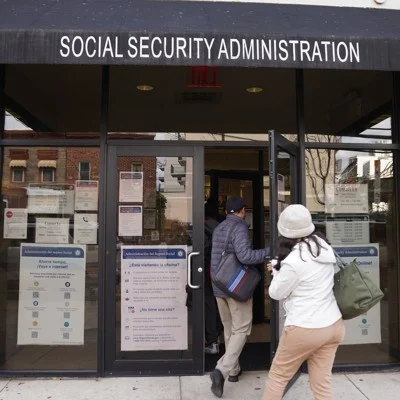
The Social Security Administration wants to halve the number of people that go to its field offices in the 2026 fiscal year.
More than 31 million people visited SSA field offices over the last fiscal year. Now, the agency aims to have 50% fewer visits — or no more than 15 million total — in fiscal 2026, which began in October, according to internal planning documents viewed by Nextgov/FCW.
Under Social Security Commissioner Frank Bisignano, the agency is aiming to push people to interact with Social Security online instead of going to a field office or calling the agency, although Bisignano told lawmakers in June that, even with his focus on technology, the agency is not “getting rid of field offices,” despite reports of planned closures.
The strategy is to offer more online self-service options, like letting people view their claims status or access a digital social security number online.
This plan to move people online comes as staffing in Social Security field offices is down by nearly 2,000 people, according to the AARP. In July, the agency moved 1,000 field office workers off their roles to answer its national phone line, squeezing staffing even more.
A Social Security spokesperson told Nextgov/FCW that the agency is shifting its strategy and goals “to match our customers’ evolving service preferences” with “national scale, improved workflows, and modern technology.”
Still, not all claimants will want to or be able to access the agency online.
“It is good to see SSA provide more online service options as it works towards becoming a digital first agency,” Michelle Spadafore, a senior supervising attorney at the New York Legal Assistance Group, told Nextgov/FCW. “However, there must still be in person options available for folks, like some of our clients, who cannot navigate online services due to mental or technological barriers.”
“If they want fewer people coming in the front door, the average person will need to be able to do a lot more online,” one agency employee, who was not authorized to speak on the record, told Nextgov/FCW.
The agency’s push to technology hasn’t been without its challenges. Social Security has created and then altered plans to add new identity proofing requirements or anti-fraud checks to its phone line several times, and the artificial intelligence chatbot on its phone lines has been criticized for being difficult to use.
“Between staffing reductions, more restrictive documentation requirements for Americans to get assistance on the phones, and rapid reorganization of offices around the country, it’s difficult to see how this goal will lead to anything other than worse service and more challenges at Social Security,” Sen. Ron Wyden, D-Ore., told Nextgov/FCW in a statement.
“Slashing field office visits in half sure sounds like another way to make it even harder for Americans to get their benefits,” said Sen. Elizabeth Warren, D-Mass., in a statement.
‘Quietly killing field offices’
Social Security is also embarking on a plan to further centralize claims processing, folding more work currently done by field offices into central operations, the agency’s chief of field operations Andy Sriubas told staff in an email last week.
“For decades, our ~1,250 field offices have operated as independent ‘mini-SSAs.’ That model no longer serves the public or our people,” Sriubas wrote last week. “That model must evolve into a truly national system that leverages our full capacity.”
Better processes and technology will help the agency deliver services even with expected retirements and attrition, although the changes are “not a veiled attempt to impact staffing levels,” he wrote.
The Social Security spokesperson told Nextgov/FCW that “field offices are, and will always remain, our front-line, serving the more than 330 million Americans with Social Security numbers.”
“The changes we are implementing will empower field office staff to focus on what they do best, resolving customers’ needs in-person with care, accuracy, and efficiency, while directing more complex cases and time-intensive tasks to specialized teams in a centralized environment,” they said.
Already, Social Security has reassigned many employees to frontline work, like processing disability claims, as it has thinned out its headquarters and regional offices. Those reassigned employees face steep learning curves and may lack support from the regional offices, which the agency consolidated in February.
Now, Sriubas’ email has caused anxiety among staff uncertain about the future of field offices, the agency employee told Nextgov/FCW.
“They want fewer people in the front door and they want all work that doesn’t require direct customer interactions to be centralized,” they said. “They appear to be quietly killing field offices.”
Stakeholders haven’t had any input in the field office centralization process, said Jessica LaPointe, president of the American Federation of Government Employees Council 220, which represents field office staff.
“Everything they are doing is just rearranging the deck chairs on the Titanic and hoping that will make space in the lifeboats,” said another current employee, who emphasized staffing shortages in field offices. They also were not authorized to speak to the press.
In addition to slashing field office visits, the agency also set goals within its operating plan to schedule appointments within 30 days, cut field office wait times to 20 minutes and more.
“We can’t meet any of these goals without more staff,” the employee said.
Standardization and centralization have potential advantages, said Kathleen Romig, director of social security and disability policy at the Center on Budget and Policy Priorities.
But “I do not think that you can reorganize your way out of a staffing crunch, particularly when you cut staff first and reorg later,” she noted.