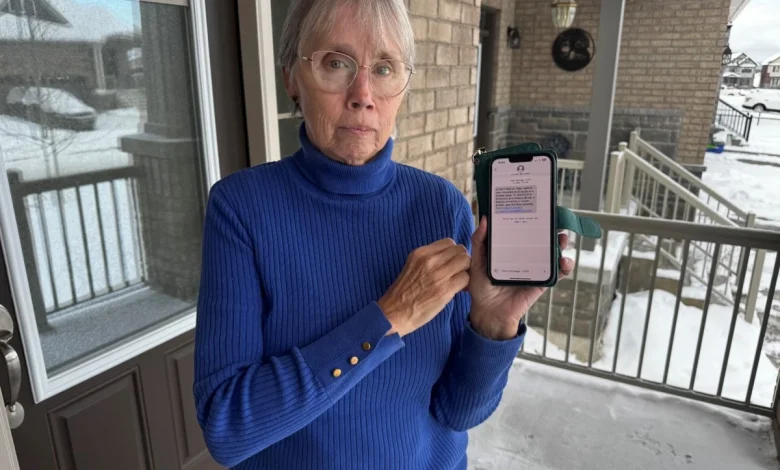
‘There are so many people who just aren’t aware. It breaks my heart to think of them stuck like that,’ says 75-year-old who warns people to be cautious with texts
On Saturday morning, Wilma Van Schelven’s phone buzzed with a message that made her stop in her tracks.
It claimed her vehicle had been recorded travelling “41 kilometres an hour in a school zone,” warned her to resolve the infraction to avoid “driver’s licence penalties or court action,” and urged her to click a link to pay the fine.
Her husband received a nearly identical text two days later, telling him he’d parked in a lot for “five minutes without paying.” Both messages looked simple, believable, and designed to slip past someone’s guard.
“We were confused at first,” Van Schelven said. “Because they were both so little, we thought, well, the ticket won’t be much.”
She had driven through a school-zone camera the week before, and the thought lingered in the back of her mind, maybe she’d drifted a kilometre or two over without noticing.
Her husband had recently pulled into a lot and paused for a minute without paying, and while he wasn’t parked long, the wording in the message made him second-guess himself, too. That small seed of doubt was enough to make the scam feel believable.
The texts didn’t contain a licence plate, address, or any identifying details. Just a vague accusation and a link.
“It didn’t give me a website,” she said. “It just gave me a link. And I thought that was odd because usually when the municipality or the province or the government sends you anything, it looks more formal than that.”
She almost paid it; that was the unsettling part.
“I’ll just pay it and then it’ll be over with,” she remembers thinking, before something made her stop.
By Monday, she decided to go to Orillia City Centre with her phone and ask staff directly. The answer was immediate.
“They said, anytime you get anything with a text, it’s fake. They would never text with any kind of ticket,” Wilma said.
Staff told her that real parking or bylaw notices come by email or regular mail, not by text message, and never through a standalone payment link.
The structure of the scam aligns closely with what the Canadian Anti-Fraud Centre has been warning about for months. The CAFC says scammers have increasingly shifted to high-volume text campaigns, sending out messages that mimic government fines, parcel notifications, banking alerts, and toll charges.
These messages almost always follow the same pattern, a brief warning, a low-stakes but believable penalty, and a link that leads to a spoofed payment page designed to harvest banking or credit card information. The centre notes that these scams rely on “the psychology of small infractions,” an amount low enough that victims feel embarrassed questioning it, but urgent enough to nudge someone into clicking before thinking.
Van Schelven said that’s exactly what made these messages feel plausible.
“This would have been so easy to fall for,” she said. “Once you do that, they have your banking information.”
She’d just finished reading about another senior who had been scammed and left wondering how the fraudsters got access to their accounts.
“I thought that this would have been one way,” she said.
The CAFC warns that clicking the link, even without entering banking details, can expose victims to malware or allow scammers to collect device information. They advise Canadians to avoid clicking any unexpected text link, especially if it claims to be from a government body.
They also recommend visiting the organization’s official website manually, not through any link provided, which aligns with the approach Wilma took.
Van Schelven considers herself reasonably tech-aware, the kind of person friends come to when they’re unsure if something is a scam.
“I’m 75,” she said, “But I was even fooled with that for a minute.”
The realism, the timing, the tiny details, she fears many people wouldn’t hesitate long enough to question it.
“There are so many people who just aren’t aware,” she said. “It breaks my heart to think of them stuck like that.”
Her biggest worry is how easily these schemes target vulnerable people who can’t afford to lose money, especially when banks don’t always reimburse fraud losses.
“And this time of year, with Christmas and stuff, you’re busier, you need to get it out of the way,” she said. “But just before you pay anything, stop, take a breath, find out if it’s real.”
She hopes sharing her experience will spare someone else from making a quick click that could cost them far more than a $20 ticket ever would.
“If you ever get any kind of invoice from any official organization, never just pay it from the text or the email,” she said. “Check it out on the official website, but not from that message. Go to Service Canada, Service Ontario, or the city website yourself.”
Van Schelven has deleted the messages and moved on, but the uneasiness stays with her
“I’d like to let other people know,” she said. “It would be so easy to lose all your money.”