Jayson Tatum’s recovery, synergy with Maine, late-game foul logic, and other Celtics observations

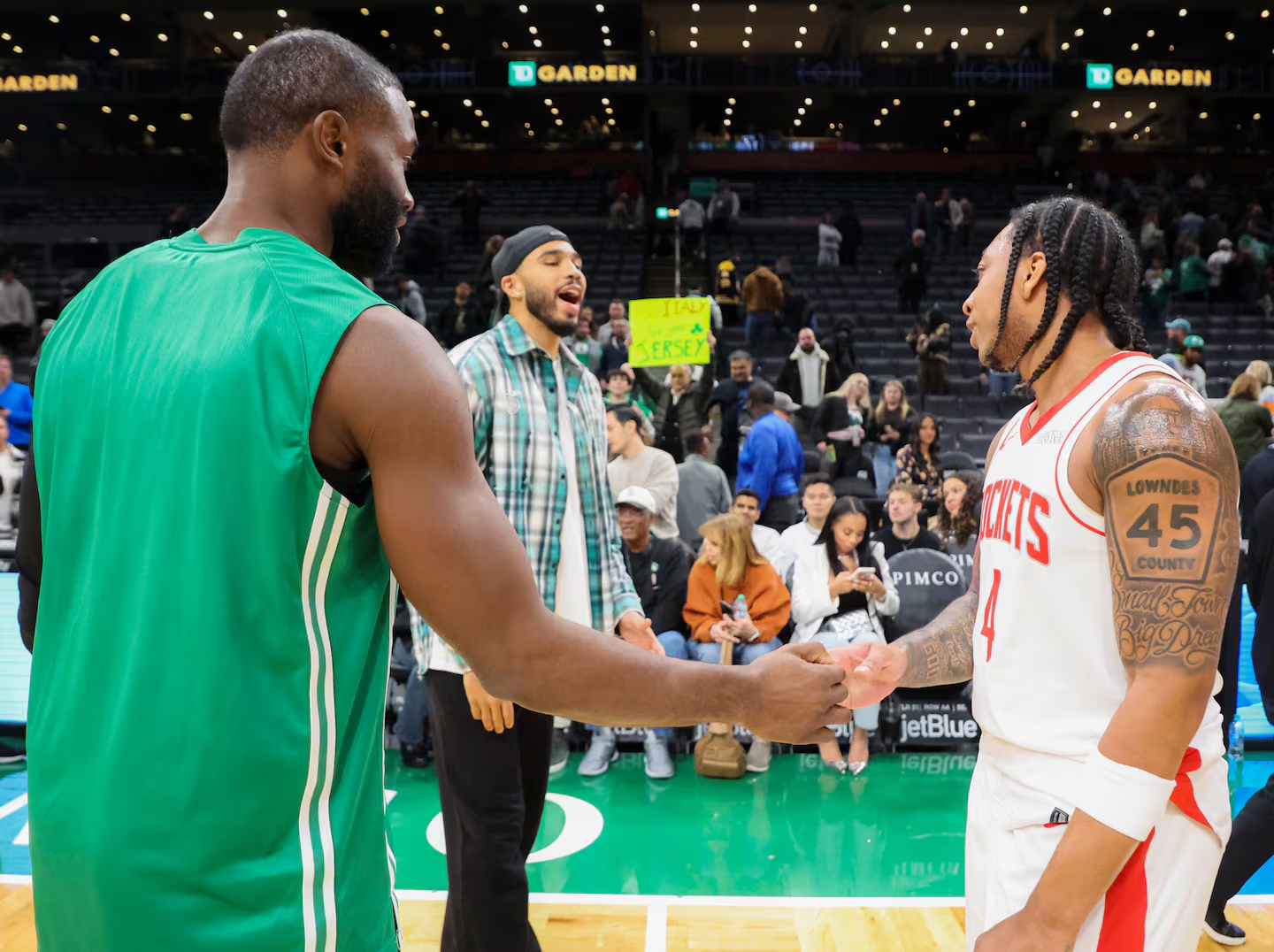
“He’s staying mentally, physically, emotionally prepared,” forward Sam Hauser said. “He’s working his tail off every day, as you can see. And his presence is still felt even though he’s not out there with us. We appreciate him giving his time to us still, even though he hasn’t been able to compete with us in full. But hopefully [he’ll return] at some point in the season. If not, no big deal. But he’s definitely still one of our leaders.”
Get Starting Point
The notion that Tatum will come back and lead the Celtics on a playoff run seems to be wishful. But if he is cleared in a couple of months, it could be valuable for him to start to knock off rust and gain familiarity with the younger players.
Amari Williams acquitted himself well against the East-leading Pistons on Wednesday.Erin Clark/Globe Staff
⋅ The synergy between the Celtics and their G League affiliate in Maine was evident when two-way contract rookie Amari Williams, who had played just seven minutes all season entering Wednesday’s game against the Pistons, played extensively with center Neemias Queta out with an injury.
Joe Mazzulla mostly deployed the 6-foot-11-inch, 250-pound Williams to battle against Jalen Duren, the Pistons’ hulking big man. Still, Williams did not look out of place within Boston’s scheme as he tallied 1 point, 3 rebounds, and 2 blocked shots in 15 minutes.
“The ability for a guy to step right in and know the plays, know the coverages, all the pregame work that the player development staff does on the court, and then with personnel, that’s just kind of a testament to the alignment,” Mazzulla said. “One, to Amari’s mind-set, but also to the staff [in Maine]. So, I think with all those things combined, [it] felt just as comfortable for him to be on the floor. I thought he did some good stuff.”
⋅ As Baylor Scheierman completed a group interview session in the locker room after Wednesday’s win, rookie Hugo González joined the scrum and held out the insole from one of his sneakers to mimic a microphone. No one nearby recoiled, at least.
⋅ Most coaches want their team to intentionally foul when up by 3 late in a game, but the layers make the situation complicated. When should you foul? Where should you foul? What player should you foul?
On Wednesday, the Celtics held a 113-110 lead and the Pistons had possession with 9.9 seconds left. During a timeout, Mazzulla instructed them to foul.
Duncan Robinson inbounded the ball to Cade Cunningham, who was fouled by Scheierman after just 0.8 seconds dripped off the clock. Mazzulla said later the Celtics should probably have waited a bit longer, but they were wary of Robinson, who could have set a quick brush screen and gotten the ball back after passing it in.
Payton Pritchard and the Celtics had to sweat out a close finish with the Pistons.Erin Clark/Globe Staff
Cunningham hit both free throws and the Pistons fouled the Celtics, keeping the cycle in motion. Then things became more unsteady for Boston.
The Pistons were out of timeouts and the baseline inbounds pass came to Cunningham with 6.3 seconds left. He rushed toward midcourt and anticipated the Celtics’ plan as he fired up a 3-pointer just as Jordan Walsh reached out and made contact. Cunningham received three foul shots; the Celtics were fortunate that he missed the third.
“You’re looking to do it around half court, and that’s a credit to Cunningham,” Mazzulla said. “He timed it up perfectly, but there’s no right answer there. We have to just have the feel for it.”
Mazzulla pointed out that a similar play unfolded in the Celtics’ Nov. 16 game against the Clippers. The Celtics did not foul James Harden, and he drilled a 3-pointer to pull his team within 1 point with two seconds left.
“So, that’s just the epitome of late game,” Mazzulla said. “It’s kind of a crapshoot in some sense.”
Adam Himmelsbach can be reached at adam.himmelsbach@globe.com. Follow him @adamhimmelsbach.