By Adam Lucas
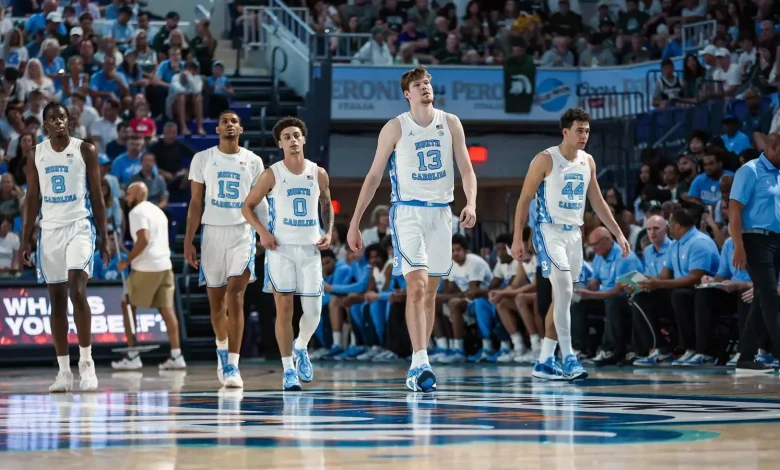
FORT MYERS—Twelve minutes and 19 seconds into Thursday’s game against Michigan State, Carolina led, 22-15.
At that point, the Tar Heels were 8-of-17 from the field and a judicious 2-for-5 from the three-point line. Jarin Stevenson and Jonathan Powell had each swished a three-pointer. Caleb Wilson had three dunks. Stevenson had just scored on an aggressive drive to the rim.
The Spartans, meanwhile, were hitting the offensive glass but not having much other luck offensively. Carolina, the top-ranked two-point defensive field goal percentage team in the country entering the game, was smothering them to 6-for-17 from two-point range (35.2 percent).
Then everything changed.
Henri Veesaar picked up his second foul with 7:13 left in the half and went to the bench for the remainder of the half. With 2:37 left, the same fate befell Caleb Wilson.
The remainder of the game was never the same. Over the final 27:13 of game action, the Heels hit just 13-of-38 shots. Eighteen of those 38 shots were hoisted from three-point range (in other words, they took 47 percent of their shots from three-point range after building the lead by taking just 29 percent of their shots from three), and they made just two of them.
“It felt like we got some open looks from three that we normally make,” Hubert Davis said on the Tar Heel Sports Network. “What was challenging is when we didn’t change sides of the floor. Against their set defense in the halfcourt, against Michigan State you’re not going to get to the paint and to the rim. You have to change sides of the floor. In the first half and the start of the second half, we did that. But it’s very difficult to get into the paint when we struggle from three. Everyone talks about spacing. That’s created by your ability to make some shots, which moves defenders further out.”
At the same time, the Spartans were figuring out exactly how they wanted to attack. During that same 27:13 stretch, they went 24-for-39 from the field and 4-for-6 from the three-point line. Given those numbers, it probably wouldn’t surprise you to know that the score during that span was Michigan State 59, Carolina 36.
Sinking four of their six three-point attempts is a gaudy percentage. What was much more striking, though, was the way the Michigan State offense—keyed by point guard Jeremy Fears, who was terrific—got exactly what it wanted and moved the ball to the spots on the court it wanted on almost every trip down the court.
The Tar Heels struggled defensively against MSU’s pick and roll, allowing Fears to spend most of his time operating inside the arc (just one of his 10 shot attempts came from three-point range). One particular play, with three minutes left, crystallized the issues.
Derek Dixon got entangled with a Carson Cooper screen near the three-point line and fell down. Cooper simply slid a couple steps to his right, accepted a pass from Fears, and happily shot the most wide open 15-footer he’ll likely ever take in his college basketball career.
He missed it. But three Tar Heels failed to box out two Spartans, and Coen Carr came swooping in from the corner to dunk home the rebound. The Heels work on boxing out every day in practice and defending the pick and roll almost every day. But they executed it very poorly on Thursday, and it led to predictable results.
Carolina came into the game allowing opponents to shoot just 35.7 percent from two-point range. MSU shot 52 percent from two in the game and improved to a red-hot 61 percent from two over the final 27 minutes.
Michigan State’s 46 points in the paint were the most by a UNC foe since the Spartans scored 50 last year in Maui. In those two meetings, they have a whopping 96 points in the paint.
“Defensively, heading into this game we were pretty good at protecting the paint,” Davis said. “But they were able to get there through post and penetration and that’s what they want. They only took ten 3s. We didn’t foul them or put them on the free throw line. Forty-six points in the paint can’t happen. In games like that, we have to be better defensively.”
Truthfully, Carolina has to be better defensively and offensively. They struggled to find an offensive identity over the final 27 minutes, too often taking what Michigan State wanted them to take instead of what the Tar Heels themselves wanted. Veesaar and Wilson took eight shots and four free throws in the first 12:19 of the game. They took only 14 shots and four free throws over the final 27 minutes.
Part of that figure is limited by the foul trouble, but whether they were on the court or the bench, Carolina didn’t generate any meaningful or consistent offense inside the arc. That includes getting good shots for the two most effective players close to the basket.
It is, of course, worth remembering that Seth Trimble was unavailable for the game and would have made a dramatic difference on both ends of the court. It is also true that Carolina had the capability to play more effectively even without him.
An insightful comment from Tom Izzo before the game is a reminder of how early it is, and what the value of these games really might be.
“I believe in testing guys,” the MSU head coach said in his pregame THSN interview. “In this age of social media, everyone thinks they are better than they are. We’re not always successful in November but it’s about building for the year. That’s what this game will do for both our teams.”