Coverage of the labor market in 2025 has taken on a decidedly white-collar tone, with artificial intelligence being cast as the principal long-term threat to the American workforce.
With the ability to write billions of lines of code daily and conduct other repetitive, cognitive tasks at scales and speeds humans could never challenge, such fears are not unfounded, and AI has already been cited in many of the mass reductions announced by Amazon and other corporations in recent weeks.
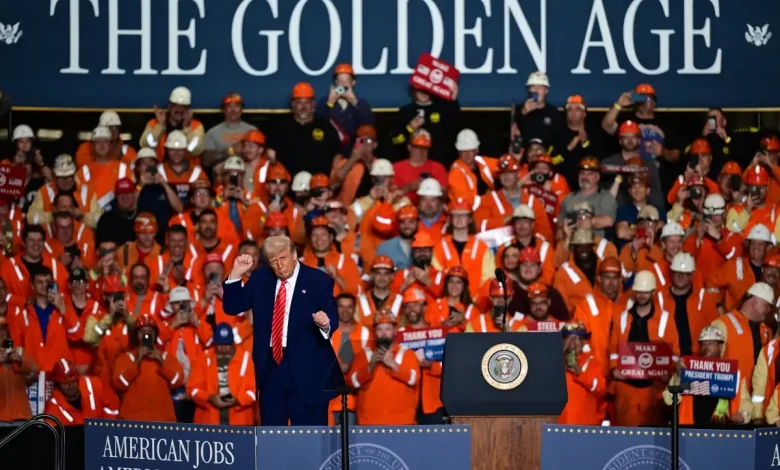
But for all the hand-wringing over the potentially ill-fated employees of Silicon Valley and Wall Street, a quieter crisis appears to be unfolding for the U.S.’s blue-collar employees, despite the pledges and efforts of the current administration to foster a renaissance in marquee industries such as construction and manufacturing.
“Reviving the blue-collar boom that Americans experienced during the first Trump term has been a day one priority for the administration,” the White House told Newsweek, while citing improvements to real wages and manufacturing output in 2025.
The latest Labor Department data puts the issue of employment into sharp relief. September’s delayed jobs report showed an encouraging uptick in overall hiring but no pause in blue-collar employment’s long-term decline.
Of the five industry groups or “supersectors” that could be broadly considered “blue collar”—manufacturing, mining and logging, transportation and warehousing, utilities, and construction—only the latter saw an increase in September. Construction’s 19,000-job gain was also insufficient to offset the monthly loss of 25,300 jobs in transportation or manufacturing shedding a further 6,000.
Year-over-year changes show that annual payroll declines have accelerated since January—albeit continuing a long-term trend—and have pushed blue-collar job growth into negative territory for the first time since the pandemic.
Heidi Shierholz, the chief economist for the Department of Labor during President Barack Obama’s tenure, told Newsweek there was undeniably a deterioration in employment conditions for the U.S.’s blue-collar workers.
“Between April and September, goods-producing industries (manufacturing, construction, logging, mining), lost 72,000 jobs, with most of those losses (58,000) in manufacturing,” she said, adding that the services sector—which falls partially under the blue-collar umbrella—is “limping along” thanks solely to gains in health care.
David Dorn, a labor market expert at the University of Zurich, noted the sluggish-to-negative employment growth across several blue-collar sectors and particularly in construction.
“This sector is highly sensitive to broader economic deceleration,” he told Newsweek, “and increasingly restrictive immigration policies under the current U.S. administration are likely constraining labor supply.”
As for manufacturing, Dorn said it was “difficult to isolate” the direct effects of President Donald Trump’s tariffs on employment, but he doubted whether these had “generated any sustained gains” in jobs.
To Dean Baker, a co-founder of the Center for Economic and Policy Research, tariffs have been largely to blame for the uncertainty and “overall weakness in demand” that has driven cautious hiring across blue-collar sectors.
“Companies are reluctant to invest in a context where they have no idea what tariffs will be in place six months from now, much less three to five years from now,” he told Newsweek. “Also, tariffs pull money out of consumers’ pockets, reducing demand.”
While the data unveils a downgrade in hiring conditions for American blue-collar workers, taking a step back shows this to be an acceleration rather than a sudden free fall that began in 2025. Aside from the effects of Trump’s policies—trade, immigration or otherwise—exogenous factors from offshoring to automation seem destined to disrupt blue-collar work for the foreseeable future.
Economist Orley Ashenfelter noted one revelatory paradox: Despite declining employment in the sector, manufacturing output has risen this year—proof, he said, that productivity was improving despite fewer humans being on the factory floor.
“This change is probably inevitable. It is just too easy to mechanize in manufacturing,” he said, adding that “those good old-school jobs are not coming back.”
Baker said manufacturing’s gradual decline as a share of total employment had “been the case for more than 50 years,” as labor demand shifted toward health care, education and other roles within the more service-focused economy.
“Trump is doing nothing to address these issues,” Baker said, though he conceded, “It is not clear what he could do.”