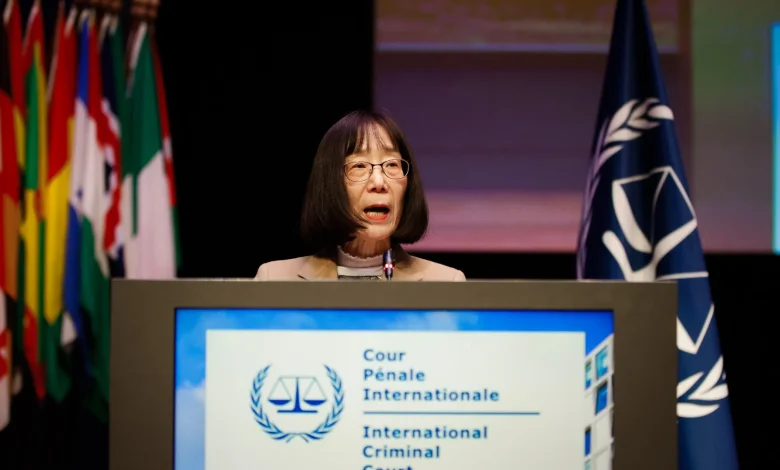
International Criminal Court (ICC) officials on Monday said the court is implementing countermeasures to protect the court from US sanctions, but they will remain confidential to ensure their effectiveness.
The officials spoke in The Hague on the first day of the annual meeting of the Assembly of States Parties (ASP), which is made up of representatives from 125 countries that have ratified the ICC’s founding Rome Statute.
The gathering is taking place at a time of unprecedented threats to the court, prompted mostly by its investigation into Israeli officials over alleged war crimes in Gaza and the occupied Palestinian territories.
Since February, US President Donald Trump’s administration has imposed financial and visa sanctions on the court’s chief prosecutor, Karim Khan. In August, Trump then sanctioned two deputy prosecutors, Nazhat Shameem Khan and Mame Mandiaye Niang, and six judges. He has also threatened sanctions against the court itself – described by some as a doomsday scenario.
The sanctions have upended the daily lives of the nine ICC officials, banned them from travel to the US, and effectively cut them off from much of the global financial system, including within Europe.
New MEE newsletter: Jerusalem Dispatch
Sign up to get the latest insights and analysis on
Israel-Palestine, alongside Turkey Unpacked and other MEE newsletters
The crisis overshadowed the plenary sessions and side events on the assembly’s first day.
“Nine elected officials, including six judges, have been designated for sanctions by the US alongside terrorists and drug traffickers,” ICC president Tomoko Akane told member states in the first plenary session.
“Their family lives have been unsettled, and their ability to conduct financial transactions disrupted, also in the territories of state parties, including in Europe.”
She also added that Russia has issued arrest warrants in absentia for nine elected officials, including one-third of the judges and the entire ICC presidency, in response to the court’s investigation into alleged Russian war crimes in Ukraine.
“The court has taken several measures to mitigate the impact of these coercive measures and strengthen our resilience. Most of these measures remain confidential to ensure their effectiveness,” she said.
‘We will survive’
Trump’s executive orders placed financial and visa sanctions on Khan, as well as other non-US individuals and their family members who assist in ICC investigations of US citizens or allies.
The ICC president has previously warned that the sanctions may pose an existential threat to the court.
Meanwhile, Niang, one of two deputy prosecutors subject to US sanctions, said the sanctions are detrimental not only to the court’s ability to carry out its work but also to victims.
UN rapporteur urges EU to use legal powers to protect ICC from Trump sanctions
Read More »
“If those who are pursuing justice are targets, victims themselves become under threat,” he said.
“This pressure, personal or institutional, has strengthened instead of weakened our conviction in the noble mission of this court.”
At a side event later on Monday, deputy prosecutor Khan said the work of the prosecutor’s office continues despite the sanctions.
“We do have measures to try and protect ourselves from sanctions. They wouldn’t be effective if we shared them, but we will make a statement in due course,” she said.
She added that the court is seeking alternatives to its main cloud services provider, the US tech giant Microsoft.
“We are working very hard towards technological sovereignty,” she said.
“We will survive, and we will survive in a way that doesn’t let our stakeholders down.”
Deputy prosecutor Mame Mandiaye Nian speaking at the ASP plenary session, 1 December 2025, The Hague (ICC gallery)
Since the sanctions were imposed in February, there have been many calls on the EU to activate its Blocking Statute, a legal instrument designed to shield European citizens and businesses from the extraterritorial enforcement of foreign sanctions.
This has yet to happen, however, prompting renewed calls during the ASP on the EU to take action.
“The EU commission has the tools to try to annul the effect of the sanctions,” Alexis Deswaef, the president of the International Federation for Human Rights, told Middle East Eye on the sidelines of the assembly.
“They must implement the Blocking Statute, but it’s not enough. They must do more, and they can do more,” he added.
“They must give access to a banking system that is independent of the US financial network.”
The ICC, established in 2002, is the world’s only permanent international court with the power to prosecute senior officials for international crimes. It is currently investigating a dozen situations, including Palestine, Ukraine, Afghanistan, Darfur (Sudan), Libya, the Democratic Republic of the Congo and the Philippines.