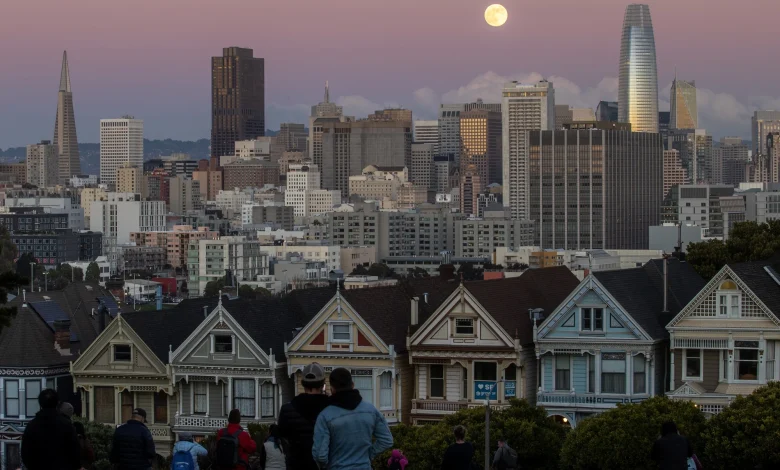
A full moon at its closest point to Earth
When to see: Thursday
December opens this week with a full moon, dubbed the “Cold Moon,” that also happens to be near perigee: the point in the moon’s elliptical orbit when it’s closest to Earth.
That proximity on Dec. 4 makes the moon appear slightly larger and brighter. But should we be calling it a “supermoon” too?
Day-to-night time-lapse panorama of downtown San Francisco with full moon. (iStock)
“That’s a very misleading term,” said Andrew Fraknoi, astronomer and professor at the University of San Francisco’s Fromm Institute — one of the astronomers who rolls their eyes at this particular label.
This is because the average stargazer “cannot tell the difference between full moons that are regular or super: a complaint people sometimes have about cheap burger places, too,” Fraknoi said.
Still, whatever you want to call this event, this week brings a good excuse to appreciate our nearest celestial neighbor.
The Geminids meteor shower, with a moon-free show
When to see: Dec. 13–14
The Geminids meteor shower is considered one of the most reliable meteor displays of the year — and sometimes, it’s the most spectacular, too.
This winter, conditions are nearly perfect to view the Geminids, since the shower peaks overnight around midnight on Dec. 13 and 14, but the moon won’t rise until around 2 a.m., according to the American Meteor Society. That means the skies will be wonderfully dark during the evening and just past midnight.
Long exposure of the sky taken during a past Geminids meteor shower. (Courtesy of Asim Patel)
The Geminids are fragments shed from an asteroid-like object called 3200 Phaeton, which often produces bright, colorful meteors. And with the peak happening on a weekend this year, families can bundle up, find a dark spot away from city lights and look up without worrying about school the next morning.
Another reason to stay up for the Geminids: The next major meteor shower, the Quandratids on Jan 3–4, are predicted to be largely washed out by a full moon.
The winter solstice
When to see: Dec. 21
This one may be less something to “see,” but the solstice is still a momentous milestone for winter: marking the shortest day and longest night of the year in the Northern Hemisphere.
A teenage girl uses the astronomy telescope to observe the stars on a cold winter night. (Imgorthand/Getty Images)
Astronomers believe that billions of years ago, Earth collided with a mini planet called Theia, which caused our planet to tilt by 23 degrees — giving our globe its seasons. “The Earth was in a traffic accident and has never been able to straighten out,” Fraknoi said.
After Dec. 21, daylight slowly begins its long climb back toward summer — good news for anyone who doesn’t enjoy the deep, dark nights of winter.
Earth at perihelion
When to see: Jan. 3
On Day 3 of 2026, at around 9:15 a.m. PST, our planet will be at “perihelion” — that is, at its closest to the sun.
To many who aren’t on the lookout, the sun may just look the same as any other day. But it will actually appear slightly larger than any other day in the year.
A fun fact: At perihelion, the Earth receives 7% more solar energy than when the planet is at its furthest from the sun.
Jupiter at opposition
When to see: Throughout January 2026
Just after the New Year holidays, Jupiter reaches opposition — the moment when the giant planet sits directly opposite the sun in our sky. As the sun sets, Jupiter rises and stays visible all night long, making the planet exceptionally bright in January.
NASA’s Juno mission captured this view of Jupiter’s southern hemisphere during the spacecraft’s 39th close flyby of the planet on Jan. 12, 2022. (Courtesy of NASA)
Since Jupiter reflects sunlight well, “it will be a brilliant point in the sky, easy to find with the naked eye,” Fraknoi said.
And with a small telescope, you can even try to spot Jupiter’s moons. “Galileo’s first small telescope revealed four big moons orbiting Jupiter, forever destroying the notion that everything has to go around the Earth,” Fraknoi said. And this winter, these moons will be widely spaced and easy for you to see.