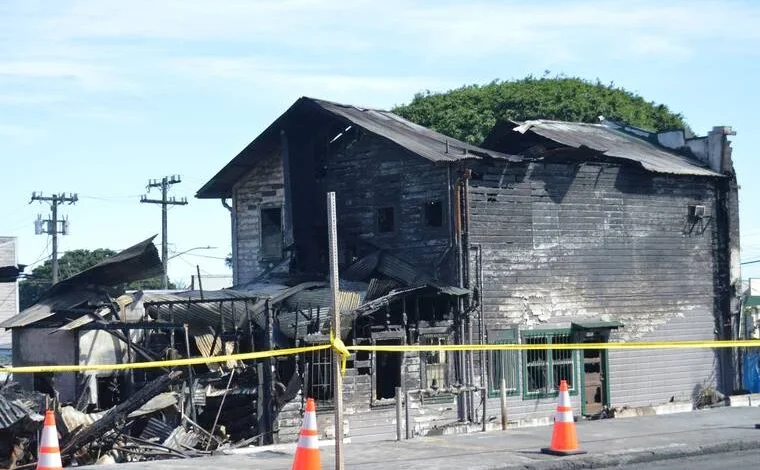
It appears that three buildings were destroyed by fire early Saturday morning in downtown Hilo rather than the four initially reported by authorities. Two of the buildings were on Kinoole Street, while the third was on Haili Street.
The two Kinoole Street buildings had more than one street address assigned to businesses on the street level, which apparently added to the confusion which caused the release of misinformation.
According to county property tax records, the two buildings on Kinoole Street are the Goo Building at 207 Kinoole, the corner of Kinoole and Haili streets, and 193 Kinoole, directly adjacent to the Goo Building in the Hamakua direction.
And while the exterior hulk of the structure remains standing, the building at 140 Haili St. — which housed Kushi and Kushi Attorneys at Law and Olena’s Massage Center — is damaged beyond repair, according to Hawaii Fire Department Chief Kazuo Todd.
“You could basically say a total loss,” Todd told the Tribune-Herald on Monday.
Regarding the number of buildings destroyed, Todd said, “If you look at the satellite (images), it looks like there’s four roofs right next to each other. So, there may have been multiple address points. I’m not sure if they’re classified as one building because they’re connected, or they’re classified as different buildings.
“On the property (tax website), I’ve seen at least two different owners. But I’m not 100% sure how the buildings are designed or addressed, or anything like that.”
Both Kinoole Street buildings, according to property tax records, were owned by Emilia Wagner-Prekaski. The Haili Street property is owned by the Lynne K. Kushi Trust.
The Hawaii Police Department released information that a building on the 100 block of Keawe Street also was destroyed, but that was an apparent reference to the Haili Street building as there were no Keawe Street buildings damaged by the blaze, Todd said.
All the buildings are zoned commercial, two stories, with mixed uses — businesses downstairs and apartments upstairs.
The 193 Kinoole St. building — a grey wooden building with purple trim — was built in 1941, according to tax records. It had a real estate office that heralded “Land For Sale” on its business sign, Pinao Productions, a catering company, and Grinds. The assessed building value was $843,000.
The Goo Building at 207 Kinoole St., a grey wooden building with pink trim, was built in 1933, according to tax records — or 1942, according to a 1998 county document found online. It housed Avani Yoga and a massage studio that said simply “Massage” over its entry door. The assessed value of the building was $677,900.
The 140 Haili St. building, which was built in 1931, was assessed at $216,200.
Late Sunday afternoon, fire inspectors reported that following an extensive search of the affected buildings, no human remains were located, and as of this time, police have not received any reports of anyone being unaccounted for.
Fire investigators also reported there was no indication of accelerants or evidence of foul play, and the cause of the fire is currently classified as undetermined, police said in a follow-up statement on Monday.
Detectives are in the process of obtaining and reviewing video surveillance from surrounding businesses.
All streets in downtown Hilo are open and the businesses that were closed Sunday, including Sack N Save and McDonald’s, were open Monday.
Social media is rife with speculation the fire was caused by arson. One Tik Tok video, which has gone viral, showed the 193 Kinoole St. building with fire on a hard awning above the first story and then, after an edit, the fire coming through the front windows, with a re-poster stating the video “may have proved that” the fire was “exceedingly intentional.”
“It should be noted that the interesting thing, is the beginning of the video shows the roof a couple of seconds into it, you see a window with fire pouring out the window below it,” Todd said. “If the fire had started on the roof, the second section of the video would’ve shown the second floor on fire, not the first floor.
“That’s evidence on our side that the fire was inside, probably the first floor, and the first place it shows … probably because of the loft and the roofing … was that roof, probably. I don’t have 100% on that because my investigators are looking into it, but when I looked at that video, that isn’t evidence of arson, at least to my eye. Could be other videos show a different side of the story.”
Todd said firefighters couldn’t save 140 Haili St. but focused on keeping the blaze from spreading makai to the adjacent building, 134 Haili St., which houses Haili Barber Shop and Da Shop, a vape shop.
“We worked real hard; we were able to save that building,” Todd said. “I can’t tell you there’s no damage because we poured an unbelievable amount of water on that building to keep it from catching fire, all night long. But they should eventually be able to move back into the building.”
Todd said his firefighters also tried to save the Kushi building, but the situation was “a little bit too precarious” because of a narrow alleyway.
“That back corner ended up catching fire,” he said.
There have been two fatal fires within the past month-and-a-half.
One individual died when the Wild Ginger Hotel on Puueo Street, which was built in 1920, burned down on Oct. 22. The cause of the fire is undetermined, and police reportedly are awaiting DNA testing to identify the victim.
And two people died Friday when an apartment complex in the former Puueo Poi Factory caught fire. The building just off Kekuanaoa Street was constructed in 1960. The cause of that fire is still under investigation.
Todd said the age of downtown Hilo buildings are “part of the factor in their flammability.”
“A lot of them are entirely wood construction, balloon frame,” the chief said. “And they’ve been modified and gone through multiple owners. A lot of work has been done that is not permitted, and the usage is sometimes not what it was originally designed for. And then, some of them are, literally, inches away from their neighbor. A lot of these buildings wouldn’t be allowed to be built in the way that they are built, in the current, modern code sets.
“The reason we changed those codes is because of safety, the fact that those buildings would burn down and people ended up dying in other places in the country. So, we made up rules that new buildings had to be safer.”
Email John Burnett at jburnett@hawaiitribune-herald.com.