New York — June Squibb, an old pro when it comes to dealing with the theatrical press, was in place for her interview at the kitchen table. The Upper West Side apartment, where she’s staying while starring in the Broadway play “Marjorie Prime,” was overrun with birthday flowers.
Three days earlier, Squibb turned 96. She spent the day rehearsing and celebrated with the company, an arrangement that suited this proud working actor just fine.
Our meeting took place on a Sunday morning when many New Yorkers are setting out for brunch. Squibb had the day off, but was still hard at work, answering yet another journalist who wanted to know: How does it feel after such a long career to finally play the lead on Broadway?
Squibb made her Broadway debut in the Ethel Merman-led production of “Gypsy” as a replacement for one of the strippers whose bawdy gimmick is electric lights. What would she have said if someone had told her back then that she’d eventually get a starring role on Broadway, but that it wouldn’t happen for another 65 years?
“I would probably laugh a lot,” she said. “How insane!”
But would she have considered it a happy prophecy?
“Oh yeah,” she answered straight away. “The idea that I’m still working at that age!”
Since receiving an Oscar nomination for her performance in Alexander Payne’s 2013 film “Nebraska,” Squibb has become a senior citizen superstar. She had a starring role in Josh Margolin’s 2024 movie “Thelma,” an action comedy about an unlikely 93-year-old vigilante who jumps on a motorized scooter to reclaim the money she lost in a scam.
June Squibb, right, and Erin Kellyman in the movie “Eleanor the Great.”
(Anne Joyce / Sony Pictures Classics)
Squibb plays the title character in “Eleanor the Great,” Scarlett Johansson’s film that came out this fall about a 94-year-old whose accidental lie grows to epic proportions after the media gets hold of the story. Squibb is renowned for her crotchety wisecracks, but this touching comedy about unexpected friendship and the different levels of truth allows her to show off another of her remarkable talents: listening.
Squibb’s homespun realism isn’t a party trick but an outgrowth of an acting training that keeps her alert to the physical and emotional world of her character. Other actors aren’t her props. She responds to her scene partners with the same attention she pays to her own lines.
“My second husband was an acting teacher, and he’s the one who took me from musical theater to straight acting,” she said. “And he always said, your cue is to listen, listen, listen. And I was taught that everything I did was in reaction to what somebody else is giving and telling me.”
Christopher Lowell, left, and June Squibb in “Marjorie Prime.”
(Joan Marcus)
Squibb is now taking on the title role of “Marjorie Prime,” a play by Jordan Harrison that had its premiere at the Mark Taper Forum in 2014. Anne Kauffman, who directed the play’s New York premiere at Playwrights Horizons in 2015, stages the Broadway premiere, which opens at the Hayes Theater on Dec. 8 with a cast that includes Tony winners Cynthia Nixon (“Rabbit Hole,” “The Little Foxes”) and Danny Burstein (“Moulin Rouge! The Musical”).
Squibb, in fact, plays two characters, Marjorie and Marjorie Prime, a hologram double that has been uploaded with artificial intelligence full of information about Marjorie’s life. Harrison’s drama imagines a world (not so distant as it may have seemed at the Taper in 2014) in which human duplicates are manufactured to help those grieving the death of a loved one.
It’s a play about memory and loss in a technological age that forces us to consider more deeply what it means to be human. But Squibb isn’t given to high-minded thematic talk. Her acting is grounded in the particulars of an aging body and the indignities and frustrations of daily living. (Her character in “Thelma” is thwarted by computers and phones, and Squibb makes every little annoyance hilariously recognizable.)
Connection, viewed without sentimentality, is Squibb’s calling card. “Marjorie Prime” might have a futuristic premise, but she approached the work as she would a more traditional domestic drama — from a personal, rather than an abstract, standpoint.
“Marjorie has a form of dementia,” she said. “Now, they don’t say Alzheimer’s. They don’t say it’s not Alzheimer’s, but you don’t really know what it is, only that it’s affecting her mind. And that she is forgetting everything. Well, not everything at the beginning, but you know she’s going to lose most of it. I had two friends that I was with a lot during their trip with Alzheimer’s. So I sort of know what’s happening.”
Harrison, reached by email, had nothing but praise for his star: “June can make us love her so effortlessly — that thing that is unteachable, she does it nearly without breaking a sweat. And that’s so helpful for a play which is a bit of a sneak attack. You want to feel the warmth before you venture into the cold. Here in previews, it’s presenting at the top like a family comedy where the actors get entrance applause, and then the play’s structure sort of closes around us like a trap. June is spectacular at the sharper, almost grande dame side of Marjorie too, which is a side of her that Hollywood hasn’t asked her to show as much.”
Kauffman, also via email, described Squibb as “elastic and dynamic…and incredibly chill. Which I think is actually key not only to the process but to her role. She is comfortable being onstage and throws her weighty talent around with ease.”
Squibb praised Harrison’s “brilliant script,” but acknowledged “it’s not an easy play.” The drama goes to some dark psychological places. And then of course there’s the issue of these android-like creatures called primes, which are played by actors and not immediately distinct from the human characters.
Would she care to bring someone from her past back in the form of a prime? “I would be interested, but I don’t know that I would want to keep one around all the time,” she said with a hearty laugh.
Humans, as “Marjorie Prime” illustrates, are a good deal more complex. For Squibb, who understands acting as a relational art, complication is the source of the most resonant truths. Her scenes in “Eleanor the Great” with Erin Kellyman, who plays an NYU journalism student mourning the loss of her mother, are the heart and soul of a movie that recognizes the conflicts and contradictions within our closest bonds.
“Erin and I just hit it off,” she said. “The producers had put us all up in the same apartment building on the East Side, and we met in the elevator. And I said, ‘Come on up for dinner.’ And so we had two weeks before we started shooting.”
Like their characters, the two became fast friends. (Intergenerational friendship is one of the silver linings of getting older.) Squibb hosted a few dinner parties at Joe Allen, her favorite Broadway eatery, and Kellyman was invited every time.
After decades in New York, Squibb now lives in Sherman Oaks (“L.A. is so much easier!”) and has dinner every month or two with her buddy Chris Colfer from “Glee” and his partner. She lives with her cat (“I had two, but the other got sick”), and her trusted assistant shepherds her to appointments. Pilates, once a week in L.A., helps keep her spry.
Performing eight shows a week on Broadway is grueling, even if Squibb is often seated throughout the play. How does she manage?
“I sleep a lot more than I would normally,” she said. “I don’t go out. We had dinner with some of my closest friends who are here in New York the first Saturday after rehearsal. And then the next Saturday, we had a company dinner after rehearsal. But last night, we came home and I was in bed by 9 o’clock.”
The work replenishes her spirit. “I always say I knew from the time I came out of the womb that I was an actress,” she said. “I don’t think it ever occurred to me that I was anything else.”
Fame didn’t come early, but the goal was always to work. Who did she hold up as an example? She has fond memories of working with Merman, who told dirty jokes backstage at “Gypsy.” But Colleen Dewhurst was her North Star.
“She was my vision of what I would like to do,” she said. “I always found her honest, which is what it’s all about. Getting as close to life as you can. But I just felt she had something about her that was robust. There was nothing weak about her at all.”
Squibb describes her origins as “very Midwestern.” She grew up in a “teeny town” in southern Illinois and said she always knew she wanted out.
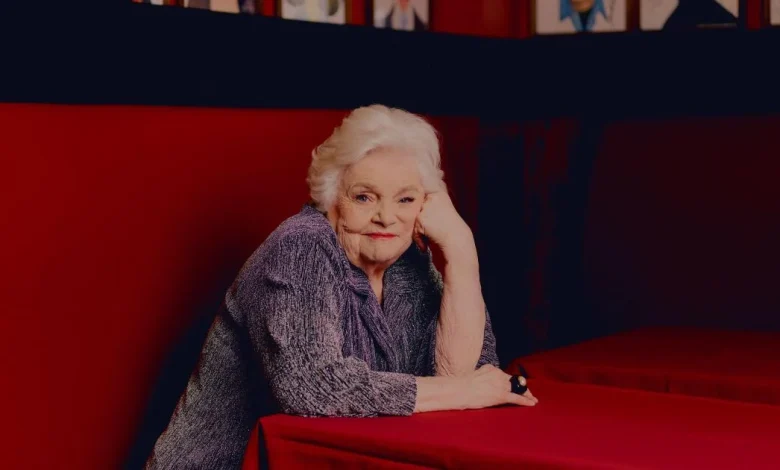
June Squibb at Sardi’s Restaurant in New York.
(Evelyn Freja / For The Times)
Her parents didn’t quite know what to make of her ambition. She thinks her father was proud. But when her mother came to see her in the Kander & Ebb musical “The Happy Time” on Broadway, she asked afterwards whether she was going to come home now.
Was it hard being an actress back then?
“I never thought about,” she said with a laugh. “It never crossed my mind.” Her calling was just a fact. “And I have no idea where it came from. It was just who I was.”
She apprenticed at the Cleveland Playhouse at a time when the theater was venturing into musicals. The person hired to oversee this mission, Jack Lee, a future Broadway conductor and musical director of note, would go on to change the course of her career.
“Jack and I became friends right away,” she said. “He was like a brother to me. He knew I danced, but he was determined that I was going to sing. So he was a voice coach on top of everything, and after he worked with me I did all the comedienne roles in the musicals.”
When Squibb moved to New York, Lee lived with her and her first husband, Edward Sostek. “A huge group left the Cleveland Playhouse, so I had a huge network immediately,” she said. “Jack was very instrumental in my being in musical theater. He started it at Cleveland, and then, because he was so instrumental in my life, it just continued in New York. That was what I was slotted for.”
Her second husband, Charles H. Kakatsakis, a respected acting teacher who taught at Bard College before opening his own studio in New York, redirected her theatrical path. “My first 20 years in New York was all musical work. I met Charlie, and he said, ‘You could be a really fine actress if you just knew what you were doing.’ So he really took it upon himself. I was gung ho. I wanted to do it, but he was determined that I was going to make the shift.”
He coached Squibb for auditions and encouraged her to come to his class. “And oh, we yelled and screamed at each other,” she said. “And everybody in the class would laugh. They all knew me anyway. I was always around. It was the funniest thing, all that yelling and screaming, but it worked.”
So is acting something that can be taught?
“I don’t say that,” she said. “I think he taught me a way to work. I think my approach in musicals was similar to what he taught, but I didn’t know exactly what I was doing. He sort of broke it all down for me.”
How has she dealt with the fallow periods that befall every actor?
“I had one period like that in New York,” she said. “I had had my baby, and I was heavy. And I wasn’t getting work. I was involved with a group who wrote. I came in as an actress, but then I started writing at the meetings to the point where I finished some things. I had a full-length play and it was produced off-off-Broadway. And then people said to me, ‘Forget about your acting.’ But I just found that I didn’t want to. And then I was offered a job at a regional theater and that sort of started me off again.”
Baltimore Center Stage is one of those regional theaters where she honed her craft. She was getting work in film and television as well, but smaller roles until “Nebraska” catapulted her into the spotlight. Would this consummate journeyman ever have imagined that she’d be starring in feature films and a Broadway play in her 90s? A veteran’s veteran, Squibb seems to be taking it all in stride.
What advice would she give her younger self?
“I think one of the things that a young actor has to learn is how to deal with people telling them what to do,” she said. “You put yourself into work, and that’s what makes it exciting. But then people come along and say, ‘If she just did this, if she just did that.’ And you sort of have to push it away. I’m not talking about mentors, if you have someone you trust, but even that sometimes can backfire. Because you have to start realizing what you are and what you have to give.”