That suit included every New England state except New Hampshire. It accuses HUD of changing its program in violation of congressional intent and of imposing new, unlawful conditions on access to the funding, including requiring providers to recognize only two genders.
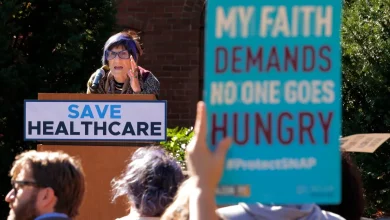
“Last year we fought them on the same grant and won,” Wu told reporters at a downtown Boston event Tuesday evening. “This year, they’ve tried a different way since they lost in court on the other front.”
“They’re trying now to say the money cannot be used for permanent supportive housing and the efforts that have led the nation from Pine Street Inn to other local providers to really tackle and address chronic homelessness,” she said.
“It works and we know it works,” Wu continued. “We’ve seen it happen. It’s why our numbers are as low as they are.”
Since the early 1990s, Boston has received grants from HUD through its Continuum of Care program. The money is used for permanent housing projects and serves veterans, seniors, people with disabilities, survivors of domestic violence, the homeless community, and others in crisis, according to the statement.
“Boston’s Continuum of Care funds the backbone of our work to house our homeless population,” Chief of Housing Sheila A. Dillon said in the statement. “The proposed federal changes in this year’s notice puts our residents at serious risk. Without these federal grants, people who rely on permanent supportive housing, designated to help those who live with disabling conditions, could lose the homes that have helped them rebuild their lives.”
This year, Boston received an estimated $48 million from the program, which supported 19 local nonprofits, such as the Pine Street Inn, and more than 2,000 households that had formerly experienced homelessness, Wu’s office said.
On Nov. 13, HUD issued new criteria that would reject proven anti-homelessness strategies and require Boston to take $29 million previously earmarked for permanent housing and instead use it for temporary housing projects with strict mandatory services, such as forced treatment and employment requirements, Wu’s statement said.
Boston and Cambridge joined, as did San Francisco, Nashville, Tucson, Santa Clara County in California, King County in Washington, and several nonprofit organizations, in filing the suit.
The nonprofits behind the legal challenge include the National Alliance to End Homelessness, the National Low Income Housing Coalition, and Crossroads Rhode Island, Youth Pride, Inc.
“We cannot allow the federal government to punch down on our most vulnerable residents by abandoning its responsibility to fund housing and essential services for people experiencing homelessness, including veterans and those facing mental health challenges,” Boston City Council President Ruthzee Louijeune said in the statement.
Funds from the HUD program help support Boston’s “housing first” strategy, which focuses on getting people to move into stable housing as quickly as possible with supports to help them stay housed, Wu’s statement said.
The Trump administration’s new funding notice “upends the stability of the program,” Wu’s statement said. “This new funding notice makes drastic changes at every step of the process, including changing the types of projects eligible for funding, the criteria for selecting awardees, and the conditions grantees will be required to accept.”
The 19 local nonprofits that receive the grant money to fund their work also use it to pay salaries for more than 125 people, according to Wu’s office.
“With 98% of our tenants remaining housed after a year, and a street homelessness rate of under 2.5%, we are doing something right in Boston,” Lyndia Downie, Pine Street Inn’s president and executive director, said in the statement. “
The Trump administration is appealing a ruling on a previous lawsuit brought by Boston and others in May over $3.6 billion in Continuum of Care grants for housing and homelessness prevention.
In June, a federal judge in the Western District of Washington issued a preliminary injunction barring the federal government from imposing grant conditions as to Boston and the other plaintiffs.
Shirley Leung of the Globe Staff contributed to this report.
Tonya Alanez can be reached at tonya.alanez@globe.com. Follow her @talanez.