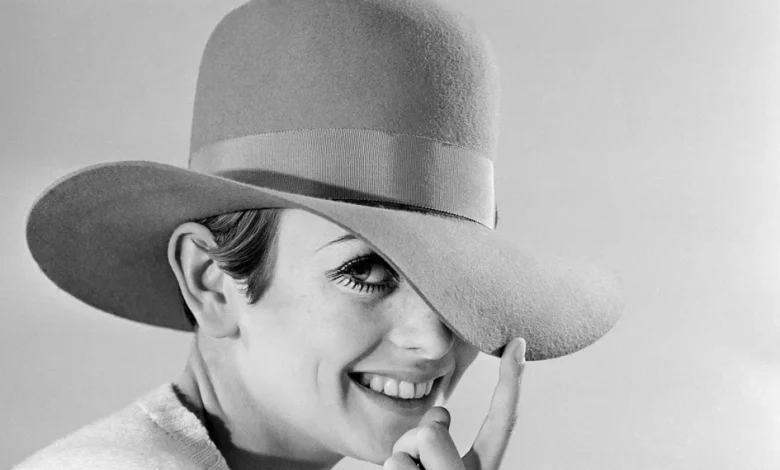
There’s a scene in the documentary about her extraordinary life that stays with Twiggy.
It occurred during her triumphant first visit to New York in 1967. As the barely 17-year-old was taking part in a shoot with acclaimed fashion photographer Richard Avedon, a crowd had gathered. With girls holding up photos of Twiggy’s face in front of their own, suddenly there was a dangerous surge.
“I nearly got squashed, I was so scared” she tells The Weekly now of the mass panic that set in on the street.
“There’s a shot where I turned to the camera, because the cameraman got knocked out and his last shot of me was when I was turning around and shouting for my mum.”
Twiggy with her lookalikes, ahead of the pandemonium.
It’s hard to remember that this world-famous phenomenon was, less than 12 months earlier, a complete unknown. Back then she went by Lesley Hornby, a working-class girl living with her mum, dad and two sisters in the north-west London suburb of Neasden.
But being named the Face of ’66 by a London paper after her very first photograph was taken would shake up the fashion world – and launch an incredible career that continues well beyond what was actually a very short modelling stint.
This is the story that is being revisited in Twiggy, a feature film documentary directed by Sadie Frost. With appearances from friends and colleagues including Joanna Lumley, Dustin Hoffman, Paul McCartney and many more as well as her daughter Carly and husband Leigh Lawson, it’s a fascinating insight into a woman who is far more than just a pretty face.
The Weekly was fortunate to score a chat with the British legend. Read on for more of her memories.
Photo by Michael Ochs Archives/Getty Images
What was your overwhelming thought when you watched the documentary for the first time?
I cried through the whole thing. It just was so emotional. I mean, I’d seen bits when they were putting it together, but to sit in a private cinema and watch it as a whole brings it all up.
Everyone has a photo album, don’t they? Occasionally you dig it out at Christmas to look at.
But normally, your life you kind of think about it occasionally, but you live in the present. You are doing what you’re doing and dealing with what you are dealing with. So to suddenly sit and see my mum and dad and (my daughter) Carly as a little girl was just very emotional.
How did it feel to hear everyone in your life – both family and friends – saying such wonderful things about you on film?
Sadie was the one who picked who she wanted to talk to, I had nothing to do with that. I was just very touched and honoured that the ones who did agreed to do it. One of my favourites is Joanna Lumley, because she’s so funny. She’s that little bit older than me so all her stories about being a working day to day model really made me laugh. She’s brilliant and just a dear friend. And also it was very eye-opening as to what happened to me did change things. Because when I hit the modelling scene, it did all change at that point.
Take us back to your very first modelling job. What was that experience like?
I was very, very scared. I was very lucky in the fact that the first photographer I worked with professionally was Barry Latega, who took the photograph, which is probably the most famous photograph of me with the Fair Isle sweater.
That was the first time I’d ever been in front of a professional camera before. I was a school kid. I was 16, but a very young 16. And, he was very, very gentle with me and very kind.
Twiggy in December 1966.(Photo by Daily Herald/Mirrorpix/Mirrorpix via Getty Images
That first photo would launch you as the Face of ’66. What happened next?
My first paid modelling was with him for a magazine with a wonderful American model called Peggy Moffitt. And I learned a lot from her actually. I watched her in front of the camera moving. I’m quite quick to pick things up and I thought, “Oh, I see. That’s what you do.”
By the time I got to New York and was working with Richard Avedon, who would get you dancing and leaping in the air, it was very different to the kind of modelling pictures of the late fifties and early sixties.
How so?
Suddenly everything changed in the mid-sixties. Fashion became very young, and that’s why somebody like me happened. Because if you look at the models before me, they were all very elegant, very beautiful, very tall, women. And I was this funny kid.
The discovery came so fast for you. How did you handle that leap from anonymity to what ended up being complete chaos at times?
Well, as you saw in the film, I nearly got squashed in New York. That was scary. I mean, they didn’t mean to hurt me, but, you know, crowds get out of hand. They got me into the car, and people were jumping on the car. It was so frightening.
Photo by © Hulton-Deutsch Collection/CORBIS/Corbis via Getty Images
There’s also the famous video of Woody Allen asking you to name your favourite philosopher…
(Photographer) Bert Stern was doing a documentary on my trip to New York and he said to me, I’ve got this friend, he’s a comedian, a musician – Woody Allen wasn’t famous then – and I’d love to put you in a studio and get him to interview you. I was used to people saying, how did you get your name? What do you eat? The usual things. And his first question to me was, “Who’s your favourite philosopher?”
What were you thinking?
Oh, look, I remember that feeling in my stomach. Because I didn’t know any philosophers. And I was panic stricken. And I was begging with him with my eyes, please help me.
But then you asked Woody who his favourite was, and he couldn’t name a single one. So really the joke was on him…
People say to me, oh, you were so clever to turn it on him. I didn’t do to be clever, I did it for, well, desperation actually. Because I wanted him to help me and he didn’t.
Photo by Bert Stern/Condé Nast via Getty Images
The world has changed so much now in how we talk to young people as journalists. But one thing that struck me in the documentary was how many people would ask you about your measurements and your body. How did you cope with that?
There’s one clip when the guy says to me, “I’d like to see you in a bikini.” And you can see my face, I kind of look at him and thought, “you weirdo.” In this country they’d be struck off today talking about women like that; a about their shape and their weight and having no boobs. Most of the time I coped with it, but I didn’t like it. I found it very intrusive.
How did your family react to your sudden fame?
I’d go off traveling and working most of the time, but I’d always come home to them. And at home, I was still their Lesley, helping with the washing up. I’m really close to my sisters and they adapted brilliantly actually. And my mum was proud. But it must have been weird for them. I never really thought about it at the time. It must have been so crazy, but I think it was exciting as well.
A scene from The Boy Friend. Photo by MGM Studios/Hulton Archive/Getty Images
You then moved into acting. Was that always the plan?
No, it just happened. [Director] Ken Russell changed my life really, because he gave me that chance to be in The Boy Friend. I wasn’t planning to act or do any of that. He obviously saw something within me and once I started doing that, I always say it was like going into the secret garden. It was like, “Ohh my God, this is fabulous. I love it.”
It saw you win two Golden Globes as well…
So other opportunities opened themselves up. I got offered a TV series in England, a variety show where I had guests on and we sang and we danced. Then I got offered a recording deal. I was so young. When the film came out I was 21, and it was like, “Oh, there’s this whole other world.” Because you know where I grew up, it was a happy home, but it was a very ordinary working-class suburban family. I didn’t plan to do any of the things that have happened to me, so everything was a new exciting adventure.
Photo by Bert Stern/Condé Nast via Getty Images
Was that why you quit modelling at 22?
In those days there was that kind of stigma that if you’re a model you can’t act and all that silliness. So I thought, if I carry on modelling, I might not be able to do the other things. Also fitting it all in would’ve been madness actually.
The Boy Friend was a musical. Did you have any dancing or singing lessons as a kid?
Not until The Boy Friend. We had a year to prepare and Ken Russell sent me to dance class and singing lessons. I was in the choir at school like most kids and luckily I can sing in tune. He said, I don’t want you to go to acting lessons. He banned me. I had that year to learn to tap dance and I became okay.
Twiggy with Tommy Tune during a press call at the St James Theater on January 13, 1983. (Photo by Gary Gershoff/Getty Images)
Twelve years you were tap dancing on Broadway in My One and Only with Tommy Tune …
I was so scared of the thought of going on Broadway. I mean, filming was another thing because I was used to the camera that didn’t phase me. But the thought of going out on Broadway in front of 1500 people eight times a week? When Tommy rang me, I said, I can’t do that. And he said, there’s no such word as, can’t get your bags packed and get out to New York. And he was right. It was an amazing experience. We did 18 months. I got nominated for a Tony Award. It was the most extraordinary experience of my professional life, I think.
Twiggy and husband Leigh today (Photo by Sébastien Courdji/Getty Images)
You’re still doing so many things today – designing clothes, singing, acting, presenting and so much more. What do you put your longevity in the business down to?
I don’t know, really. I mean, it’s very flattering that people still are interested, I suppose. Really, I get involved in the new projects I’m doing, and some of them are much of more high profile than others, because I love to do it, you know?
I think I’ve been very lucky in my life of the people I’ve met and who are in my life. Leigh and I have now been together for 40 years. We are lucky in that respect., And my family, my kids, my grandkids, my sisters. My home life has always been really important because I think that is your core. That’s what holds you together when all the madness is going on.
Twiggy is in cinemas on December 4.
Tiffany Dunk
Sign up for our newsletter
Want 15% off at ADORE BEAUTY? Sign-up to the latest news from Australian Women’s Weekly
Disclaimer: By joining, you agree to our Privacy Policy & Terms of Use
About your privacy
Are Media Pty Limited collects your personal information through this site to process registrations, send out newsletters, communicate offers, discounts, competitions, or surveys, and to provide you with targeted advertising based on your online activities. Our Privacy Policy contains information on how you can access or correct your personal information, which entities we may disclose your personal information to (including overseas recipients), how to opt out of targeted advertising, and how to lodge a complaint.