Richard Gere on Dalai Lama Documentary ‘Wisdom of Happiness,’ His 20-Year Oscar Ban and Donald Trump: ‘I Don’t Know How You Explain What He Has Done to This Country’

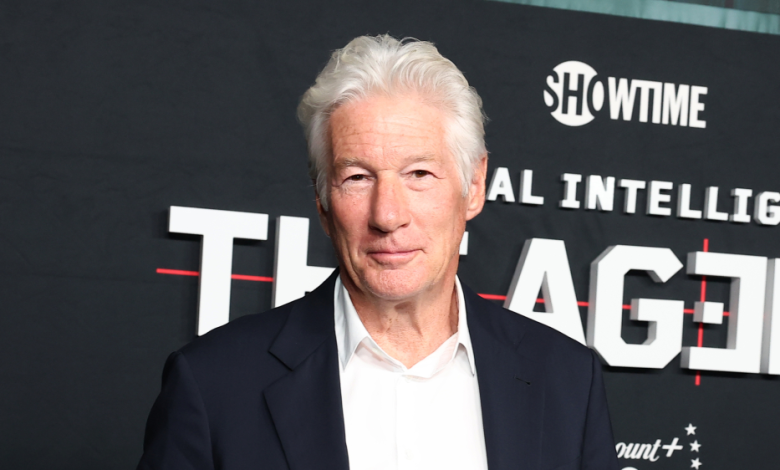
Richard Gere is more than just an executive producer by name on “Wisdom of Happiness,” a documentary about his longtime friend the Dalai Lama.
“I’ve never worked this hard to get a film that I’ve been associated with to be seen in the world,” Gere, who first met the Dalai Lama about 45 years ago, tells me. “I think this is important enough that I have to give my last bit of energy to put this out there for people to see. At the very least, it will put a seed in the minds of people who see it.”
The film chronicles the then 89-year-old Dalai Lama’s life. It features the Nobel Peace Prize winner speaking directly into the camera as if he is having a one-on-one conversation with the viewer.
Gere joined the doc as executive producer after co-directors Philip Delaquis and Barbara Miller showed him an early cut. Gere, alongside his longtime collaborator writer-director Oren Moverman, spent a month helping to re-edit the film and add a new score.
Throughout the film, the Dalai Lama recalls his childhood and family memories. He also offers guidance about the search for happiness and his belief that compassion and being of service are the key to achieving “peace of mind.”
“When I originally saw it about a year ago, I thought about his 90th birthday coming up. I said, ‘This is terrific and I think we can make it even better,’” the “Pretty Woman” star says. “Everything was coming to together and I was thinking, yes, this is the center of a celebration of this extraordinary life. But then in the meantime, the world has gotten so much crazier that this has taken on a different kind of life to me. There is a medicinal quality I think to this film at a time when there’s a deep sickness.”
The Dalai Lama asks audiences to “take a deep breath, step back and question ourselves,” Gere explains. “We’re on a very wrong track here, and it’s gotten worse over the last years. Even a sense of basic kindness is lacking in the way people talk to each other. Obviously, this comes from our leaders, especially the one we have now. How did that happen? We were responsible. We all have to take credit for that and responsibility for that.
“If we want a world a certain way, then we have to elect leaders who have a similar vision to us and will lead us towards this higher level of possibility — who we are as individuals and how we can create a world, a society where people can live with each other rather than this battlefield every day, all day long, with the craziness. Especially, as I say, coming from this very crude mentality that is now in our leadership.”
I wonder if Gere thinks the Dalai Lama could have an impact even on a man like Donald Trump. “I don’t know that it would touch him,” Gere says. “I would hope that it would. I would pray that it would. But boy, I don’t know how you explain what he has done to this country, what it feels like to be an American now, 10 or 11 months in. It’s just astonishing. It’s beyond what anyone could ever imagine.”
There have been dozens of documentaries made about the Dalai Lama. Gere says he’s seen most, if not all of them. He laughs when he remembers being pitched a script for a biopic. “It was the silliest script I’d ever read,” he says. “It was the CIA literally carrying him out of the Potala Palace [in Tibet] in the middle of the night. They were trying to honor the invasion of Tibet and the escape of His Holiness after he’d been threatened by the Chinese, but it was just a ridiculous, silly story. It was like Rambo coming and getting him out.”
Ever since meeting the Dalai Lama, Gere has been an outspoken activist for Tibetan independence. He was banned from the Academy Awards for 20 years when he went off script while presenting at the show in 1993 to denounce China’s policies in Tibet. He didn’t present again until 2013.
Gere has never discussed the controversy with the Dalai Lama. “It never came up,” he says. “They’ll tell him once in a while if I get an award or something and he sends a note, congratulating me, that he’s happy for me, But that’s about as close as it gets to actually talking about movies.”
In fact, Gere insists the ban never bothered him as much as one might assume.
“I didn’t take it particularly personally,” Gere says. “I didn’t think there were any bad guys in the situation. I do what I do and I certainly don’t mean anyone any harm. I mean to harm anger. I mean to harm exclusion. I mean to harm human rights abuses, but I try to stay as close to where His Holiness comes from… that everyone is redeemable, and in the end, everyone has to be redeemed or none of us [are]. So in that sense, I don’t take it personally.”
The Dalai Lama has seen “Wisdom of Happiness.” Well, parts of it. He watched it with his niece, Tencho Gyatso, who is the president of the International Campaign for Tibet. “He really didn’t have any interest in seeing himself at all,” Gere says. “So she kind of skipped forward through that, but when there was this old footage where he was seeing his old friends and family and remembering — he was delighted going into his memory bank of his childhood, like we all would.”
Watch the trailer for “Wisdom of Happiness” below.