When The Sopranos premiered on HBO in 1999, it set fans up for a TV experience unlike any other. The world had seen plenty of successful gangster movies over the years, but no one had seen anything comparable on television. Coming to life in all its grit and glory, The Sopranos brought gangsters into living rooms in ways that had audiences rooting for the bad guy.
To credit The Sopranos with the birth of the antihero wouldn’t be entirely accurate. Just as many antiheroes came before Tony Soprano as those who followed in his footsteps. Though it may not be a new concept, The Sopranos can definitely be credited with ushering in a new era in television that set the precedent for dozens of other shows that followed.
Tony Soprano Appeals to Viewers Because They Can Relate
Image via HBO
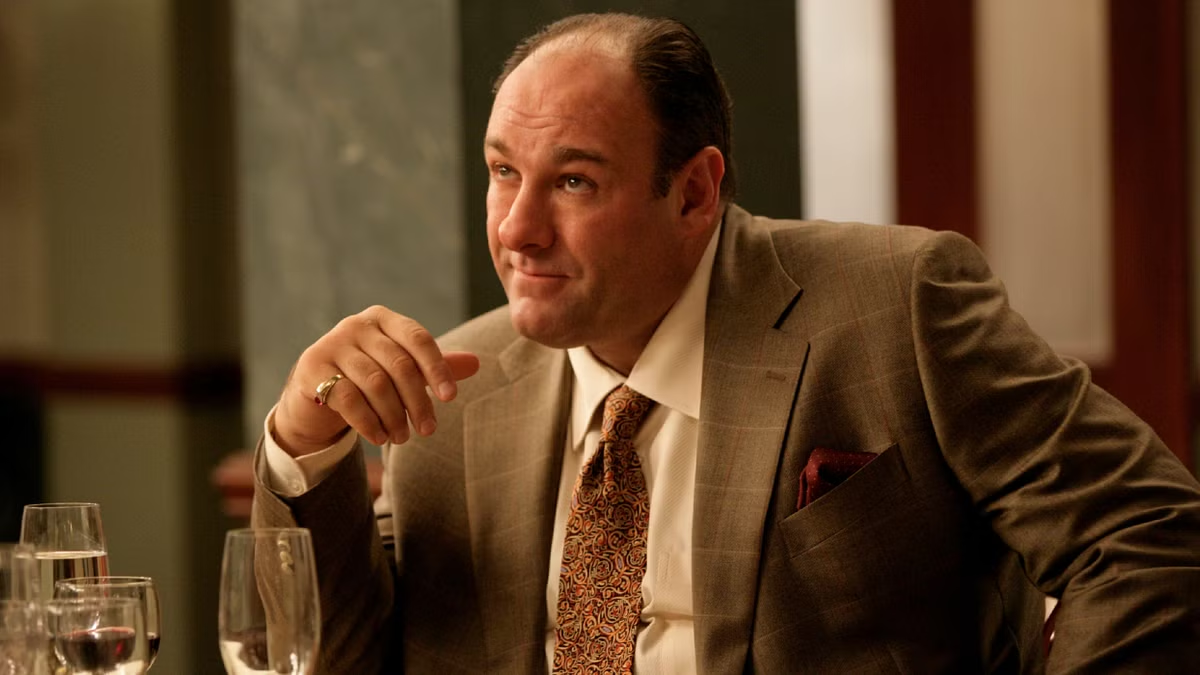
In the very first episode of The Sopranos, fans get a firsthand look behind the curtain at a New Jersey crime boss, and believe it or not, it wasn’t scary. Not at first, anyway. Presented as a father and husband, his struggles with mental health are highly relatable to viewers. Even 26 years ago, when The Sopranos first aired, mental health issues and going to therapy were still topics that made people uncomfortable.
Introducing James Gandolfini’s Tony Soprano through his first session with his therapist, Dr. Jennifer Melfi, expertly put viewers in the hot seat with the series’ main character. Tony’s discomfort was palpable, and it was something a lot of people with mental health issues could easily relate to. Talking about one’s problems can be uncomfortable, and here was Tony Soprano on TV, struggling with the very idea of talking about his problems.
The stigma of looking weak by seeking help has waned significantly since The Sopranos premiered, but at that time, it was groundbreaking. It humanized a villainous man, prone to violent outbursts, cruelty, and murder, in ways that made him someone even the straightest-laced person could sympathize with. Tony Soprano, as a character, could easily represent humanity, taking on the role of father, husband, uncle, nephew, son, and boss, in ways a viewer could envision in their own lives.
As an antihero, the viewer starts looking for reasons to justify Tony’s many bad behaviors. Even Dr. Melfi finds herself confused at times, a part of her just wanting to help the un-helpable man in her office. It becomes far too easy to fall into the trap of believing he’s not such a bad guy. He’s doing these bad things because that’s how he was raised. He doesn’t know any better. He’s trying to be a good provider for his family. He’s protecting the people he loves.
The Sopranos Deconstructs Tony Through the People Around Him
Image via HBO.
As the series progresses, the viewer notices that even those who love, look up to and idolize Tony Soprano begin to see through his dangerous layers. The greatest example is his self-proclaimed nephew, Christopher Moltisante, who starts out believing Tony can do no wrong. He wants to be exactly like him, but the deeper Chris gets into the family business, the harder things become for him.
Tony tears him down at every turn, even jeopardizing his sobriety and all but pushing him off the wagon once he got clean the first time. Chris was so loyal to his villainous uncle that he turned his own girlfriend over to Tony the minute he discovered Adrianna had been talking to the feds. Tony had Adrianna whacked without a second thought, making it impossible for Christopher and the viewer to deny exactly who he was at heart.
Siding with Tony over Adrianna was the catalyst that pushed Chris toward his own downfall, which happened at Tony’s hands after he was so high that he wrecked the car. Looking around the scene of the accident, Tony focuses on the baby seat in the back. Seeing a tree branch has torn through, and he realizes that Chris is going to get someone innocent killed, probably his own baby daughter.
The audience can almost feel the rage that compels Tony to suffocate his nephew. Despite how out of control Chris had become, it’s crystal clear at that moment that no one is safe from Tony Soprano. Not even his own family will stand in his way. He is absolutely irredeemable.
The Antiheroes Who Followed Tony Soprano Were Built From His Template
Walter White has completely turned into Heisenberg in Breaking Bad.Image via AMC
Nine years later, in 2008, Breaking Bad utilized a similar tactic when it diagnosed Brian Cranston’s antihero, Walter White, with incurable cancer. A loving father and husband working as a school teacher is even more relatable than a man born into a crime family. When faced with the possibility of not just dying miserably, but leaving his family behind with nothing, of course, he’s going to do whatever it takes. Even if it means breaking the law, Walter White will go there because he has nothing to lose and everything to gain.
Walt is relatable at first, just like Tony Soprano, but as Breaking Bad picks up momentum, the antihero’s colors shine in ways that make it impossible to excuse his behavior. Walter White comes across as a good guy gone bad, battling his circumstances, but underneath the surface, he was always that cold, calculating person.
Fox released Sons of Anarchy the same year as Breaking Bad, giving fans a whole motorcycle gang of antiheroes, led by Clay Morrow and Jax Teller. SoA took The Sopranos’ antihero formula west, putting a fresh spin on gangster TV fans couldn’t get enough of. Unlike Walter White, it was hard not to root for Jax Teller for similar reasons fans got behind Tony Soprano. Jax grew up in that life, with a mother pushing him to excel in ways his pacifist father failed to do, and the stepfather who helped her kill John Teller.
The interesting difference between Jax Teller and Tony Soprano is that Jax wants to move away from crime and become legitimate. He doesn’t want his kids to grow up in the same environment that shaped him. The saddest thing before all is said and done is that he can’t. And the only way he can keep his own sons from going down the same dark, criminal road he spent his life on is by taking himself out of the equation entirely.
Because there are moments of doubt and question for Jax, he becomes a different kind of antihero than Tony Soprano. The template he was built from definitely started with Tony, but it had evolved into a new kind of antihero, just like it had with Walt’s character. The age of the antihero may have been popularized by the likes of Walter White and Jax Teller. Still, by the time The Sopranos ended in 2007, it had perfected and then deconstructed the antihero archetype fans today know and love.
The Sopranos
Release Date
1999 – 2007
Network
HBO
Showrunner
David Chase
Directors
Tim Van Patten, John Patterson, Alan Taylor, Jack Bender, Steve Buscemi, Daniel Attias, David Chase, Andy Wolk, Danny Leiner, David Nutter, James Hayman, Lee Tamahori, Lorraine Senna, Matthew Penn, Mike Figgis, Nick Gomez, Peter Bogdanovich, Phil Abraham, Rodrigo García
-
James Gandolfini
Tony Soprano
-
Edie Falco
Carmela Soprano