Key safety regulator figure had ‘close personal relationship’ with former CFMEU president, inquiry told

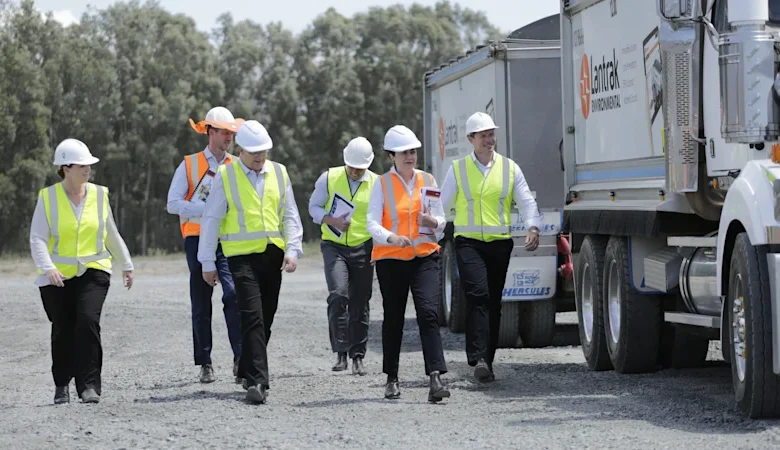
This related to the third stage of the Gold Coast light rail project, and the chance that the changes could give unions such as the CFMEU the ability to enter agreements where they did not have majority membership.
Loading
“I issued a warning that I believed the government was on tenuous grounds,” Schinnerl said. The ministers said they had “crown law advice and their strategy was sound”.
Schinnerl asked for that advice, but it was not provided. She said Bailey indicated “that the government doesn’t have any interest in getting involved in union turf wars”.
Despite the AWU getting the agreements for the earlier light rail stages with contractor John Holland, the third-stage agreement was eventually made with the CFMEU.
Schinnerl said prior to this, one of the firm’s representatives, Trent Smith, told her the pressure from the CFMEU on the separate non-civil building side of business was too great.
Loading
She said Randall Fuller, who advised the government on its broader policy approach, appeared to be aligned with the CFMEU and was favouring its views.
Schinnerl raised similar concerns about the approach on civil construction projects with the heads of various state government departments and then-premier Annastacia Palaszczuk’s office.
This culminated in a letter sent by Schinnerl, drafted by legal counsel, to de Brenni in August 2023 detailing Fuller’s “infected bias” and its potential to undermine government decisions.
De Brenni’s response was “very brief” and only acknowledged her concerns, she said.
Schinnerl’s evidence also extended to her concerns about a police memorandum of understanding with the state’s Office of Industrial Relations.
The CFMEU’s then president, Royce Kupsch (centre), with Jade Ingham (left) and Michael Ravbar (right).Credit: Facebook/CFMEU
She confirmed revelations by this masthead last week that a version of the document, setting out how the regulator and police shared responsibilities, appeared to inaccurately reflect the law.
Particular sections and references to the state-registered CFMEU were viewed by Schinnerl as a “do-around” to enable that union’s officials to access worksites without federal entry permits.
“What is contemplated here is not actually practically possible,” Schinnerl said, explaining police were also required to notify the industrial relations office about any workplace entry disputes.
The fact that one of the first points of contact was former construction compliance and field services director Helen Burgess “exacerbated her [Schinnerl’s] concerns”.
“I know her to be associated with the CFMEU by virtue of a close personal relationship she had, or has, with the then president, Royce Kupsch,” Schinnerl told the inquiry.
“I would have inferred that as a direct line to the CFMEU.”
Schinnerl then referenced allegations and investigations against Burgess before the state’s Crime and Corruption Commission.
The Office of Industrial Relations has previously declined to answer questions about Burgess’ employment, relationship with the CFMEU, or the agreement.
This masthead has also independently tried to reach Burgess and Kupsch.
Schinnerl also told the inquiry that, in May this year, a CFMEU executive confirmed the existence of a well-established and funded plan at that union to take over the AWU.
Some members were said to be plotting to use joint AWU membership to take over their rival’s state branch at a future election, with $1 million from unknown sources set aside.
Federal CFMEU secretary Zach Smith was said to have repeatedly floated a demarcation agreement around union coverage as a way to end violence and threats, Schinnerl told the inquiry.
“Quite frankly, I think that proves what I suspected all along – that this exercise … has been entirely about coverage,” Schinnerl said.
The hearings are expected to resume in February.
Start the day with a summary of the day’s most important and interesting stories, analysis and insights. Sign up for our Morning Edition newsletter.