Top astronomy events for December 2025
From the best meteor shower of the year, the Geminids, to the changing seasons on the solstice, here are the top astronomy events for December 2025 calendar.
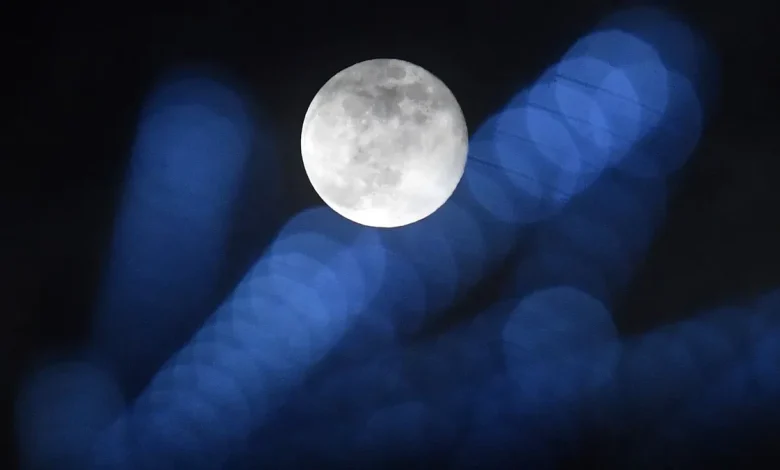
The last full moon of 2025 will rise on Dec. 4, bringing with it brighter skies and a second round of king tides to the Oregon Coast.
December’s full moon is known as the Cold Moon and is also the last supermoon of 2025. A supermoon occurs when the moon happens to be full at its closest point to the Earth during its orbit.
“The path the Moon takes as it orbits our planet is not quite a perfect circle,” according to the NASA website. “Sometimes the Moon is a little closer to Earth and appears slightly larger than average.”
As the moon orbits the Earth, there are a few times a year when its closest point coincides with the full moon, creating a supermoon.
On Dec. 4, the moon will also reach what’s known as a perigee, or its closest point to Earth of 221,808 miles. The scientific term for this phenomenon is called a “perigee moon,” according to Jim Todd, director of space science education for OMSI.
“Full Moons that occur on the perigee side of the Moon’s orbit seem extra big and bright,” Todd said. “A supermoon exceeds the disk size of an average-sized Moon by up to 8% and the brightness of an average-sized full Moon by some 16%.”
During the 2025-26 season, there are four supermoons: the October Harvest Moon, the November Beaver Moon, the December Cold Moon and the January Wolf Moon.
Here’s what to know about December’s Cold Moon.
When is the December 2025 full moon?
The December 2025 full moon will reach peak illumination at 3:14 p.m. PST on Dec. 4.
December’s full moon will appear higher and brighter this month and throughout the winter, and the reason it reaches peak illumination during the day is due to where it sits in relation to the sun.
“The moon rises and sets, like the sun does, rising towards the east and setting towards the west, reaching its highest point due south around midnight,” Todd said. “Like with the sun, the maximum distance above the horizon of the ‘full moon’ varies over the year. The Sun is at its lowest due south around noon on the Winter Solstice (Dec. 21) and at its highest due south around noon on the Summer Solstice (June 21).”
Full moons occur when the moon is on the directly opposite side of the Earth from the sun. It’s as if they are on either side of a celestial see-saw, according to Todd.
“On the day when the sun is highest in the middle of the day (in summer), the moon is at its lowest high point at midnight,” Todd said. “And on the day when the sun is at its lowest high point in the middle of the day (in winter), the moon is at its highest high point at midnight.”
In more practical terms, winter full moons are typically high overhead and appear brighter earlier in the evening because that is when they are directly opposite the sun.
Where does the Cold Moon get its name?
December’s full moon is a supermoon and is called the Cold Moon.
The name Cold Moon is said to have originated from the Mohawk tribe and was also known as the “long night moon” by the Mohicans, based on the frigid conditions that often occur in December, according to the Old Farmer’s Almanac.
Does the supermoon cause higher-than-usual tides?
Yes, supermoons can cause higher-than-usual tides known as king tides.
“You might know that especially high tides, sometimes called king tides, tend to fall in the day or so after the full moon for November through January,” Todd said. “A king tide is a non-scientific term for a very high tide that occurs when the sun, moon, and Earth are aligned, creating a strong gravitational pull on the ocean.”
The first round of king tides on the Oregon Coast occurred during November’s supermoon between Nov. 5-7. The December supermoon will bring another round of king tides between Dec. 4-6.
What will the weather be like on Dec. 4 in Oregon?
Oregon is predicted to have mostly cloudy skies on Dec. 4, with 73-95% chance of cloud cover throughout most of the state, according to the National Weather Service.
Ginnie Sandoval is the Oregon Connect reporter for the Statesman Journal. Sandoval can be reached at GSandoval@gannett.com or on X at @GinnieSandoval.