Green light stuck on amber: Star allrounder should focus on batting to finally live up to potential

A
Set small text size
A
Set the default text size
A
Set large text size
This month marks five years since Cameron Green was fast-tracked into the Australian Test team.
Anointed the future of Australian cricket, it’s been a slow burn since his debut against India at Adelaide Oval in late 2020.
All of a sudden he’s 26 and still yet to cash in on his enormous potential.
He’s been described as the kind of cricketer that you would create in a lab.
Tall, powerful, a classical batting technique, a propensity to bowl fast and the ability to catch anything that comes within a 10-metre radius of his prodigious wingspan.
Injuries, mainly to his back, have hampered his development and it’s easy to expect too much from an allrounder, particularly in Australia where there has not been a truly great one since Richie Benaud and Alan Davidson retired more than half a century ago, following on from one of the best in Test cricket history in Keith Miller.
Many of the modern Australian allrounders have morphed into specialist batters, such as Steve and Mark Waugh, and Steve Smith.
Or they have been constantly battling the pressures of handling the workload to produce a consistently high quality across two, then three formats, like Shane Watson and Andrew Symonds.
Watson and Symonds are still both under-rated for the way in which they were able to adapt their game to the red-ball and limited-overs formats, particularly the former, who also had to contend with a mid-career switch to the top of the order.
Green still has time on his side and the Australian selectors will play the long game with him – if they can stretch out the careers of struggling 38-year-olds, they are hardly going to put pressure on the only current squad member who is in their 20s.
But the next couple of years could define whether Green goes on to become a world-class performer or whether he never quite maximises his considerable talent.
In allrounder terms, the platform is there. The numbers are tantalising.
His batting average of 33.8 is only just below his bowling return of 34.97.
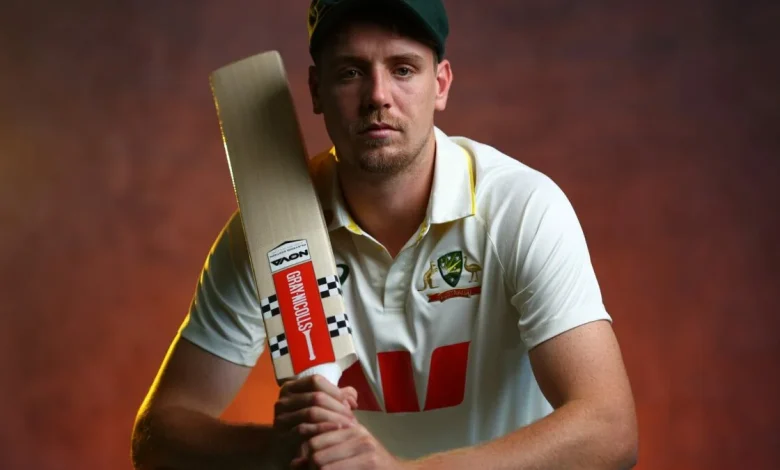
Cameron Green of Australia celebrates with teammates. (Photo by Chris Hyde/Getty Images)
But he has only managed to strike a century twice – his breakthrough 114 on an Ahmedabad road in 2023 and his match-winning epic of 174 not out, while batting at No.4, to vanquish the Kiwis in Wellington early last year.
One of the main problems which has held Green back is that he is a nervous starter.
In 31 of his 52 innings, he has been out before reaching 30.
And the fact that he has been bowled 15 times and LBW on eight occasions shows that he has a deficiency to full-pitched deliveries which can make his footwork seem a touch sluggish.
That suggests that the experiment to elevate Green to first drop was done out of necessity after Marnus Labuschagne’s form slump rather than what was best for him or the team.
An aggregate of 188 runs at 23.5 from eight innings doesn’t tell the full story – his three straight knocks of 52, 46 and 42 in the Caribbean on tricky batting surfaces were worth their weight in gold but it was a no-brainer for the selectors to send him back to six when Labuschagne demanded a recall with a flood of runs earlier this summer at Sheffield Shield level.
And again, the stage was set for Green to drop anchor in the first Test after the Aussies lost a flurry of early wickets to be in strife at 4-31 on day one in reply to England’s modest 172.
Green looked as composed as anyone had done so on the bouncy but by no means unplayable Optus Stadium surface.
The ship had been steadied after 12 overs without incident but when Travis Head fell to a Ben Stokes half-tracker to leave the hosts at 5-76, Green had to stick around.
But after a couple of picturesque boundaries and 49 balls resisting the fired-up pace attack, he snicked the 50th he faced with a nothing shot outside off stump to Stokes and the England captain couldn’t believe his luck.
Shane Watson. (Photo by Gareth Copley/Getty Images)
For someone with such a resolute technique who rarely appears flustered at the crease, Green can be prone to lapses in concentration like this one which leave an air of under-fulfillment.
Being physically gifted only takes a player so far if they can’t build the mental stamina required at the highest level.
Green is a very good bowler but he’s never going to be a frontline seamer.
Perhaps it is time to shelve the bowling duties for an extended period of time, whether it’s the rest of this series, the next year or however long it takes before he is starting to peel off hundreds with far greater regularity than once every 16 Tests.
Australia have a chance to keep Green in the middle order and defer his bowling duties to Beau Webster if they drop struggling veteran Usman Khawaja for Thursday’s Gabba Test to keep Head at opener after his blistering 123 in Perth.
Putting aside the optimistic/futile wish that Khawaja is going to suddenly rediscover his best form a fortnight shy of his 39th birthday, the argument against elevating Head is that he has been such a potent weapon in the middle order.
It’s time to give Green that responsibility. He bats at four for Western Australia and probably only deserves the six slot for the Test side so split the difference and put him in at five after Steve Smith as another batter who can occupy the crease after a shaky start or build on momentum if the top three fire.