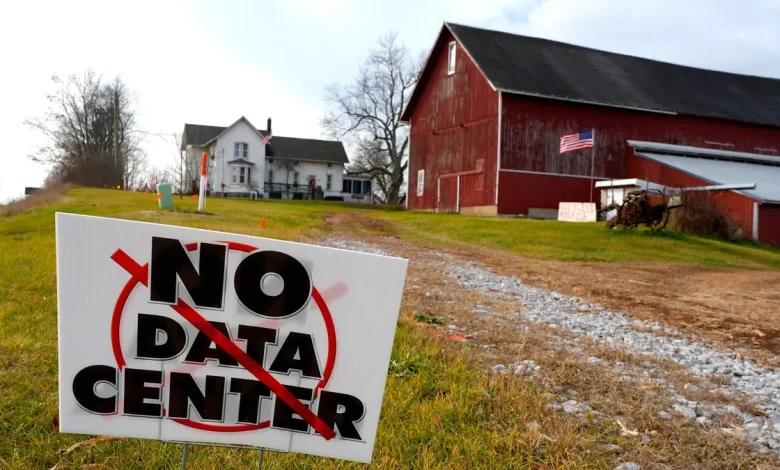
AI data centers suck energy, water
AI-driven data centers are quickly becoming one of the most high-profile technology, economic development and environmental stories of the year.
- State regulators took public comments about a DTE Energy proposal to power a data center campus planned for Saline Township.
- While business groups and labor unions support the deal, many residents urged commissioners to reject the proposal.
State regulators heard public comments on a DTE Energy proposal to power a massive data center campus on Dec. 3, with business and labor advocates urging the Michigan Public Service Commission to approve a request to fast-track the contract, while many residents and environmental supporters called for further scrutiny.
The Detroit-based utility has asked the commission to approve its contract with developers of a massive data center project planned for Saline Township without a contested regulatory process, arguing in MPSC filings that the project does not need a closer look because its plan to supply energy for the proposed campus won’t lead to higher residential energy costs or place a strain on current energy demands. The legal mechanism DTE is asking for is known as an “ex parte” motion.
Opponents of the project, however, argue that DTE should have to prove its claims about the data center’s impact on energy rates and availability.
“This demands scrutiny, especially since these questions are going to come around again and again,” said Christopher Slat, one of the dozens of commenters who spoke during the virtual meeting.
General opposition to data centers exists as well, with critics raising concerns about their impact on the environment, water demand and local noise levels, along with energy usage. They also note the added energy demand could threaten Michigan’s clean energy standards — while state law mandates electric providers to transition to 100% “clean” energy sources by 2040, the law does carve out exemptions for utilities if they cannot meet energy demand without using traditional fossil fuels for generation.
It’s unclear how the MPSC will ultimately rule on DTE’s ex parte motion. In a regulatory filing submitted by DTE lawyers Nov. 26, the company said its contract with the data center backers called for approval of its energy plan by Dec. 5. The commission is scheduled to meet in Lansing Dec. 5, although it doesn’t usually post its meeting agenda until the day before.
“As Michigan transitions to a clean energy future with more renewable energy, while at the same time looking to grow and expand our economic development opportunities, in some instances with businesses that will need access to significant amounts of energy, it’s important to ensure that we’re putting the right customer protections, long term planning and customer oversight in place to protect our residents, utility customers, energy grid and future economic opportunity,” said Commissioner Shaquila Myers.
During the hearing, which was held virtually, business advocacy groups and union chapters urged commissioners to approve DTE’s request, pointing to potential job creation by the data center campus’ construction. When the project was announced in October, developers said the facility will create 2,500 union construction jobs and then 450 on-site jobs once it’s built.
“It’s huge for workers,” said Randall Whitaker, president of UA Local 190, which represents plumbers, pipefitters, service technicians and gas distribution workers in Washtenaw County.
But others echoed concerns about the data center’s anticipated energy demand straining the grid and raising residential electric rates. While DTE and developers have argued the project won’t lead to increased utility bills, opponents of the project called for more stringent review of those claims.
Michelle Martinez, a Detroiter who said she worked for the University of Michigan, warned of AI being a bubble that, if burst, would leave DTE customers “at risk of holding the bag for billionaires and trillionaires.”
Tim Bruneau, who said he was a Saline Township resident, argued the promises made by DTE and developers need further vetting. “Who’s paying for this? We need guarantees that we’re not paying for the infrastructure of this data center,” he said.
Josh Fraley, who said he was a Saline Township resident who lives within sight of the proposed data center campus, said he actually doesn’t have great concern about the data center campus, but is concerned about his electric bill being affected by the project.
“Whether or not the proposal to fast-track is granted, it’s imperative to protect customers,” he said.
The data center project was announced in late October. Tech giants OpenAI — which runs the ChatGPT program that’s synonymous with generative artificial intelligence globally — and Oracle are backing it, along with developer Related Digital. Saline Township trustees initially voted against rezoning a parcel of land for the data center, before reaching a court settlement after Related Digital sued the township.
Supporters of the project include Gov. Gretchen Whitmer, whose office released a statement backing the Stargate campus as a matter of economic competitiveness.
“Right now, time is of the essence,” Whitmer said. “There is a shortage of global computing capacity, and China is moving aggressively to build their own centers and get a leg up on America. At the same time, other states are moving fast too, competing against Michigan to land similar projects with far less oversight. This is a matter of national security and economic competitiveness, and if we do not act, it will cost us thousands of jobs and billions of dollars of investment in our economy.”
Once operational, the data center campus will provide computing power for OpenAI’s “Stargate” project, which aims to power artificial intelligence development. Initially, the campus will feature 1.4 gigawatts of computing power, also the amount of electricity it will draw from the grid. For reference, a large nuclear reactor provides about 1 gigawatt of electricity, according to the U.S. Department of Energy. There are also plans for a further 3 gigawatts of energy demand at the campus at a future date, according to regulatory filings. The campus will consist of three single-story buildings, each 550,000 square feet, on a 250-acre site north of U.S.-12 in Saline Township.
While some have pointed to data center projects as a way to promote job growth, critics say data centers don’t provide the jobs they promise because once built, the facilities serve a more infrastructural purpose than a typical business.
Large data centers also use large amounts of water, mainly to cool the air that gets heated by constantly running servers and other computer equipment. Developers behind the Stargate campus say the facilities will use a closed-loop water system that won’t negatively affect local water supply.
The MPSC is the three-member body tasked with overseeing utility companies in Michigan, including DTE and Michigan’s other large energy provider, Consumers Energy.
You can reach Arpan at alobo@freepress.com