Christmas party season is here with a vengeance – but there is one shindig that ever greater numbers of music fans will be delighted to skip. That is the digital jamboree that is Spotify Wrapped, the streaming Goliath’s annual deep dive into the listening habits of its 700 million or so monthly users.’
Spotify has been making a song and dance about Wrapped for going on a decade now – stoking the hype by keeping the release date of its yearly stocking filler (ahem) “under wraps” until as late as possible, making it ever more personalised with slide shows including, this year, your “listening age” and “personality”. It has also cajoled some of the world’s biggest stars into recording short “thank you” videos to the fans who help them clock up their billions of streams. These clips generally have the vibe of a hostage forced to lie to their loved ones that they’re doing just fine and are looking forward to further quality time with their kidnapper.
Maybe it’s time to scrap Wrapped. A backlash is building amid deeper disquiet about Spotify’s influence on the industry and its negative impact on both artists’ ability to make a living and listeners’ ability to distinguish between real and AI music. The push against the dominance of Spotify is largely artist-led, with more and more speaking about the downside of a service that has come to dominate streaming, much as Live Nation and Ticketmaster – the two-headed Cerberus of cash-hoovering monsters – have with live music.
“It’s a myth that Spotify loves to perpetuate that they are the ones who solve the problems of how we can find music,” Will Anderson of US indie band Hotline TNT said recently. “Music was alive and well for many, many years before Spotify came around and will continue after they’re gone – which they will be.”
Anderson described Spotify as “evil” – and expressed the hope that artists would follow his lead and remove their music. Other critics include Portlaoise singer, Kean Kavanagh, who runs the label Soft Boy and says that what Spotify ultimately boils down to is giving away your music for free in the hope of raising your profile. “It’s more a marketing tool, where you’re giving a free sample basically of your music,” he says.
Spotify’s royalty rates are indeed paltry – under its basic model, it pays an average of $0.004 per stream, so one million streams generate about $4,000 (€3,400). By contrast, its biggest rival, Apple Music, pays an estimated $0.01 per stream, meaning that a million streams earn roughly $10,000 (€8,500). That’s 150 per cent more.
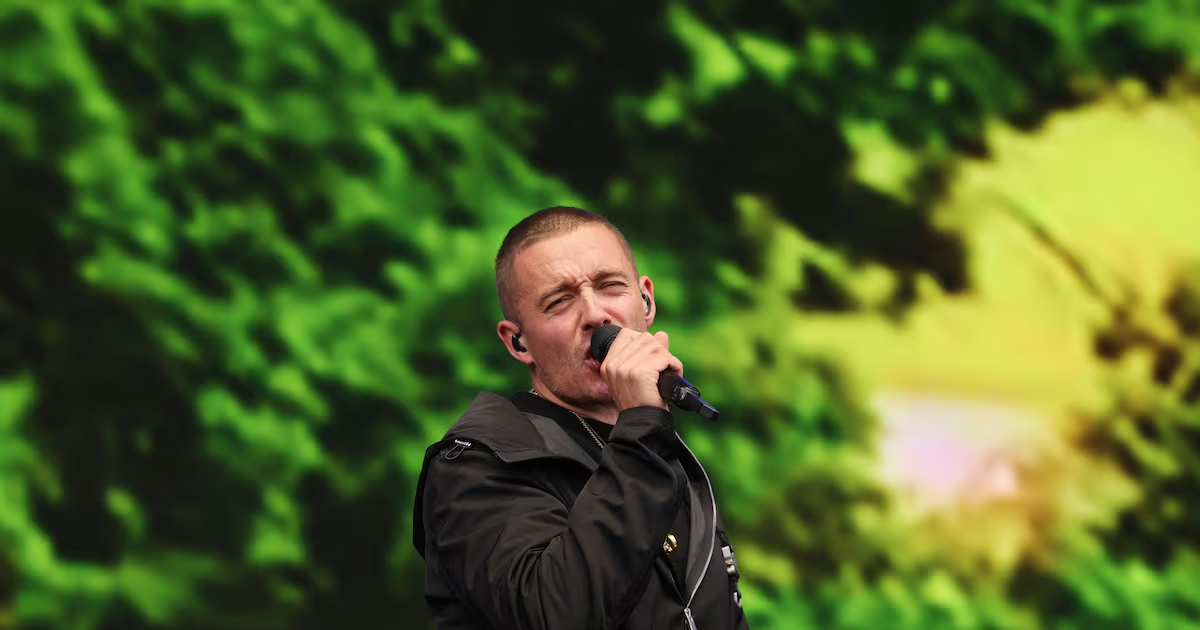
Such is the backlash that even artists who previously praised Spotify have had second thoughts. They include Dermot Kennedy, who has nearly 10 million monthly listeners on Spotify but, as far back as 2022, seemed ambivalent about its hold on music. “I went from doing nothing to doing something because of Spotify,” he told me. “However, I also don’t want to be the artist who is out there whooping and hollering about a platform that doesn’t pay artists a lot of money. They hold the keys in a way. And that’s not fair: artists should be paid more. There’s a conversation to be had for sure: to be getting billions of [streams] and collecting essentially nothing.”
There are downsides for listeners too: Spotify reduces music from an art form to a commodity – to be put on in the background while you are doing something else. Music has been turned into muzak, and Spotify’s founder, Daniel Ek, has become a billionaire in the process.
[ If you didn’t have qualms about Spotify before, wait until you hear what its founder has doneOpens in new window ]
Some will correctly point out that Spotify has also had a liberalising effect, making music available to more of us than ever. As recently as 20 years ago, we had to pick and choose because we couldn’t afford to experience it all. But the pendulum has now swung too far in the opposite direction by encouraging listeners to consume “playlists” rather than dig deep into favourite musicians. Hence the rise of a “Spotifycore” or “Streambait” – which the author of Mood Machine: The Rise of Spotify and the Costs of the Perfect Playlist, Liz Pelly, has described as the “chill-pop-sad-vibe” ubiquitous on playlists, where artistic individuality takes a back seat to a happy-sad, scented candles vibe.
There are also growing concerns about Spotify’s use of artificial intelligence, which the company has implausibly pledged to utilise in a “responsible way”.
But even more so than the soulless rot of AI, it’s the anaesthetising effect of Spotify on the listener that is the most concerning aspect of streaming. By pushing playlists over albums, Spotify’s algorithm encourages us to regard music as a background distraction – to be gulped down and burped away like a refillable serving of soft drinks. That makes good music hard to discover. There’s just so much of it that nothing ever stands out.
[ The mystery of Spotify’s disappearing songs: What we lose when artists erase their musicOpens in new window ]
This is an experience we’ve all had. I no longer subscribe to Spotify, but earlier this year I briefly listened to a “downtempo and chill-out” playlist from one of its rivals. One tune in particular began to obsess me – but because it was on a playlist, the name of neither the artist nor the song registered. Then one day it was gone: I can still hear it in my head but it will be impossible to ever find it again. That’s what streaming does – it reduces music to something that bobs past us, entertaining in the moment but ultimately ethereal and ephemeral.