
Front Burner
The U.S. Supreme Court is expected to rule this month on whether Donald Trump’s sweeping tariff regime violates the U.S. constitution. But either way, in the year since they were announced, the tariffs have drastically overhauled the Canadian-American economic and political relationship.
CBC News · Posted: Dec 04, 2025 4:00 AM EST | Last Updated: 7 hours ago
Listen to this article
Estimated 2 minutes
The audio version of this article is generated by text-to-speech, a technology based on artificial intelligence.
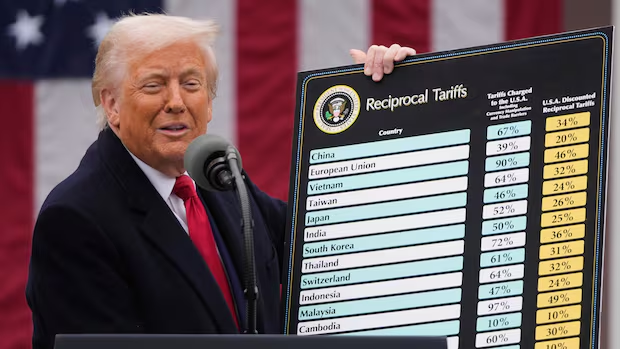
President Donald Trump speaks during an event to announce new tariffs in the Rose Garden at the White House, on April 2, 2025, in Washington. (Mark Schiefelbein/AP Photo)LISTEN | FRONT BURNER:
Front Burner30:13Will Trump’s tariffs survive the Supreme Court?
The U.S. Supreme Court is soon expected to rule on the legality of President Donald Trump’s sweeping worldwide tariffs. The court will rule on whether his use of a 1970s national security law violates the U.S. constitution, which clearly states that only Congress has the authority to implement taxes — of which tariffs are a type.
But regardless of which way the court rules, Trump and his administration have made it clear that tariffs will continue to be a central pillar of both their economic and foreign policy. And, just over a year after they were first announced, those tariffs have had perhaps no bigger impact than here in Canada. They’ve reshaped not just our economic relationship with our closest trading partner, but they’ve fractured the political relationship too.
Eric Miller, president of Rideau Potomac Strategy Group, explains what’s at stake in the Supreme Court’s ruling, and breaks down the impact of a year of Trump tariffs.
For transcripts of Front Burner, please visit: https://www.cbc.ca/radio/frontburner/transcripts
Subscribe to Front Burner on your favourite podcast app.
Listen on Apple Podcasts
Listen on Spotify
Listen on YouTube





![[주말날씨] 토요일 낮 기온 올라 따뜻…일요일부터 다시 하락](https://cdn1.emegypt.net/wp-content/uploads/2025/10/주말날씨-토요일-낮-기온-올라-따뜻…일요일부터-다시-하락-390x220.webp)