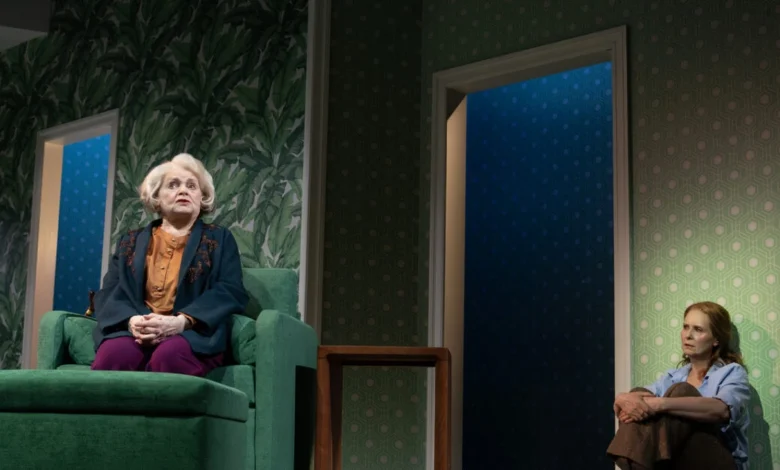
Quick Read
- Cynthia Nixon stars in the Broadway premiere of ‘Marjorie Prime’ at the Helen Hayes Theater.
- The play explores memory, loss, and artificial intelligence through a family drama.
- Directed by Anne Kauffman, the production features June Squibb, Danny Burstein, and Christopher Lowell.
- Opening night is December 8, 2025; the play was a 2015 Pulitzer Prize finalist.
- The story centers on AI holograms recreating deceased loved ones, sparking ethical debates.
On a brisk December in 2025, Broadway welcomed back one of its most versatile talents, Cynthia Nixon, in the highly anticipated premiere of Jordan Harrison’s Marjorie Prime at the Helen Hayes Theater. Known for her fearless performances, Nixon steps into a role that’s as intellectually charged as it is emotionally resonant, sharing the stage with an illustrious lineup: Academy Award nominee June Squibb, Tony Award winner Danny Burstein, and Christopher Lowell. The production, directed by Anne Kauffman, marks a significant moment for the play—a 2015 Pulitzer Prize finalist now reimagined for the Main Stem, opening officially on December 8.
Why Cynthia Nixon’s Return Matters to Broadway
For theatergoers and Broadway aficionados, Cynthia Nixon’s return is more than a headline—it’s a cultural event. Nixon, celebrated for her work in classics like The Little Foxes and Rabbit Hole, brings a depth and nuance to her characters that resonates with audiences across generations. Her presence in Marjorie Prime signals not just a star turn but a commitment to works that challenge and provoke. The play, which debuted at Center Theatre Group in Los Angeles before its acclaimed Off-Broadway run at Playwrights Horizons in 2015, has already cemented its reputation as a modern classic. Now, with Nixon among its leads, the questions the play raises—about memory, mortality, and technology—find a new urgency.
Inside ‘Marjorie Prime’: Memory, Loss, and AI on Stage
At its core, Marjorie Prime is a family drama with a science fiction twist. The story unfolds in a not-so-distant future, where the bereaved can interact with holographic AI recreations of lost loved ones—so-called “Primes.” What would you say to someone you lost, if you could see them again? Would they listen better now than when they were alive? Through these hauntingly intimate encounters, Harrison’s play explores the blurred line between a life lived and a life remembered, asking audiences to reflect on the ways technology can both heal and complicate the human heart.
Nixon’s character, alongside Squibb’s Marjorie, navigates a landscape where artificial intelligence isn’t just a plot device—it’s a catalyst for examining grief, legacy, and the stories we tell ourselves about family. The script is spare, wryly funny, and deeply powerful, as noted by BroadwayWorld, weaving together aging, memory, and the ethics of AI with a delicate touch.
The Powerhouse Cast and Creative Team Behind the Scenes
June Squibb, fresh from her Oscar-nominated turn in Nebraska and a Broadway career stretching back to the 1959 run of Gypsy, anchors the cast as Marjorie. Danny Burstein, lauded for his performances in Moulin Rouge! The Musical and The Drowsy Chaperone, and Christopher Lowell (Cult of Love) round out the principal ensemble. Understudies Mike Shapiro, Collin Kelly-Sordelet, Kate Hampton, and Barbara Kingsley ensure the production’s depth and resilience.
Anne Kauffman, who directed the Off-Broadway staging, returns to helm the Broadway bow. The creative team boasts scenic design by Lee Jellinek, costumes by Márion Talán de la Rosa, lighting by Ben Stanton, and original music and sound design by Daniel Kluger—each element working in concert to evoke the play’s futuristic yet familiar atmosphere.
A Play That Invites Debate and Reflection
Since its inception, Marjorie Prime has spurred spirited conversations about the ethics of artificial intelligence and the nature of memory. As Playbill notes, audience members may leave the theater debating not just what technology can do, but what it should do. Is it comforting or unsettling to converse with an AI version of a loved one? Can a hologram truly stand in for the complexities of human connection? These questions echo far beyond the proscenium, touching on concerns that grow more relevant as technology advances.
The play’s journey from stage to screen—its 2017 film adaptation starring Lois Smith—underscores its broad appeal. Yet it’s in the live, immediate space of the theater where its themes resonate most powerfully, especially with Nixon leading the charge.
Legacy, Innovation, and the Human Story
Marjorie Prime is a testament to Broadway’s willingness to take risks on thought-provoking material. It’s not just about star power or technological gimmickry; it’s about storytelling that asks audiences to confront their own assumptions. Nixon’s return is emblematic of the kind of artistry that thrives in this environment—one that rewards curiosity, empathy, and a willingness to wrestle with the big questions.
The production’s timing, amid growing societal interest in AI and digital legacy, couldn’t be more apt. By placing these issues center stage, the play invites viewers to consider not just how we remember, but what those memories mean in a world where technology can preserve, alter, and even recreate them.
With Cynthia Nixon’s nuanced performance anchoring a stellar cast, the Broadway debut of ‘Marjorie Prime’ stands as a bold, timely meditation on memory, grief, and the ethics of technological resurrection. It’s a production that doesn’t just entertain—it provokes, challenges, and, in its quiet way, changes the conversation about what it means to remember.