Normal text sizeLarger text sizeVery large text size
A selection of sporting luminaries will, on Saturday morning (AEDT), reach into a series of glass bowls and grab, one after the other, 48 plastic balls containing pieces of paper, assigning the nations whose names are written upon them their 2026 FIFA World Cup destinies.
When you break it down like that, it is rather boring and procedural. And, look … yeah, it is. These ceremonies tend to drag on with needless formalities, cringey on-stage exchanges and pre-prepared video packages that tell us things we already knew.
But it is important, and – if you’re emotionally invested in the fate of the Socceroos, as you should be – kind of exhilarating in its own way.
Jordan Bos is arguably Australia’s best player.Credit: Getty Images
The World Cup in the United States, Canada and Mexico doesn’t begin for another seven months, but really, it starts here. This is the tournament’s first decisive moment. This is when we get something tangible to look forward to: match-ups, narratives, groups of life and/or death, plus times, dates and venues.
This is when you can actually start planning your trip, if you’re taking one. Hope you’ve saved up.
This draw will be different. There are 48 plastic balls because for the first time, there are 48 teams, up from 32 – a controversial expansion that will make this the biggest World Cup ever.
Here’s everything you need to know, including what it all means for the Socceroos.
When? Where? Who?
Have an early night on Friday, if you are planning to get up: it’s on at 4am AEDT on Saturday morning and will run for about an hour and a half. SBS, the World Cup broadcaster, will be showing it all live from the Kennedy Center in Washington DC – and again at 1pm, if you can’t be bothered getting up.
And what an experience it promises to be. It’ll be hosted by supermodel Heidi Klum and comedian Kevin Hart, while actor Danny Ramirez will “engage football greats in attendance, bringing Hollywood flair”, which sounds just wonderful. Then, we’ll be treated to the musical stylings of Andrea Bocelli, Robbie Williams, Nicole Scherzinger (remember the Pussycat Dolls?) and then, after the draw … the Village People, performing Y.M.C.A. for some reason.
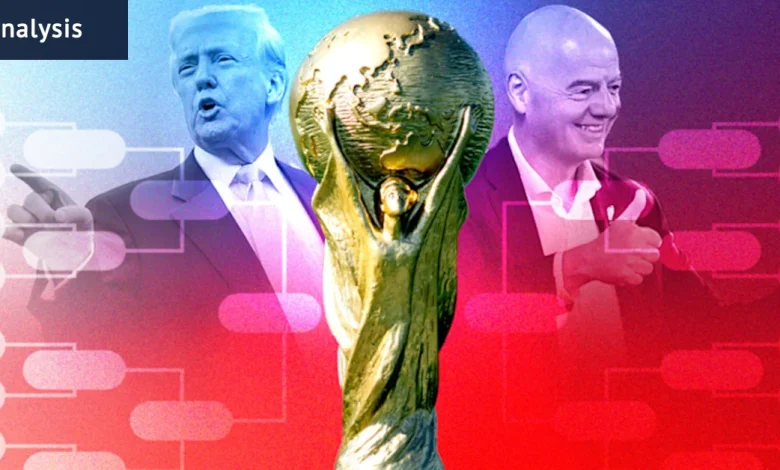
Actually, this might be the reason: Donald Trump will be there, too, reportedly, and he’s expected to receive the inaugural “FIFA Peace Prize” from his new best friend Gianni Infantino, the FIFA president. That’s a whole other story.
Kevin Hart! Why not?Credit: Dominic Lorrimer
As for the people grabbing the balls: one actual (retired) footballer, Rio Ferdinand, will lead the formalities with the assistance of the legendary Tom Brady, Shaquille O’Neal, Wayne Gretzky and Aaron Judge, representing the ‘big four’ American sports leagues, the NFL, NBA, NHL and MLB, respectively.
How does it work?
The 48 teams have been divided into four pots (see below), based on rankings – except for the three host nations, who are all in pot 1, and the six play-off teams, who are all in pot 4.
At the draw, they will be sorted into 12 groups, containing one team from each of the four pots, starting with pot 1.
So it’s all down to the luck of the draw, except for one key rule: no group can have more than one team from the same confederation in it, with the sole exception of UEFA, which is contributing 16 nations. At least one UEFA team will be in each group, but no more than two.
That rule also applies to the play-off teams. There are 16 European teams competing for four remaining UEFA slots, and then six teams from the rest of the world for the other two – that’ll all be determined in March, when the final qualifiers take place. But until then, for the draw, the constraints will be on all possible teams: so, for example, if an Asian team is drawn into a given group, the second intercontinental play-off berth (which will be one of Bolivia, Suriname or Graham Arnold’s Iraq) can’t also be in it, because an Asian team could win it.
Get it? If not, read the document below.
We’ll also find out when and where the games will be, right?
Yes, but not on Saturday. FIFA has also announced that a separate event will be held in Washington to reveal all that. By the time we wake up on Sunday morning (AEDT), we’ll know everything.
The host cities and venues have already been announced, of course, and are below.
The other major consideration for qualified teams is their “base camp”, where they will train and stay before and during the World Cup. As soon as match venues are locked in, that’s what teams will be rushing to try and sort out.
What happened to groups of three? Wasn’t that the original plan?
You’re on the ball. That was FIFA’s original plan with the expansion to 48 teams: 16 groups of three teams each, which would have been the most significant format shift in World Cup history. It was wildly unpopular when it was announced. Then, when the 2022 World Cup’s group stage wrapped up on an enthralling final day in Qatar, FIFA relented to public sentiment and switched back to four-team groups.
It is, however, worth noting that the cadence of the group stage will still be substantially different. Instead of only the top two teams in each group going through to the knockout phase, the eight best third-placed teams will also qualify for the new round of 32, which takes some of the jeopardy away. If you do the maths, you’ll realise that we’re going to have 72 games just to eliminate one-third of the teams in it.
These things are rigged, right?
Ah, you’re a draw conspiracy theorist. Welcome, welcome.
Despite age-old speculation that the plastic balls are either heated or cooled to enable the dignitaries selecting them to achieve a pre-determined outcome, nothing has ever been proven, so we can classify it as an urban myth.
However, the draw will be a little bit rigged: FIFA has announced that the four highest-ranked teams – Spain, defending champions Argentina, France and England – will be randomly drawn into separate pathways, ensuring that the two highest-ranked teams (assuming they win their groups) cannot meet until the final. So that’s new, too.
The Socceroos are going to cop a group of death, aren’t they?
Maybe, maybe not.
For the two World Cups since FIFA started basing the pots on world rankings, rather than geography, Australia was in pot 4. But for the first time, partly thanks to the tournament’s expansion and partly because they’ve earned it over the past four years, the Socceroos have landed in pot 2 – a massive boost that guarantees they will avoid the other teams in it, including 2022 semi-finalists Croatia and Morocco, and CONMEBOL powerhouses Colombia and Uruguay.
In theory, they should get an easier group – but in practice, they could still get stiffed.
If you’re after something different from pot 1, you should be hoping to avoid Spain, Argentina, France, Brazil, the Netherlands and Germany – those are the teams in it that the Socceroos have met before in the World Cup group stage or beyond. There are no easy options, but by rankings, the easiest would be Canada, a team the Socceroos beat 1-0 in October.
Floating at the top of pot 3 is Erling Haaland’s Norway, who finished ahead of Italy to top their UEFA qualifying group. They’re the ones Popovic will be hoping to avoid, while due to the aforementioned constraints, the Socceroos can’t draw AFC rivals Saudi Arabia, Qatar or Uzbekistan.
Aziz Behich and the Socceroos celebrate direct World Cup qualification.Credit: Getty Images
Then there’s pot 4, which could be a crap shoot, and entirely dependent on who the Socceroos get from pots 1 and 3: if it’s two European teams, it won’t be one of the UEFA play-off slots, or if they get an African side, it won’t be the first intercontinental play-off slot, which could be DR Congo. And so on.
The variance is wild. They could cop Spain, Norway and Italy (if they make it), which would be rough – or they could get Canada, South Africa and New Zealand, in which case the Socceroos would be in with a genuine shot of winning all three group games.
Have a play around with a World Cup draw simulator and see for yourself.
Wait. Did you say Italy might not make it? Again?
Don’t get me started. If they can’t get past Wales, Bosnia and Herzogovina, and Northern Ireland in March, the Azzurri will miss out on the World Cup for the third successive cycle – an unimaginable horror for the four-time champions.
Dio mio.
How have the Socceroos been going – and how should they go next year?
Pretty well, all things considered. Since the last time you were probably paying attention, if you’re a once-every-four-years Socceroos supporter, the previous coach Graham Arnold walked away at the very start of World Cup qualification after a disastrous 1-0 loss at home to Bahrain, and a 0-0 draw away to Indonesia.
In came Tony Popovic, a member of Australia’s famed “golden generation”, who went unbeaten in his first 11 matches in charge as coach, including rare wins over Japan and away to Saudi Arabia to seal automatic qualification for the first time in three cycles.
Tony Popovic.Credit: Getty Images for Soccer Australia
Popovic has expanded Australia’s depth and integrated some of the more exciting players to have emerged from the A-League in recent years, including Nestory Irankunda and Mohamed Toure, while the team’s best player is probably Feyenoord’s Jordan Bos.
Meanwhile, young gun Alessandro Circati is playing week in, week out in Italy’s Serie A for Parma and looks set to marshall the Socceroos’ defence for the next decade.
Loading
There have been a few hiccups more recently, though. The Socceroos have lost their past three matches – their worst such run since the 2014 World Cup – as Popovic has chopped, changed and experimented with line-ups, testing players and combinations against highly ranked opponents.
The biggest question mark is, as always, what they do with the ball: like most Australian teams over the years, this one is tough, competitive and difficult to break down, but struggles to maintain possession or generate significant goalscoring chances aside from counter-attacking play.
What would a good World Cup look like? Like with qualification, it’s hard to measure against the past due to the 48-team expansion.
Depending on the draw, getting out of the group is a reasonable minimum expectation, although Popovic and his players talk as if they’re setting their sights much higher.