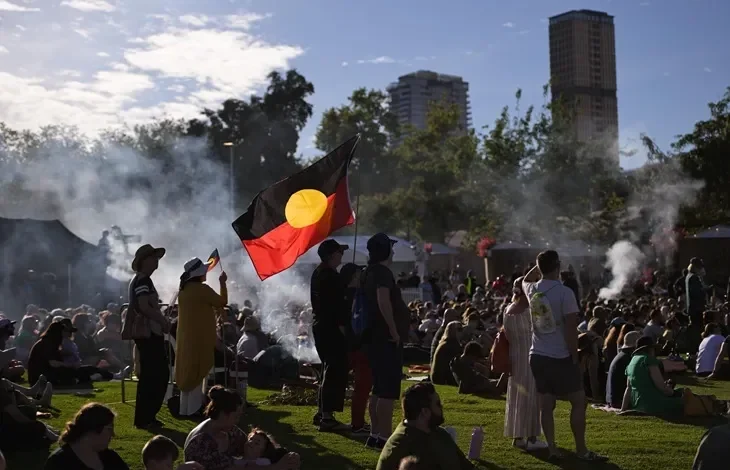
South Australia is currently progressing elements of the Uluru Statement from the Heart at a state level, including the establishment of a First Nations Voice, the development of truth-telling processes, and the intention to explore treaty negotiations with South Australian Aborigines.
These initiatives began with consultations led by Dale Agius, appointed as the inaugural Commissioner for First Nations Voice on July 5, 2022, following the South Australian Labor government’s election win in March of that year.
This laid the foundations for South Australia’s First Nations Voice to Parliament which began in August 2022. After several rounds of consultation, the South Australian Parliament passed the First Nations Voice Bill 2023 in a special sitting on Sunday March 26, 2023. This formally established the Voice in South Australia.
The first elections for the SA First Nations Voice were held on March 16, 2024, though with very low turnout. Truth-telling processes are being planned for rollout over the next several years, and treaty discussions are expected to follow.
If fully implemented, these reforms would embed a new, ancestry-based governance framework into South Australian law and could have long-term implications for decision-making, land use, public expenditure, and accountability.
Given that the Uluru Statement has drawn national and international attention, and that Australians recently voted ‘No’ to a similar federal proposal, it is important for South Australians to clearly understand what is being proposed, how far it has advanced, and what consequences it may carry for the state.
In a democracy where authority flows from the people, reforms should enhance fairness rather than divide Australians along racial lines. Over 64 per cent of South Australians voted ‘No’ in the 2023 federal Voice referendum, signalling limited support for ancestry-based governance structures, which was echoed in the 2025 supplementary elections’ low participation.
Australians for Better Government (ABG) affirms that government must remain accountable to all people equally, under the rule of law and with democratic consent.
One central question must be addressed: Will reforms based on ancestry strengthen equality, or undermine it?
Learning From History – Without Repeating It in Reverse
Australia’s history includes discriminatory policies, from the White Australia Policy to laws that marginalised Aboriginal Australians. These policies were wrong, harmful, and incompatible with the principle that every person should stand equal before the law.
Some argue that ancestry-based structures are necessary as a temporary measure to address the disadvantage experienced by many Aboriginal communities. While this goal is important and widely shared, creating new political distinctions based on descent risks entrenching division rather than solving it.
Targeted programs can and should address disadvantages directly, but altering the structure of democratic representation based on ancestry is not the right mechanism. Equality before the law is a permanent principle, temporary challenges should not be met with permanent changes to how voters are represented.
For ABG, government must serve all Australians equally, not specific groups defined by descent.
Legal and Governance Risks
Experts have highlighted several risks associated with implementing Voice, Treaty, and Truth-telling structures at the state level.
Discussions within South Australia have raised concerns about:
- Establishing parallel governance expectations based on ancestry.
- Treaty provisions that may bind future parliaments or alter land-use frameworks.
- Potential conflicts with principles of equal treatment before the law
significant and ongoing financial obligations without explicit public consent.
These are not abstract issues, they affect governance, legal clarity, budgets, and social cohesion.
ABG believes these areas must remain transparent and accountable to the people.
Existing Aboriginal- and Torres Strait Islander–Specific Expenditure Requires Scrutiny
A substantial amount of Indigenous-specific funding already exists. The Commonwealth allocates an estimated $5.3 billion annually to Indigenous Australians (Aboriginal and Torres Strait Islander peoples), while South Australia spent around $1.3 billion on targeted Aboriginal services in 2021-22.
These are ongoing taxpayer commitments, not symbolic gestures. Creating new ancestry-based governance structures, such as a Voice, treaty authorities, or expanded truth-telling bodies, risks duplication, blurred accountability, and long-term financial obligations for future governments.
Before expanding these frameworks, the public deserves clear answers:
- How will new bodies interact with the billions already being spent?
- What mechanisms will ensure transparency and prevent overlap?
- Who will be accountable for outcomes, and how will performance be measured?
Without clarity, South Australia risks building a parallel governance system without reforming the substantial funding architecture already in place.
Democracy Requires Consent – Not Assumption
While South Australia has the legal authority to pursue these reforms, legitimacy depends on public consent. Many South Australians, including those who voted ‘No’, feel unheard. The referendum was not a rejection of reconciliation or of Aboriginal culture; it was a rejection of the idea that ancestry should determine a person’s role in government.
This concern is reinforced by extremely low participation in the SA First Nations Voice elections, with turnout recorded at around 8.7 per cent, some candidates were elected on as few as six votes. Such figures raise questions about whether these processes reflect a broad democratic mandate.
It is important to highlight, that because South Australia’s Constitution can be changed by Parliament without a referendum, the government was able to create the SA Voice without seeking public approval.
The 2023 First Nations Voice Act, which amended Section 3 of the SA Constitution was enacted solely by parliamentary vote without a referendum, despite public debate and the federal ‘No’ vote. This illustrates how governments can embed divisive structures into foundational law without voter input, risking erosion of equal democratic participation.
ABG’s reform agenda addresses this by advocating mandatory referendums for constitutional changes and enhanced accountability to ensure representatives serve all constituents equitably, not partisan interests, starting at the state level to inspire national improvements.
Lessons From Abroad
After the Brexit referendum, UK parliamentary debate continued for years, and campaigns such as ‘The People’s Vote’, backed by figures including Keir Starmer, pushed for a second vote.
South Australians ought to recognise the similarity: introducing state-level structures that mirror the rejected federal Voice risks sidestepping a decision the public has already made.
In a democracy, outcomes should not be rerun until the ‘right’ answer appears.
Reconciliation That Brings Every Australian With Us
This is not a rejection of Aboriginal identity, culture, or the need to acknowledge past wrongs. It is a defence of a principle that protects everyone: the law should treat all Australians equally.
Reconciliation is strongest when grounded in unity, shared nationhood, and equal dignity, not in structures that reintroduce divisions.
If South Australia wishes to pursue the Uluru Statement’s aspirations, it must do so with community-wide consent and in line with democratic principles that uphold equality. True reconciliation invites every Australian to move forward together, with the same rights, the same voice, and the same respect.
In line with its messaging, ABG’s position regarding the South Australian Voice to Parliament, is that it should be taken to a vote to allow the people of South Australia to decide.
South Australia deserves a government focused on growing the State’s economy, strengthening opportunities, and ensuring that it remains one of the best places in the nation to live and raise children. The State should be aspirational, not backward-looking.
Enormous time, energy, and resources have already been spent revisiting proposals the Australian people have clearly rejected. The growing message from the public is unmistakable: it is time to move forward, united, without revisiting divisive, ancestry-based political structures. Imagine what South Australia could achieve if resources were redirected toward shared economic growth for all?
For more about ABG’s mission or to become a member, visit www.australiansforbetter.com
Mark Neugebauer is a committee member and South Australian Coordinator for Australians for Better Government. His views do not necessarily reflect those of the entire committee.
Note on terminology:
While the author recognises that the word ‘Indigenous,’ by its Latin etymology, could apply to all people born in Australia, the term is used in this article only because it has been adopted by governments, policymakers, and legislative frameworks to refer specifically to Aboriginal and Torres Strait Islander peoples. The author believes that words and their meanings matter; therefore, ‘Aboriginal’ is used wherever it provides greater clarity and accuracy.
Mark Neugebauer, Committee Member and South Australian Coordinator, Australians for Better Government (ABG)