ALLEN PARK, Mich. — All offseason, the Detroit Lions told us they were good with their pass rush. Now it’s looking like their pass rush isn’t good enough.
“I don’t think we’ve affected the quarterback to play any style these last couple of weeks,” Lions defensive coordinator Kelvin Sheppard bluntly said Monday. “I don’t care what kind of style we want to play. … The guys understand that and again, that starts with me. I’m not going to just point the finger, ‘You’ve got to win the one-on-one.’ Yeah, no s–––. Yeah, you’ve got to win your one-on-ones in this league.”
Impassioned words from Sheppard, but predictable ones, given the offseason discourse around the position. This conversation, taking place in December, dates back to February. At the NFL combine that month, Lions GM Brad Holmes told reporters that he’d love to add multiple pass rushers. He said he wasn’t ignoring it. He pointed to the return of Aidan Hutchinson from injury. But what would they do to help him?
When free agency arrived, Holmes’ words didn’t match his actions. The Lions opted to run it back with the oft-injured Marcus Davenport and journeyman Al-Quadin Muhammad. They banked on healthy seasons from Levi Onwuzurike and Josh Paschal — perhaps a bit too much. They’d later add the likes of rookie sixth-rounder Ahmed Hassanein and Tyler Lacy. Hardly needle-moving acquisitions when a Super Bowl is the goal.
They’re getting what they paid for these days.
The Lions (7-5) are among the league leaders in pressure rate. TruMedia has the team 12th at 38.4 percent. Next Gen Stats has the Lions fifth at 38.7 percent. The Lions are tied for ninth in sack rate and 10th in sacks. A top-10 unit by the surface numbers. But if you dig a little deeper, you’ll see the underlying issues.
Yes, the Lions are generating pressure. But they’re taking longer than any team to do so. Detroit’s average time to pressure of 2.92 seconds is the slowest in the NFL, per Next Gen Stats. Opposing quarterbacks have had an average time to throw of 2.99 seconds. That’s the highest in the NFL. They rank 18th in average get-off time at 0.86. Detroit’s defensive success rate when pressuring ranks 20th. The Lions allow an explosive pass (passes of 16 or more yards) rate of 16.4 percent when pressuring the quarterback — fifth-highest in the league. Opponents are converting 32 percent of third-down attempts when pressured. That’s also the fifth-highest rate in the league. Opposing offenses are averaging 4.6 yards per play vs. the Lions when pressured — eighth-highest.
The residual effect of a pass rush that takes too long to affect the quarterback is a disparity between pressures and meaningful production.
They’re feeling it.
“When your name is called, if you draw a one-on-one, you have to win in this league if you want to be around,” said Sheppard, whose defense faces a Cowboys’ passing attack Thursday night that averages a league-best 271.3 yards per game. “And it’s just simple as that.”
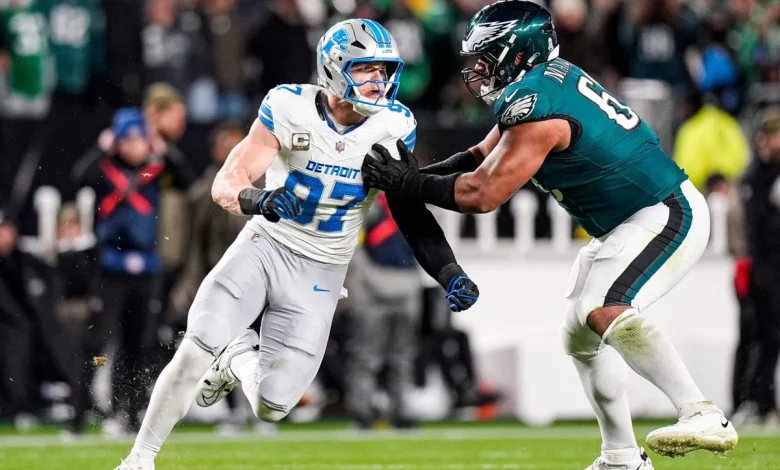
We’ve seen two different versions of this pass rush. From Weeks 1 through 9, the Lions ranked second in the NFL in sacks (28) and sacks per game (3.5), fourth in sack rate (9.6 percent) and 11th in pressure rate. But there’s been a concerning trend developing. Since Week 10, the Lions rank 27th in sacks (4), 28th in sacks per game (1), 27th in sack rate (3.3 percent) and 15th in pressure rate (35.9). It coincides with a drop-off in production from the Lions’ best edge rushers.
Those first nine weeks saw Muhammad playing at an unprecedented, perhaps unsustainable level. He earned more snaps when Davenport was placed on injured reserve in September — predictably so given his history. For a while, it looked like Muhammad was a quality running mate for Hutchinson. He ranked third among all defenders in splash play rate — defined as a sack, pressure, TFL, run stuff, third- or fourth-down stop, interception, forced fumble, fumble recovered or a pass defended — at 17.8 percent. Hutchinson wasn’t far behind, ranking 11th at 16.1 percent.
Since then, both players have fallen outside the top 100. Hutchinson ranks 101st at 9.4 percent from Weeks 10-13. Muhammad ranks 121st at 8.3 percent, and has been phased out of certain game plans when the Lions roll with heavier defensive line packages. It remains to be seen whether he can recapture his early-season heroics.
Hutchinson, meanwhile, has seen one of the highest chip rates in the league at 23.56 percent, per PFF — third in the NFL as of Week 12. That’s been a theme throughout the season, but maybe the fatigue is catching up with him, having to deal with so much attention amid his first full season since 2023. His pass-rush win rate has fallen from 22.6 percent over the first nine weeks (fourth) to 16.9 percent (14th) over the last four. Respectable, but noticeable.
“What I know is I have a high-level player,” Sheppard said of Hutchinson. “One of the best, if not the best, edge rushers in this league. He knows just like we know, people are going to plan for him. That’s why he is one of the best and he has to combat that. But it isn’t a one-man show. Other people have to win.”
But who else can on the edge?
It’s a familiar conversation. This was always the risk, operating this way. The Lions don’t typically splurge in free agency. When they did this offseason, it was for cornerback D.J. Reed. They would rather save money to extend homegrown talent, in an effort to keep their core in place. They prefer to supplement the roster in free agency, while building the core through the draft. It’s what good organizations do.
Al-Quadin Muhammad has 6 sacks this season, but doesn’t have a sack or QB hit in the Lions’ past four games. (Junfu Han / Imagn Images)
However, that philosophy allows for gaps. The Lions don’t draft for need. They do their homework on character and scheme fit, then take the best player on their board. If the best player doesn’t align with a position of need, and the team didn’t address said need in free agency, you’re left with a void that’s never filled.
Edge was an obvious one entering the 2025 NFL Draft. The Lions haven’t selected one in the first two rounds since 2022. Tyleik Williams was the selection at pick No. 28 — a run-stuffing defensive tackle who appears to be the future of the position. The team had its eye on a couple of pass rushers in the second and third rounds of the 2025 draft, but ultimately landed on Tate Ratledge and Isaac TeSlaa. Ratledge could be a long-term answer at guard, and it’s easy to see the vision with TeSlaa.
But the Lions didn’t come away with any meaningful additions to their pass rush — be it free agency or the draft. Their depth took a hit when Onwuzurike was declared out for the season with an ACL injury, and Paschal was never able to return from back surgery. Davenport returned from a pectoral injury suffered in Week 2, but has missed nine of the Lions’ 12 games. The Lions lacked the trade chips to deal for an edge, sending both of their 2026 third-round picks to the Jaguars to trade up for TeSlaa. Out of necessity, they’ve been forced to play three-technique Alim McNeill on the edge at times. Now they’re left trying to manufacture a pass rush.
“You do your best that you can to set up a one-on-one where you can find one,” Lions coach Dan Campbell said. “You’re trying to fabricate some of these, most of them come up in third down to where you want to get your guy in a one-on-one, and then it’s up to him to win. … Got to be a little bit better.”
“I also got to find ways to try to maximize what we do have to our disposal and put these guys in optimal positions to be able to win, give them tools to win,” Sheppard said. “I told the room, it’s our job to eliminate any gray, any hesitation in play and it’s their job to go out and execute. And that’s coach-to-player, player-to-player on the field. So, no, obviously we haven’t affected the quarterback at the rate that we were earlier in the year.”
So, then, what can the Lions do to fix their pass rush? It starts with their best playing their best. That includes Hutchinson. It includes Davenport. It includes Muhammad. It includes McNeill. Sheppard says he’s going to switch up Detroit’s personnel and scheme a little bit. Maybe Hassanein gets a shot. Maybe Mekhi Wingo gets some run. Blitzing more might not be the answer, but the Lions might have to. Additionally, Detroit’s stunts have often failed to generate a pass rush. It’s an area that could be cleaned up or communicated better.
Simply put, the Lions need more from their pass rush. What we’re seeing isn’t, in fact, good enough.