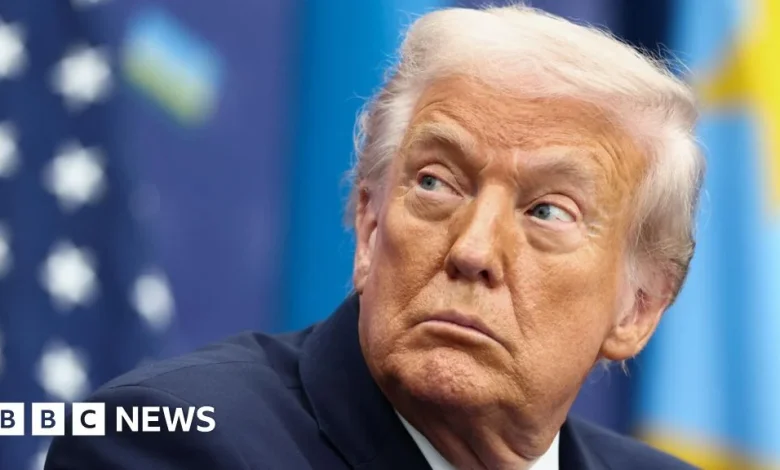
President Donald Trump’s administration has warned that Europe faces “civilisational erasure” and questioned whether certain nations can remain reliable allies, in a new strategy document that puts a particular focus on the continent.
The 33-page National Security Strategy sees the US leader outline his vision for the world and how he will wield US military and economic power to work towards it.
Trump described the document as a “roadmap” to ensure America remains “the greatest and most successful nation in human history”.
European politicians have begun to react, with Germany’s Foreign Minister Johann Wadephul saying his country did not need “outside advice”.
A formal National Security Strategy is typically released by presidents once each term. It can form a framework for future policies and budgets, as well as signalling to the world where the president’s priorities lie.
The new document follows similar rhetoric to Trump’s speech to the United Nations earlier this year, where he had harsh criticism for Western Europe and its approach to migration and clean energy.
The new report doubles down on Trump’s point of view, calling for the restoration of “Western identity”, combatting foreign influence, ending mass migration, and focusing more on US priorities such as stopping drug cartels.
Focusing on Europe, it asserts that if current trends continue the continent would be “unrecognisable in 20 years or less” and its economic issues are “eclipsed by the real and more stark prospect of civilizational erasure”.
“It is far from obvious whether certain European countries will have economies and militaries strong enough to remain reliable allies,” the document states.
It also accused the European Union and “other transnational bodies” of carrying out activities that “undermine political liberty and sovereignty”, said migration policies were “creating strife” and said other issues included “censorship of free speech and suppression of political opposition, cratering birthrates, and loss of national identities and self-confidence”.
Conversely, the document hails the growing influence of “patriotic European parties” and says “America encourages its political allies in Europe to promote this revival of spirit”.
The Trump administration has fostered links with the far-right AfD party in Germany, which has been classified as extreme right by German intelligence.
German Foreign Minister Wadephul stressed that the “United States is and will remain our most important ally in the [Nato] alliance. This alliance, however, is focused on addressing security policy issues.”
“I believe questions of freedom of expression or the organisation of our free societies do not belong [in the strategy], in any case at least when it comes to Germany,” he added.
Referring to Russia’s full-scale invasion of Ukraine, the document says Europe has a lack of “self-confidence” in its relationship with Russia.
Managing European relations with Russia will require significant US involvement, the document says, adding it is a core US interest for hostilities in Ukraine to end.
The Trump administration has proposed a plan to end the war, the original version of which called for Ukraine to hand over some territory to the de facto control of Russia. However Trump’s envoy presented a modified version in Moscow. Russian President Vladimir Putin has warned that Ukrainian troops must withdraw from Ukraine’s eastern Donbas region or Russia will seize it by force.
The White House strategy document repeatedly references the Western Hemisphere, and the need for the US to protect itself from outside threats.
The document says there must be a readjustment of “our global military presence to address urgent threats in our Hemisphere”. To do this, the strategy calls for moving assets away from theatres which are less important to American national security than they once were.
This re-prioritising of military power can be seen already in the Caribbean, where the US military has a growing presence and has carried out repeated deadly strikes on boats which the government alleges are carrying drugs. The world’s largest warship, the USS Gerald Ford, is currently based in the Caribbean along with its strike group.
Away from the Western Hemisphere, the Trump administration singles out the South China Sea as a key shipping passage that has major implications for the US economy, and the document says the US will “harden and strengthen our military presence in the Western Pacific”.
The US also calls on an increased defence spending from Japan, South Korea, Australia and Taiwan.
It says “deterring a conflict over Taiwan, ideally by preserving military overmatch, is a priority”. China views self-governed Taiwan as part of its territory and has not ruled out the use of force to “reunite” with it.
The strategy also talks of pushing for a stronger industrial base in the US and less reliance on foreign technologies, which matches some of the moves the Trump administration has taken with its sweeping global tariffs.