Nuremberg
★★★½
M, 148 minutes
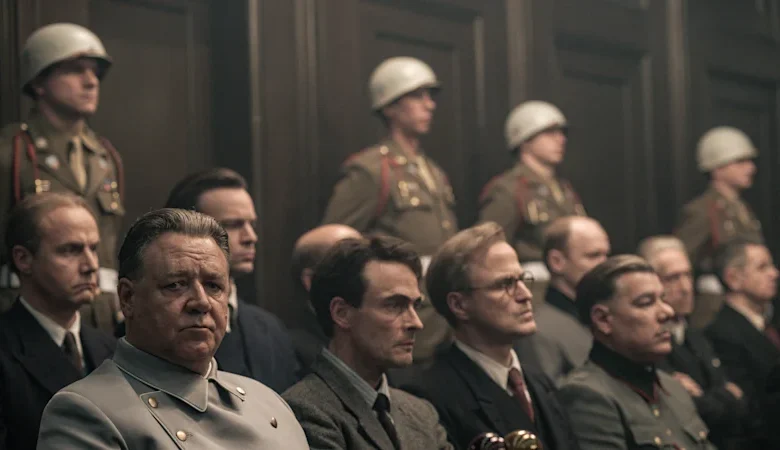
Filmmakers take a risk when they cast a movie star as somebody famous or notorious and I had a moment of amused disbelief when Russell Crowe made his first appearance as the Nazi war criminal, Hermann Goering, in Nuremberg.
Russell Crowe as Hermann Goering in Nuremberg.
In full uniform with chest puffed out, he looked – well, like Russell in a funny getup.
But that impression fades as he sinks into the role and you become caught up in the effort to understand the nature of someone who could perpetrate such atrocities while projecting an air of affability and common sense.
The story of the Nuremberg trials was first brought to the screen in Stanley Kramer’s 1961 film Judgment at Nuremberg and a two-part TV series came along in 2000, but this version takes a new tack. The screenplay written by the film’s director, Jack Vanderbilt, is based on The Nazi and the Psychiatrist, a book by Jack El-Hai which focuses on the relationship between Goering and Douglas Kelley (Rami Malek), a young US army psychiatrist who is called to Nuremberg, where Goering and 21 other members of the Nazi high command are in prison. He’s assigned to analyse each of them to see if they are fit for trial but he’s also determined to find out if there is anything in their psychological profile which makes them innately evil.
Kelley wastes no time in introducing himself to Goering, whom the prosecution believes to be the key to their case. As the highest-ranking Nazi left alive, he is the one they need to crack if the whole command is to be brought down.
Kelley can see the point, but his rapport with Goering develops so fast and he’s so intrigued by him that the ethics of doctor-patient confidentiality start to conflict with the prosecution’s desire to know more about the line Goering will take in trying to defend himself. Kelley has got too close to him. While he recognises him as a power-mad narcissist and a remorseless pragmatist interested only in his own advancement, he’s disarmed by his tender regard for his family and by the undeniable fact that he finds him entertaining company.
There are plenty of dubious assumptions in this scenario but fortunately it’s not just a two-man show. Michael Shannon brings a lot of gravity and toughness to the role of the US chief prosecutor, Robert Jackson, who’s struggling with a challenge that’s never been attempted before – the trial of a nation’s entire leadership. We also get beyond the confines of the prison to range through the bombed-out centre of the city where the specially built courtroom is rising from the rubble, and the cast is packed with big names in cameo roles as prosecutors and army officials. Up-and-coming British star Leo Woodall, recently seen in Bridget Jones: Mad About the Boy, plays Kelley’s German-speaking interpreter, Sergeant Howie Triest, who delivers one of the film’s best scenes – a heartfelt but delicately restrained monologue in which he confides in Kelley about his family’s experiences during the Holocaust.