Transportation Department says Minnesota has issued CDLs illegally, threatens to pull funding

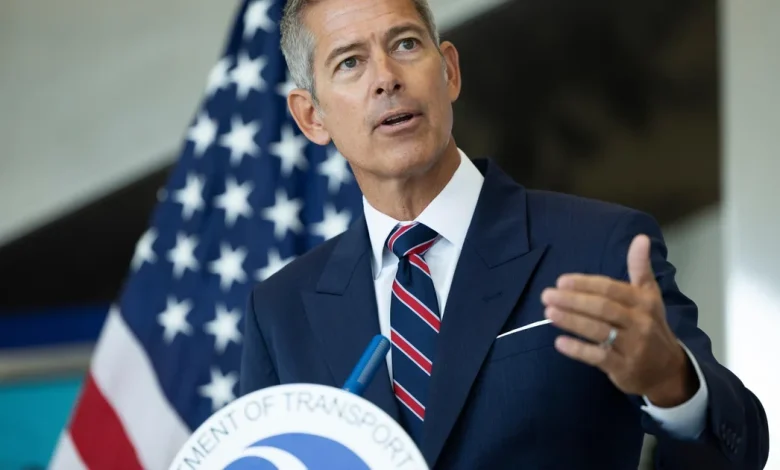
Federal transportation officials allege Minnesota has been illegally issuing commercial driver’s licenses and are threatening to withhold highway funding from the state unless it takes “corrective measures.”
The U.S. Department of Transportation said Monday an audit found one-third of non-domiciled CDLs reviewed by the Federal Motor Carrier Safety Administration were “issued illegally.” Non-domiciled CDLs are issued to those who are not U.S. citizens or permanent residents.
If the state doesn’t “come into compliance” in 30 days, the department said it could lose $30.4 million in federal funding.
“We are following the law exactly as it’s written, exactly as we implemented it for decades, and coincidentally today they decided to keep piling these things on,” Minnesota Gov. Tim Walz said Tuesday in response to the audit.
Federal officials said their audit found Minnesota issued licenses to those who were prohibited from having them and drivers whose “lawful presence in the U.S. expired,” as well as handing out CDLs without verifying applicants were legally in the country.
The U.S. Department of Transportation claimed without evidence that the audit was prompted by “months of deadly crashes caused by illegal foreign drivers.”
Walz said withholding of federal highway funds would, in fact, endanger Minnesota’s drivers.
“This threat, based on procedures we have been doing, following the law, implementing the law for decades, now puts at risk the things that we’re doing to improve safety on this,” he said.
The Minnesota Department of Driver and Vehicle Services says the state currently has 212,327 standard CDL holders and 2,117 non-domiciled CDL holders.
“Federal law authorizes non-domiciled CDLs,” a spokesperson for the department said in a statement. “All applicants take the same tests in English and must go through the same knowledge and behind the wheel testing to demonstrate the same ability to safely operate a commercial vehicle as all standard CDL applicants. We have no evidence Minnesota non-domiciled CDL holders compromised public safety in any way.”
Transportation officials are demanding the state take a pause on issuing non-domiciled CDLs, identify and revoke all noncompliant licenses, reissue licenses once compliant, and conduct an internal audit.
Tuesday night, the Minnesota Department of Driver and Vehicle Services announced it has immediately paused issuing non-domiciled CDLs.
The department also says it conducted an audit earlier this year, identifying and correcting “some administrative errors with issuing non-domiciled CDLs, including notifying customers who were ineligible that their CDL privileges were canceled.”
The audit comes amid increased federal scrutiny aimed at Minnesota, much of it targeting the state’s Somali population, which is the largest in the U.S.
On Monday, Treasury Secretary Scott Bessent said his department is investigating whether “hardworking Minnesotans’ tax dollars may have been diverted to the terrorist organization Al-Shabaab,” an al Qaeda affiliate based in Somalia.
Kelly Loeffler, administrator of the Small Business Administration, said Tuesday she has “ordered an investigation into the network of Somali organizations and executives implicated” in fraud schemes in Minnesota, including the Feeding Our Future scandal.
The New York Times on Tuesday reported the Trump administration has directed Immigration and Customs Enforcement to target undocumented Somali immigrants in the Twin Cities. Walz called the directive “a PR stunt.”
President Trump said late last month he would terminate temporary deportation protections for Somalis in Minnesota, claiming without evidence that “Somali gangs are terrorizing the people of that great state.” He later ordered all green cards from Somalia and 18 other countries be reexamined.
Somali leaders in the state, as well as Democratic lawmakers and advocates, have spoken out against Mr. Trump’s attacks on the community.
Joe Walsh and
Riley Moser
contributed to this report.
More from CBS News