Liv McMahonTechnology reporter
Getty Images
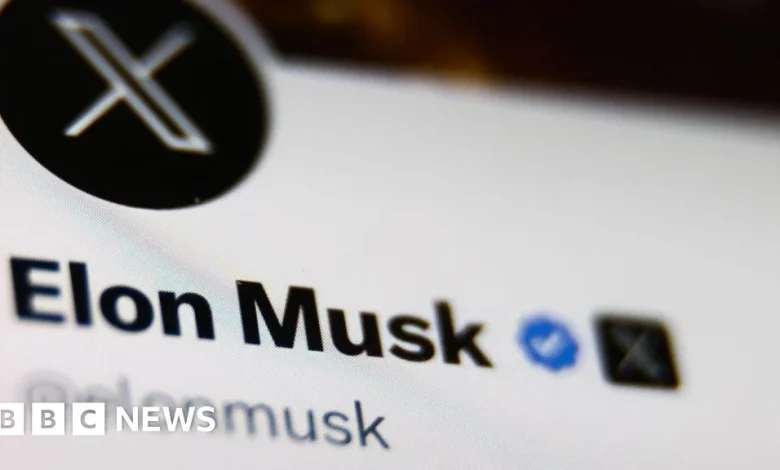
The EU has fined Elon Musk’s social media platform X €120m (£105m) over its blue tick badges – prompting an angry reaction from the US.
The European Commission said by allowing people to pay for a blue verified check mark on their profile, the platform “deceives users” because the firm is not “meaningfully verifying” who is behind the account.
“This deception exposes users to scams, including impersonation frauds, as well as other forms of manipulation by malicious actors,” it said.
But the US Federal Communications Commission (FCC) accused the Commission of targeting X merely because it was “a successful US tech company”.
“Europe is taxing Americans to subsidise a continent held back by Europe’s own suffocating regulations,” Brendan Carr, chair of the FCC wrote on X.
His comments echoed those made by US Vice-President JD Vance.
He lashed out at the EU amid rumours of its forthcoming fine on Thursday – claiming the platform was being punished “for not engaging in censorship”.
“The EU should be supporting free speech, not attacking American companies over garbage,” he said.
Social media expert Matt Navarra said the comments showed the fine was not “just a punishment [but] a statement” of the EU’s willingness to enforce its regulation of tech firms.
‘Evading accountability’
In addition to taking issue with its use of blue ticks, EU regulators said X was also failing to provide transparency around its adverts, and it was not giving researchers access to public data.
“The fine issued today was calculated taking into account the nature of these infringements, their gravity in terms of affected EU users, and their duration,” the Commission said.
Henna Virkkunen, the regulator’s executive vice-president for tech sovereignty, said it was “holding X responsible for undermining users’ rights and evading accountability”.
“Deceiving users with blue checkmarks, obscuring information on ads and shutting out researchers have no place online in the EU,” she said.
The decision means X must tell the Commission how it will bring the allegedly violating measures into compliance with EU laws, or face further, periodic fines.
The action constitutes the Commission’s first decision on a platform’s “non-compliance” with its Digital Services Act (DSA) – one of two rulebooks online firms must follow in order to operate their services in the EU.
The DSA sets out obligations for platforms around content, data and advertising, while the Digital Markets Act establishes how companies should operate in order to benefit consumers and competition.
Such rules have come under increased scrutiny from US leaders, who warned against tougher regulation of tech firms by governments and regulators.
Musk’s controversial blue tick changes
Musk’s shake-up to verification formed part of a sweeping set of changes he made after acquiring Twitter in late 2022.
It saw the previous system – which functioned similarly to other social media verification schemes displaying someone as verified if they supply proof of who they are – cast out and replaced with one tied to its Premium subscription tier.
This required people to pay a monthly subscription fee if they wanted a blue tick displayed next to their account name on the site.
To get a verified checkmark, an X account must have a display name and profile picture, a confirmed phone number and have been active in the previous 30 days.
They also cannot be “misleading or deceptive” or have engaged in spam activity.
Musk launched the new system as a way to incentivise people to subscribe and boost X’s overall income.
It also gave blue tick holders a higher presence in replies, and was mooted as a way to tackle the amount of bots on the platform.
But it proved highly controversial, with warnings it might open users up to scams by impersonators or fake accounts and increase the profile of bad actors and misleading content.
Mr Navarra said Musk’s new system marked a departure from the way platforms usually verify users.
“It’s a trust signal not a transaction, but on X that was flipped,” he told the BBC.
“There’s no meaningful ID check, there’s no rigorous validation and I think that’s where the EU has drawn the line,” he said – adding X had made itself “an easy first target” for the Commission’s scrutiny of deceptive design on social platforms.