Open this photo in gallery:
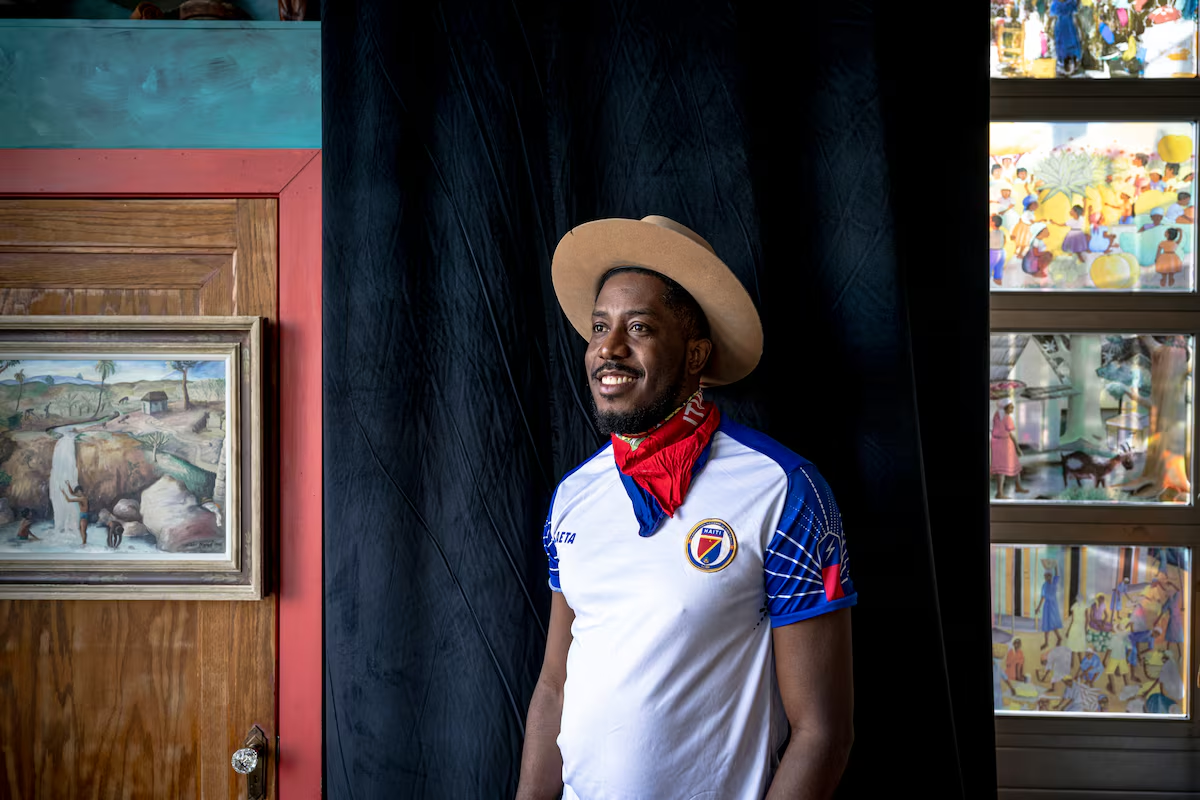
Paul Toussaint, a Montrealer with Haitian origins, in his restaurant, 3 Pierres 1 Feu, on Wednesday.Andrej Ivanov/The Globe and Mail
Soccer balls were not easy to come by when Eneck Louis was a kid growing up in 1970s Haiti.
Undeterred, he and his friends sometimes played with oranges until the fruit burst and left a streak of juice on the clay pitch. Other times, the boys made do with leftover baseballs from the nearby Rawlings factory.
“We couldn’t kick hard, because it would hurt our toes!” recalled Louis.
The country’s singular love of soccer has flourished despite the Western hemisphere’s worst poverty, generations of dictatorship, coups and natural disasters – including the 2010 earthquake that destroyed a mural to Emmanuel Sanon, hero of Haiti’s last trip to the World Cup in 1974, which pictured him alongside Che Guevara.
Now, the island nation currently paralyzed by gang violence is returning to the World Cup for the first time in more than 50 years. Celebrations rocked the usually deserted nighttime streets of Port-au-Prince after a qualifying victory against Nicaragua in November.
Cathal Kelly: The 2026 FIFA World Cup will be the one that runs off the rails
Louis cheered the team from Montreal, where he now works as a taxi driver, part of Canada’s nearly 200,000-person Haitian community. But his jubilation, like that of many, is shaded by worry about the country’s continuing gang crisis and U.S. hostility that could limit Haitian access to the tournament.
“Even when we see some light, it’s as if it’s temporary,” he said.
Haiti will learn its opponents in Friday’s World Cup draw, when the nation will be placed in one of 12 groupings, but won’t know where it will be playing until the full schedule is released Saturday.
Group matches in Mexico and especially Canada would be a relief, because many Haitian fans won’t be allowed to enter the U.S. thanks to a months-old travel ban that prohibits entry visas for citizens of their country. Many Haitian-Canadians with dual citizenship are also avoiding the U.S. as a result, for fear of being targeted at the border.
Open this photo in gallery:
Haiti’s starting team ahead of a group match against Trinidad and Tobago in the 2025 Gold Cup at Shell Energy Stadium.Troy Taormina/Reuters
Only team officials, athletes and coaches are exempt from U.S. President Donald Trump’s travel restrictions. Also affected by the U.S. travel ban will be Iranian citizens hoping to cheer on Iran’s national team, ranked 20th in the world.
Trump introduced the travel ban in June, as part of restrictions against 12 countries that he said were essential to “protect the national security and national interest of the United States and its people.”
The White House says Haiti was included on the list because “hundreds of thousands of illegal Haitian aliens” have flooded into the U.S., an influx it says harms America because of “increased overstay rates, establishment of criminal networks, and other national security threats.” Trump says Iran is on the list because it’s a state sponsor of terrorism.
Officials from both countries have flatly rejected the U.S.’s claims and appealed to FIFA.
FIFA officials, who have sought close ties with Trump, did not respond to requests for comment.
World Cup draw in Washington is one more play in Trump and FIFA’s long game of politics
Hundreds of thousands of Haitian migrants in the U.S. are also facing deportation starting in February, just four months before the World Cup is to begin, after the Department of Homeland Security announced the termination of their temporary immigration status.
That protection, given to Haitians living in the U.S. after the 2010 earthquake, was stripped away after Homeland Security Secretary Kristi Noem decided it was safe for Haitians to return to their country, despite widespread gang violence.
Fedora Mathieu, a Haitian-born immigration lawyer in Ottawa, said many Haitian-Canadians are already avoiding travel in the U.S. because of the immigration policies targeting Haitians. Her office has also been getting flooded with requests from Haitian migrants in the U.S who are trying to get out of the country, she said.
It’s all overshadowing Haiti’s Cinderella soccer story, she said, at a time when the country desperately needs some good news.
Open this photo in gallery:
Fans celebrate Haiti’s victory over Nicaragua to qualify for the World Cup in Port-au-Prince on Nov. 18.Odelyn Joseph/The Associated Press
“It’s heartbreaking,” Mathieu said. “Some of these people have lived in the U.S. for 15 years, they have homes there, they have lives there, and now they have to leave. As Haitians, we have not had much to celebrate in recent years, and it’s just sad to see this.”
Already the poorest nation in the Americas, Haiti’s gang violence and continuing humanitarian crisis have left it feeling like a “war zone,” she said. Even the very infrastructure that supports soccer has been under attack.
In February, armed gangsters took control of the country’s national soccer headquarters and training ground for its top players, the FIFA Goal Center, located in one of Port-au-Prince’s poorest suburbs. Nicknamed “the ranch,” the centre was once a rural mansion where Haitian dictator Jean-Claude (Baby Doc) Duvalier built a soccer pitch and barracks – funded by diverted U.S. humanitarian aid the dictator used to help Haiti qualify for the 1974 World Cup, according to government investigators.
The ransacking of the soccer training ground came only a few months after a gang occupied and vandalized Haiti’s national soccer stadium, the Stade Sylvio Cator, named after the Haitian Olympian who competed in the 1924 and 1928 Olympics. An employee of the Haitian Football Federation was kidnapped as part of that break-in.
As a result of the violence, which has displaced more than a million Haitians and killed thousands more since gangs effectively took over the capital in spring 2024, the team has played none of its qualifying matches in Haiti, instead hosting “home” games on neutral ground. Coach Sébastien Migné, a French national, has never set foot in Haiti.
As FIFA adds constraints to World Cup draw, the possibility for inherent bias remains
Many of the team’s leading players were also born abroad, part of Haiti’s millions-strong diaspora, including the French-born striker Duckens Nazon and Wolverhampton Wanderers midfield Jean-Ricner Bellegarde.
Still, some observers believe this improbable group could make a real difference to the struggling country. Soccer has helped catalyze political change in Haiti before, said University of Virginia professor Laurent Dubois, who has written extensively about soccer and Haitian history.
In 2004, during a time of civil unrest, the Brazilian national team visited Haiti on a peace initiative and the government floated the idea of offering game tickets to fans who would forfeit their firearms. Many Haitians supported Brazil during their own team’s years in the wilderness in part because it featured so many great Black players. The disarmament scheme was ultimately scrapped, but the friendly match against Haiti was a success.
This World Cup will not solve the country’s gang crisis, but it may be at least a temporary salve for Haitians at home and abroad who have been bludgeoned by bad news in recent years.
Paul Toussaint is a Haitian restaurateur in Montreal who grew up playing soccer on the streets of Jacmel, a regional hub. Although he decried Trump for “playing politics” on the visa issue, he said there was “nothing more beautiful” than Haiti’s World Cup qualification.
“This gives hope,” he said. “It shows that our people are capable.”
Open this photo in gallery:
Children play soccer in the Canape-Vert neighbourhood of Port-au-Prince, Haiti.Odelyn Joseph/The Associated Press