‘Giant’ Review: Boxing Legend Naseem Hamed Gets a Biopic That’s More Interested in His Coach

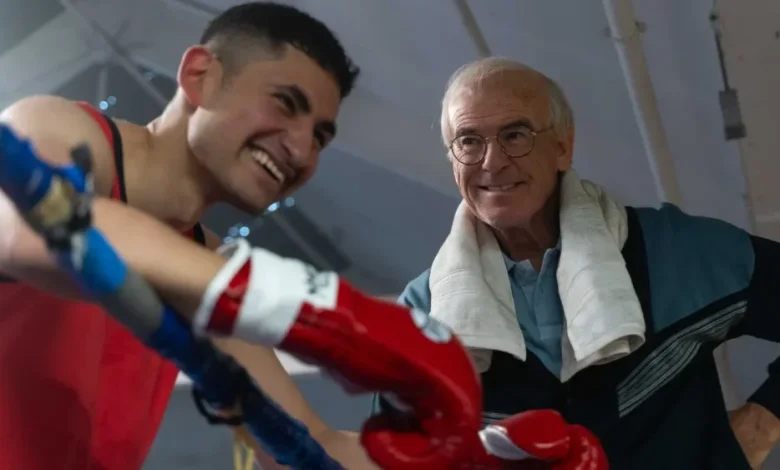
“Giant” tells the story of Yemeni British boxing champion Prince Naseem “Naz” Hamed from childhood to becoming world champion. It follows the well-trodden path of the sports biopic: rising from humble beginnings through adversity and intense training to reach unimaginable triumphs. However, at its center is the relationship between Hamed (Ahmed ElMasry) and Brendan Ingle (Pierce Brosnan), an Irish transplant in Sheffield, who coached the promising pugilist since he was 7 years old. That long connection between the two men gives writer-director Rowan Athale’s film a distinctive narrative edge.
An early pivotal scene establishes both the relationship and one of the main thematic threads of the film. The audience follows Ingle’s gaze as he looks down from a double-decker bus to a young brown boy (Hamed, played by Ghaith Saleh as a child) trying to run away from bullies in a schoolyard. They are accosting him because of his skin color and ancestry. But what impresses Ingle is his footwork as he successfully evades his abusers. His resilience against rampant racism in the U.K. of the 1980s and ’90s will continue to come up again and again in this narrative.
For a while in “Giant,” that bigotry is the only conflict the script provides. The rest is the straightforward narrative on his rise to fame and glory. Ingle and Hamed develop an almost familial bond while he teaches him to rise above the racial intolerance he’s always facing by understanding that he’s better. In the process, Hamed learns to be cocky and loud in his proclamations of supremacy. These earlier scenes flow easily and smoothly, even if they don’t surprise audiences familiar with sports movie tropes.
In the film’s second half, another conflict is introduced. As Hamed’s success grows, a rift begins to develop between him and his coach. Ingle has signed himself a large chunk of Hamed’s purse when the latter was only a child. Now as an adult, he tries to renegotiate. Hamed’s family, which has only tangentially been part of the narrative, comes forth in the character of his brother Riath (Arian Nik), who’s also his manager and becomes the main antagonist for Ingle. Hamed’s Muslim faith — he used to say that his talents were a gift from God — adds to Ingle’s frustration and to the rift between them, as he wanted to be acknowledged as the maker of his skills since he coached him.
At this point, “Giant” takes a swerve. The audience, until then, probably thinks the giant of the title is Hamed. However, it soon becomes abundantly clear that the film is telling the story of Ingle as a beloved coach and pillar of his community in Sheffield. “Giant” is trying to establish his legacy against the boxer he trained, who became much more famous than Ingle ever could. While Hamed’s family and his relationships remain mostly in the background, the film gives prominence to Ingle’s wife Alma (Katherine Dow Blyton), who acts as his sounding board and the audience’s window to better appreciating Ingle as an honorable man.
Al Masry brings bravado and gumption to his performance that belies Hamed’s reputation as a cocky opponent in the ring and a big talker who goads his opponents outside of it. He is natural in the boxing scenes and nails the smooth dance-like movements and especially the fluid footwork Hamed is known for. However, the film doesn’t give him much dramatic conflict. It saves that for Brosnan, who has a lot more to play with.
From Ingle’s fatherly warmth to his anguish over being overlooked, Brosan manages to acquit himself well. This is far from his suave James Bond and proves that he can play a life-size everyman. Nik is stuck with a thinly written character who shouts in nearly all his scenes, making his performance a loudly unnuanced creation. The technical elements — cinematography and editing in particular — are adequate if not particularly distinctive.
“Giant” sticks to a familiar sports biopic playbook, but the focus on the complicated bond between coach and fighter gives it focus. The film works best when it zeroes in on the push-and-pull between Hamed and Ingle, showing how pride, loyalty and ambition can both build and break a partnership. It leaves a lot to the audience to figure out about Hamed beyond what’s publicly known, as it’s clearly more interested in Ingle. While far from being a knockout, the film lands enough solid punches to leave a mark.