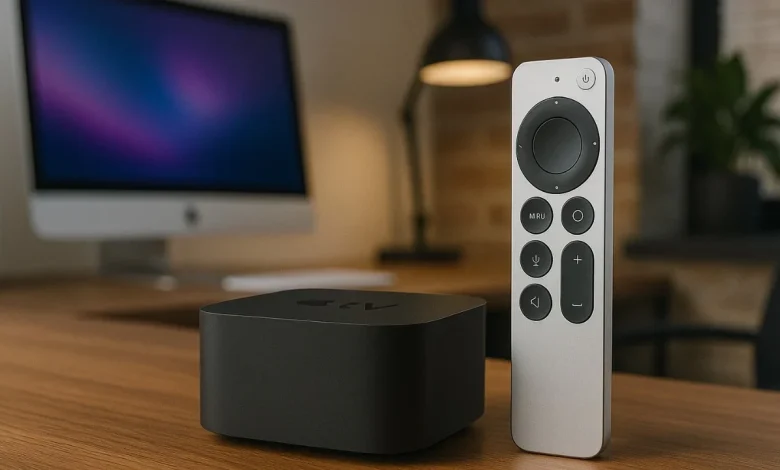
For the better part of a decade, the Apple TV has occupied a strange space in the Apple ecosystem. It is undoubtedly the most polished streaming box on the market—fast, ad-free, and reliable—yet it has often felt like a “hobby” compared to the iPhone or Mac. It was a black plastic puck designed to do one thing: play video. But as we approach 2026, the narrative surrounding Apple’s living room strategy is undergoing a radical transformation.
According to a convergence of supply chain reports, silicon leaks, and analyst predictions, Apple is preparing to launch a new Apple TV 4K that represents the most significant internal overhaul in the product’s history. This isn’t just a refresh to make apps load slightly faster; it is a strategic pivot designed to turn the device into the central nervous system of the AI-powered home and a legitimate “stealth” gaming console.
With a release window now likely pushed to Early 2026, anticipation is building. Here is the definitive deep dive into the “Silicon Trinity” powering this device, the exclusive AI features, and why the current model in your living room is about to become obsolete.
The Context: Why the Delay to 2026?
Throughout 2025, consumers waited for a refresh that never came. The reason, according to insiders, is that the hardware needed to catch up to the software.
We are currently running tvOS 26.1, an operating system that is surprisingly ambitious. It is packed with code for generative AI, predictive caching, and complex home automation. The problem? The current Apple TV 4K (3rd Gen) runs on the older A15 Bionic chip. While powerful for streaming, the A15 lacks the neural processing “grunt” and memory bandwidth required to run the advanced features hidden inside tvOS 26.1 locally.
Apple reportedly delayed the hardware launch to ensure the new device can fully unlock the potential of the tvOS 26 cycle—specifically, the on-device Large Language Models (LLMs) that the current hardware simply cannot handle.
The “Silicon Trinity”: A17 Pro, 8GB RAM, and the N1 Chip
The heart of the 2026 Apple TV appeal lies in three specific hardware components. Together, they form a “Silicon Trinity” that elevates the device from a streamer to a computer.
1. The Brain: A17 Pro (The Gaming Powerhouse)
The most aggressive rumor suggests Apple will skip the A16 chip entirely and equip the “Pro” model of the new Apple TV with the A17 Pro (the silicon originally debuted in the iPhone 15 Pro).
- The Ray Tracing Revolution: The defining feature of the A17 Pro is hardware-accelerated ray tracing. In simple terms, this allows the chip to simulate how light interacts with objects in real-time, creating realistic reflections, shadows, and water effects.
- Console-Grade Capability: This upgrade is a direct shot at the gaming market. It gives the Apple TV the raw power to run “AAA” titles like Assassin’s Creed Mirage, Resident Evil Village, and Death Stranding natively. We aren’t talking about watered-down mobile ports; these are the full console experiences, running locally on a device that fits in your hand.
2. The Memory: 8GB of RAM (The AI Requirement)
Perhaps the most critical upgrade—and the one that makes the current model obsolete—is the memory. Supply chain leaks indicate a jump from 4GB to 8GB of RAM.
- The AI Threshold: 8GB is widely considered the minimum threshold for running Apple’s generative AI models on-device. While tvOS 26.1 supports these features in code, only the new hardware with 8GB RAM will be able to execute them smoothly in the background.
- Performance Stability: For gamers and heavy multitaskers, this memory boost ensures that switching between a high-fidelity game and a 4K movie stream doesn’t force the system to close apps. It keeps the experience fluid and instant, a hallmark of the Apple ecosystem.
3. The Connection: The N1 Chip
For the first time, the Apple TV is rumored to integrate a dedicated connectivity module, tentatively branded as the N1 Chip.
- Wi-Fi 7: The N1 chip brings Wi-Fi 7 support, offering significantly higher throughput and, more importantly, ultra-low latency. For users who rely on game streaming services (like GeForce Now) or stream high-bitrate Plex files, this eliminates buffering entirely.
- The Smart Home Anchor: The N1 also acts as an enhanced Thread and Matter border router. By offloading smart home communication to this dedicated low-power chip, the Apple TV ensures that your smart lights, locks, and thermostats respond instantly, even if the main processor is under a heavy load from gaming or streaming.
The Experience: AI Audio and Conversational Computing
Hardware is only as good as the features it enables. With the A17 Pro and 8GB of RAM, the new Apple TV will finally unlock the “Pro” features dormant in tvOS 26.1.
AI Dialogue Boost
We have all been there: watching a movie where the explosions are deafeningly loud, but the dialogue is a whisper. The 2026 Apple TV aims to solve this with AI-driven Dialogue Boost. Using machine learning, the Neural Engine analyzes the audio track in real-time, identifying frequencies associated with human speech. It then isolates and amplifies the dialogue while dynamically compressing background noise. Unlike standard “Night Modes” that simply flatten the volume, this feature preserves the dynamic impact of the soundtrack while ensuring every word is crisp.
Conversational Siri
The days of robotic voice commands are over. The new hardware will enable the full LLM capabilities of Siri found in tvOS 26.1.
- Contextual Awareness: You will be able to ask vague, complex questions like, “Show me that sci-fi movie from the 90s where Brad Pitt fights a bear.” The AI understands the context, searches the metadata of every streaming service you subscribe to, and presents Legends of the Fall (or 12 Monkeys) instantly.
- On-Screen Intelligence: If you are watching a show and see an actor you recognize but can’t place, you can ask, “Who is the guy in the blue jacket?” The AI uses visual recognition to identify the actor and pull up their filmography overlay without pausing the video.
Continuity and Gestures
While rumors of a built-in camera have cooled, integration with Continuity Camera is deepening. Leaks suggest a new “Air Gesture” interface. By placing your iPhone on a stand near the TV, the Apple TV can use the phone’s camera to track your hand movements. Imagine pausing a movie by raising your hand, or swiping through a carousel of movie covers in the air—a feature reminiscent of the Xbox Kinect, but powered by the device you already have in your pocket.
Pricing Strategy: The “Sub-$100” Sweet Spot
Apple is keenly aware that at $129–$149, the Apple TV is significantly more expensive than competitors. To address this, rumors point to a two-model strategy:
- The Entry Model (Estimated $99): A streamlined version focused purely on streaming. It may use a slightly older chip and lack the N1 chip’s connectivity features.
- The Pro Model (Estimated $149+): The full experience with A17 Pro, 8GB RAM, Gigabit Ethernet, and the N1 chip—the version designed for gamers, smart home users, and those who want full Apple Intelligence features.
Verdict: The “Stealth Console” Arrives
The 2026 Apple TV 4K has the potential to redefine the living room. By combining the A17 Pro’s graphics power with generative AI and next-gen connectivity, Apple is creating something far beyond a simple streaming device.
Should You Buy Now? If you own a 2021–2022 Apple TV and only stream Netflix, you’re fine. But if you care about gaming, AI features, or smart home performance, the answer is simple: Wait.
The jump to 8GB RAM and the N1 chip marks a major turning point. When the new model arrives in early 2026, it won’t just be a better streamer—it will be the smartest computer in your living room.
Have a look at some of our other articles about the Apple TV, which you may find useful.
Filed Under: Apple, Gadgets News, Technology News, Top News
Latest Geeky Gadgets Deals
Disclosure: Some of our articles include affiliate links. If you buy something through one of these links, Geeky Gadgets may earn an affiliate commission. Learn about our Disclosure Policy.