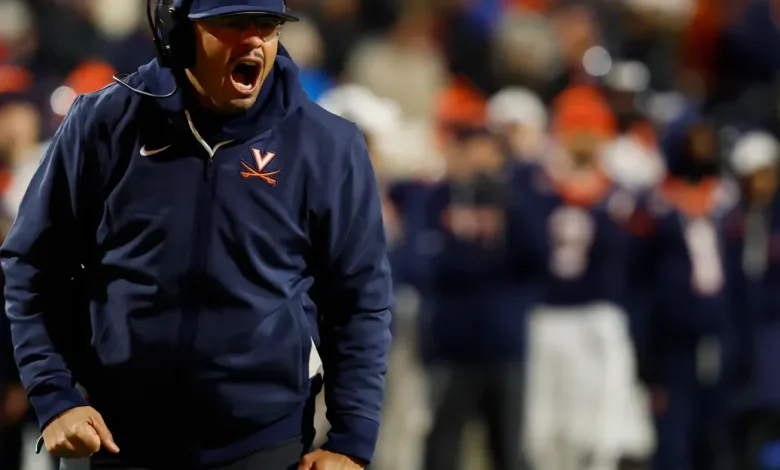
Tony Elliott has already collected one trophy this week. The harder one is still out there and, fittingly, it may come down to lifting another one on Saturday.
On Thursday, the ACC named Elliott its 2025 Coach of the Year, after he steered Virginia to 10-2, 7-1 in conference play, an ACC Championship Game berth, and a No. 17 spot in the CFP rankings. It’s a far cry from the Virginia team that was picked 14th in the league’s preseason media poll and is now in Charlotte with the conference crown, and a College Football Playoff pathway, in front of it.
Across the country, two of the other names at the center of the National Coach of the Year conversation were honored the same way: Curt Cignetti won Big Ten Coach of the Year, and Kalani Sitake won Big 12 Coach of the Year. The SEC hasn’t announced its coach yet, but it’s hard to see past Vanderbilt’s Clark Lea, who led Vanderbilt to a surprise 10-2 record and #14 ranking in this week’s CFP ranking.
Virginia’s turnaround has been dramatic, and the evidence is everywhere, starting with the offense. In the early Elliott era, the Cavaliers were a struggle to watch on offense: 17.0 points per game in 2022, near the bottom nationally. This season’s profile looks nothing like that: 33.2 points per game, 27th in the nation. Virginia’s rushing attack hovered around 118–132 yards per game in 2023 and sat at 123.1 in 2022. This year: 188.7 rushing yards per game.
The defense made the same kind of leap. After a 2023 season where Virginia allowed 33.8 points per game (119th out of 133 qualified teams), the 2025 profile has Virginia down to 20.0 (24th out of 136) and 13th in stop rate – the percentage of a defense’s drives that end in punts, turnovers or a turnover on downs. This has been paired with a dramatic tightening against the run, from 184.5 rushing yards allowed per game in 2023 to 108.3 in 2025. If you’re looking for the simplest explanation of why Virginia suddenly functions as a contender, start there: a team buying into the system with a new caliber of athletes and executing it consistently.
This statistical jump doesn’t happen without the obvious influx of talent. Virginia spent big in the transfer portal, bringing in 31 players with extensive starting experience. But portal spending alone doesn’t build a team. Just ask Florida State, who spent big in the portal, but lost to Virginia this year before falling off the face of the earth. Teams like FSU, who spent much of the last two seasons swallowed by underachievement despite pedigree and investment, are a reminder: the portal is a risk, a bet that your culture can absorb players pulled from every corner of the country.
For Virginia the transfers and homegrown talent didn’t coexist; they blended. They outperformed their collective recruiting rankings, and they did it in the hardest way: through a myriad of tough, tight games that came down to the wire, when a team’s belief is tested. This speaks to the culture that Tony Elliott has built at UVA.
And It’s difficult to talk about culture at Virginia without acknowledging what this program has carried. The work of building daily standards has unfolded in the long aftermath of the Nov. 13, 2022 shooting that killed three UVA football players – Devin Chandler, Lavel Davis Jr., and D’Sean Perry – and shook the university. Elliott inherited a program that needed healing before it could chase championships. He didn’t pretend football could replace what was lost. But he did rebuild the team’s foundation: do the little things, show up for each other, and make accountability non-negotiable.
Elliott’s line, “We can’t win if we don’t flush the toilets,” became one of the most viral moments from the team this season. It sounded silly to some. The point wasn’t hygiene. It was ownership. If players won’t take responsibility for basic shared space, Elliott’s argument goes, they won’t take responsibility for the harder, invisible parts of football. The result has been a calm, next-man-up confidence that has carried the Cavaliers through close games and chaotic moments.
Two snapshots capture it.
First: when Chandler Morris went down in the final moments against Louisville, Virginia didn’t blink – direct-snapping to J’Mari Taylor (a transfer from North Carolina Central who now leads the ACC in rushing yards) to close out the game. Second: when Kam Robinson, UVA’s All-ACC linebacker, suffered a torn ACL against Duke, Virginia didn’t collapse. His replacement, Maddox Marcellus, made his first start of the season against Virginia Tech and posted a sack and an interception as UVA clinched the Commonwealth Clash for just the second time in 21 years.
This weekend, three of the Coach of the Year frontrunners (Cignetti, Elliott, and Sitake) will all be playing for conference championships. The outcomes may well determine the National Coach of the Year winner. If Virginia wins the ACC Championship and the betting favorites hold elsewhere, Elliott’s case sharpens. Virginia, the transfer team that actually gelled and became greater than the sum of its parts, delivering a championship when it mattered most.
Note from editor: This article originally was credited to the wrong author. Grayson Miller is the correct author of this great look into Elliott’s case for National Coach of the Year.