Georgian citizens continue to fight for their freedoms in a political environment that is becoming increasingly authoritarian under the ruling Georgian Dream party. This is particularly true for the country’s prisoners of conscience, who remain resolute in their fight for a free and democratic Georgia.
December 5, 2025 –
Anastasia Mgaloblishvili
Anri Gorgiladze
–
Articles and Commentary
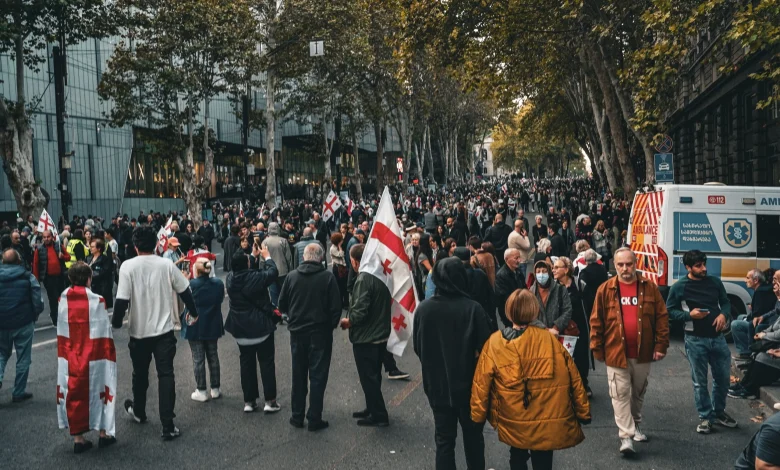
Protests on October 4th 2025 in Tbilisi. Photo: Shutterstock
On the evening of September 29th 2025, Gela Khasaia – a 29-year-old activist born and raised in occupied Abkhazia – was returning home from a daily rally on Tbilisi’s Rustaveli Avenue, when he was met by plainclothes police. Gela was arrested and faces a four to six-year prison sentence for his active participation in the ongoing protests in the Georgian capital.
A day after his arrest, Gela sent a letter from prison that read: “If they want to scare me, the only thing I am scared of is losing my country.”
In today’s Georgia, it is not just participation in ongoing protests that leads to arrest. So does wearing a medical face mask, posting something on social media that the regime deems “offensive”, or refusing to attend the Georgian Dream ruling party’s commissions aimed at “investigating” the start of Russia’s 2008 war on Georgia. Since the ruling party halted Georgia’s EU integration exactly a year ago, it has shifted from governing behind a democratic, pro-European façade to ruling through fear and repression. Georgia is now experiencing its fastest slide into authoritarianism since independence and holds more political prisoners per capita than Russia.
Yet Georgia’s political prisoners – its prisoners of conscience – reveal more than the scale of repression. Their sacrifice and resilience demonstrate Georgian citizens’ refusal to accept authoritarian rule, no matter the cost. For exactly a year today – despite the unprecedented scale of repression – citizens have taken to the streets of Rustaveli every single day.
Since no one better embodies the spirit and resilience of Georgia’s protests than the country’s prisoners of conscience, we have reached out to them across different prison cells in Georgia to let them tell the story of a year of Georgia’s relentless resistance, the sacrifices it has demanded, and what the West can do to stand with their fight for democracy.
What Georgia is fighting for
When asked why they continue this resistance, nearly all prisoners of conscience give the same answer: to free their country from Russian control.
Today, Russia does not appear only with tanks and soldiers. In Georgia, it is embodied in Georgian Dream and its unofficial leader, the oligarch Bidzina Ivanishvili. Under his influence, the ruling party has rigged elections, derailed Georgia’s EU path, and advanced the Kremlin’s interests from within. For most Georgians, EU integration is the only realistic path to freeing themselves from Russian influence and securing a democratic, economically stable, and safe future. After Russia’s invasion of Ukraine, EU accession – long a distant aspiration – suddenly felt within reach. That is why the government’s announcement last year that it was “halting” EU integration ignited the wave of protests that continues today.
“I experienced myself that living under Russian influence is the same as saying no to your own self and living in constant slavery under the regime. I do not want my country to be like this. On the contrary, I want to return my home (currently occupied) from Russia. I want this country to be independent, free, and economically strong – what heroes of our country have fought and sacrificed their lives for,” writes 29-year-old Gela Khasaia.
Gela had to leave Russian-occupied Abkhazia in 2015 and has been fighting for Georgia’s democracy in the pro-western Coalition for Change over the past few years. He had not missed a single rally before his arrest on September 29th and, even behind bars, says he both starts and ends his days by checking for updates on the ongoing rallies: “Only street protests can free both me and my country. I have faith that this country will not become Russian.”
For opposition leader Elene Khoshtaria, Russian rule is also painfully familiar. Her grandfather was executed by Stalin’s regime in 1938 at just 27 years old. Although initially arrested for scribbling “Russian Dream” on Georgian Dream’s election poster – in solidarity with 23-year-old Megi Diasamidze, who was arrested for the same act – the Prosecutor’s Office recently presented new charges against Elene, accusing her of state “sabotage” and “betrayal”, charges that carry up to seven years behind bars. These charges bear an uncanny resemblance to the accusations used against her grandfather before his execution.
“For Russia, my country is a territory to use for its imperialistic games and to strategically challenge European security,” Elene writes. “I am basically fighting for the existence of my country. As simple as that.”
Not all prisoners of conscience have experienced Russian rule firsthand. For 19-year-old Saba Jikia, his fight comes down to protecting the people he loves and the generations that will follow.
“I am fighting for my parents, who raised me. For my grandparents, who brightened my childhood. For my sisters, who taught me patience. For my friends, who taught me to be myself. For our society, which still stands on the streets fighting injustice. And for my future children – so they do not have to continue a battle that has lasted across generations.”
The high costs of European aspirations
Despite their courage, the costs are high. Prisoners of conscience include doctors, students, actors, activists – people who had their whole futures ahead of them. Now, they are spending those years in tiny cells.
Saba Jikia turned 19 in prison this June. Before being sentenced to four and a half years, he worked in a restaurant and was preparing to take Computer Science courses. While he says he has grown more accustomed to prison life, the feelings of “fear, confusion, and injustice” linger. Yet he says his new friends in his prison cell – also arrested for protesting – have helped him adjust.
Before his arrest in December 2024, 30-year-old Irakli Kerashvili worked as a plastic surgeon. During the rallies in Tbilisi, he provided medical support to injured demonstrators. Taken from his home on December 6th by men in civilian clothing, he was charged with “inciting group violence”. From his prison cell, Irakli writes that – alongside friends and family – he misses his “surgical table, white coat, and interaction with clients”. Yet his convictions keep him strong. He calls it an “honour” and a “privilege” to be arrested for protecting his homeland.
Our message to the West
As Georgians enter their second year of uninterrupted protest, their letters express both hope and frustration toward western partners. Ivanishvili’s power depends on a network of captured institutions whose officials and intermediaries often maintain ties with the West. Yet, despite the strongest statements to date – the EU halting high-level engagement and the US freezing certain funding – international actions have not yet pierced the repressive machinery sustaining the regime.
“Georgian people and political leaders are fighting at the expense of our health and freedom. It is in Europe’s own interest to support this struggle. We are not asking others to fight for us – we are asking you to support us,” says Elene Khoshtaria.
Stronger, targeted sanctions can help dismantle the structures on which Ivanishvili’s regime rests.
As Georgia enters its second year of democratic resistance – with nearly the entire opposition behind bars and Georgian Dream doubling down on repression – the country needs more robust support to keep democracy’s pulse beating.
“I am happy with the fact that finally Europe understood the evil that Georgian Dream represents. Their statements make me happy. However, words need to be followed by specific actions – such as financial sanctions. It is not right that Ivanishvili is still a citizen of an EU country and continues to get richer from European businesses while crusading against the West. Europe should not make the same mistake as in 2008. This time around, it should help a small country – which Russia wants to make disappear – with tangible steps,” says Gela Khasaia.
Anastasia Mgaloblishvili is a PhD researcher at the Berlin Graduate School for Global and Transregional Studies (BGTS) at the Free University of Berlin and a Rethink.CEE 2024 fellow at the German Marshall Fund of the United States (GMF).
Anri Gorgiladze is a graduate of International Relations at the Georgian Institute of Public Affairs (GIPA). During his studies, he specialized on the Kremlin’s disinformation campaigns and propaganda before and after its 2022 war against Ukraine. He is currently an activist and a member of Georgian pro-western opposition political party Droa.
New Eastern Europe is a reader supported publication. Please support us and help us reach our goal of $10,000! We are nearly there. Donate by clicking on the button below.
anniversary, European integration, Georgia, Georgian Dream, Georgian politics, political prisoners, protest, South Caucasus