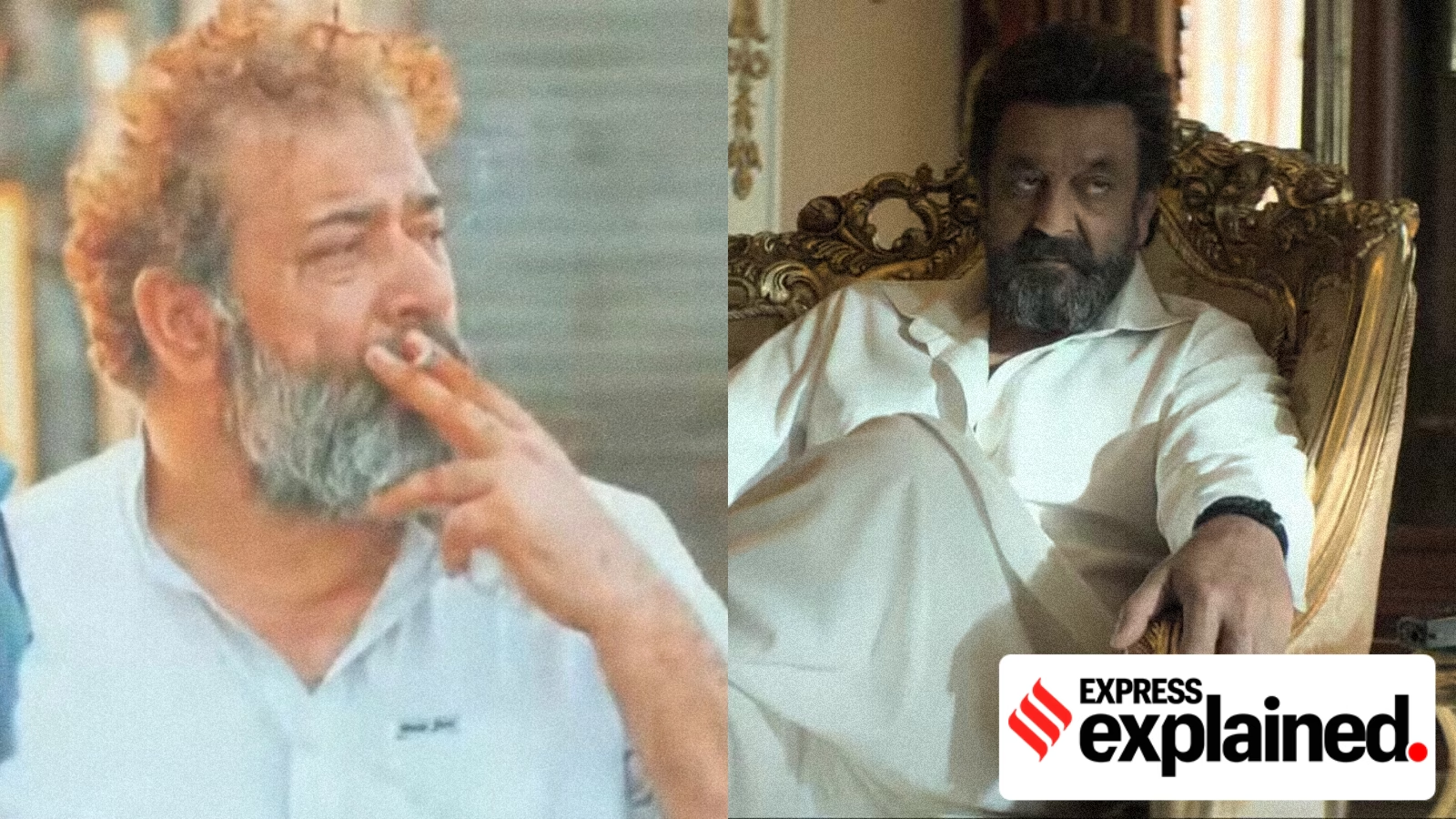
One of the most widely circulated images of Pakistani policing on YouTube shows a bearded officer in a white salwar-kameez, cigarette in hand, holding a Glock pistol with an extended magazine as gunfire sounds in the background and armed policemen stand around him. On Friday (December 5), Sanjay Dutt will bring a version of this figure, the notorious Karachi cop Chaudhary Aslam Khan, to Indian cinema screens in Dhurandhar.
Here’s the story of Khan’s career as one of Pakistan’s most prominent encounter specialists, whose work intersected with the wider intelligence and geopolitical contest between India and Pakistan.
Encounter specialist
Chaudhary Aslam Khan was serving as SSP of Karachi’s anti-terror unit when he was killed in a suicide bombing in 2014.
A Pathan from the Mansehra district, he had joined the police in the late 1980s, and first came to notice during his posting as SHO of Gulbahar Police Station in Karachi. It was around this period that he adopted the honorific “Chaudhary,” traditionally associated with Punjabi landholding families.
Karachi in the late 1980s and early 1990s saw a wave of ethnic killings which were blamed on the Muttahida Qaumi Movement (MQM). Founded by Altaf Hussain, the MQM was rooted in the political and economic marginalisation of the Mohajirs — Urdu-speaking migrants from India who had become the city’s dominant urban group. Many of these killings involved bodies being placed in jute sacks and left on city streets.
A government crackdown placed Aslam at the centre of operations that, according to critics and human-rights groups, resulted in the extrajudicial killing of several MQM workers in police encounters.
Khan vs Karachi underworld
Lyari, one of Karachi’s oldest, most densely populated and deprived neighbourhoods, is home to Baloch and Kutchi communities. It has long been regarded as a stronghold of the Pakistan People’s Party, and noted for a parallel ecosystem of organised crime. As ethnic tensions grew in the late 1980s and 1990s, Lyari’s residents were frequently in conflict with the MQM, which sought to expand its influence across the city.
Story continues below this ad
Khan, who initially clashed with the MQM, adjusted his position after the party aligned itself with General Pervez Musharraf’s military-led government following the 1999 coup. This shift paved the way for a state-backed crackdown on Lyari’s gangs, aimed both at curbing criminal activity and reducing the PPP’s grip on the area. Khan was appointed to lead the operation, known as the Lyari Task Force, which became associated with a series of police encounters.
One such encounter involving a member of the Brohi tribe led to Khan’s arrest and a 16-month jail term. After a change in government, he returned to the police hierarchy and later led the operation that resulted in the killing of Lyari gang leader Rahman Dakait, also known as Rahman Commando, who is depicted in Dhurandhar by actor Akshaye Khanna.
Fight with Pakistani Taliban
In April 2012, Khan led a 12-day police operation in Lyari targeting criminal groups then associated with Uzair Baloch. The siege yielded limited results and resulted in the deaths of 12 policemen.
By this period, Pakistan was also facing an escalation in suicide attacks and sectarian violence attributed to the Tehrik-e-Taliban Pakistan (TTP) and Lashkar-e-Jhangvi (LeJ). Khan was subsequently tasked with pursuing these groups as part of Karachi’s counter-terror operations.
Story continues below this ad
His involvement in multiple encounters with suspected militants made him a prominent target for the TTP, which later claimed responsibility for the suicide attack that killed him on January 9, 2014 when a bomb struck his convoy on the Lyari Expressway. Subsequent investigation hinted that the TTP might have received inside support for the attack.
Over the course of his career, Khan was credited with more than 100 encounters and awarded the highest officially sanctioned head-money reward of Rs 7.5 crore for killing or arresting wanted suspects.
At India-Pakistan crosscurrents
Khan’s work remained primarily within the domain of policing and operations assigned by the Pakistani state. However, some of the individuals he pursued later figured in the broader intelligence and espionage narratives that shape India-Pakistan relations.
Khan was involved in the arrest of Saulat Mirza, an MQM worker convicted of killing a senior Pakistani bureaucrat. In a recorded statement before his execution in 2015, Mirza alleged that MQM cadres had received assistance from India’s external intelligence agency, RAW, an assertion that India denies firmly.
Story continues below this ad
Khan also played a role in earlier actions targeting Uzair Baloch, a prominent figure in Karachi’s underworld. Baloch was arrested by Pakistani authorities in 2016, a year after Khan’s death, and was subsequently accused by the government of sharing information with foreign intelligence agencies. Pakistani officials have claimed that Baloch was in contact with networks linked to Indian national and naval officer Kulbhushan Jadhav, who is currently in Pakistani custody.
India denies these allegations.