There was actually a draw at the draw show, however obscured by all the gas and fluff. The group slots were filled, pathways revealed. During the 2026 World Cup, forty-eight teams will compete; that’s sixteen more contenders than there were last time. There had been some concern that expanding the tournament so dramatically would dilute the quality of matchups, but for the most part that doesn’t seem to have happened. There are tense matches everywhere: England will face Croatia early. Brazil will take on Morocco. We’ll have the chance to see France’s Kylian Mbappé, perhaps the best player of his generation, go up against Norway’s Erling Haaland, one of the few players who might rival him. Even the U.S., which has a favorable draw—it recently beat two of the teams in its group in friendlies—will need to play up to form, which has not always, or often, been the case since a promising showing in the last World Cup. The team’s first game, in Los Angeles, on June 12th, is against Paraguay; their friendly last month, which the U.S. won, ended in a brawl.
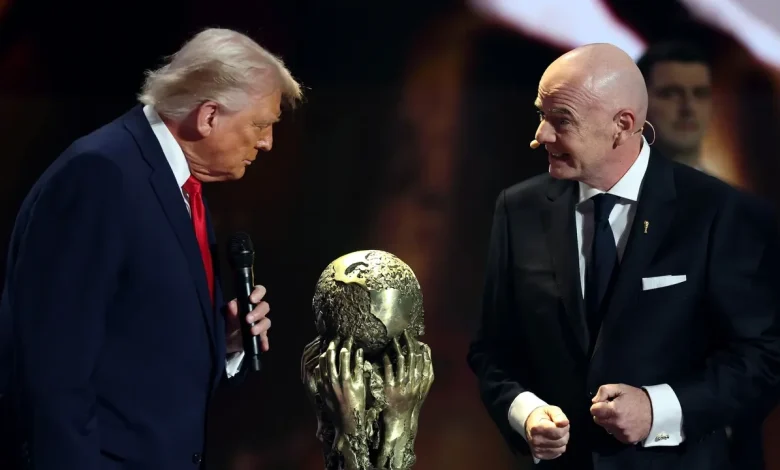
Trump once described Infantino as a child eying presents under a Christmas tree, and at another time as “sort of the king of soccer, I guess.” “Lapdog” might have been more apt. But all that sucking up on Infantino’s part sort of makes sense, I guess. There was a time when Infantino had been a relatively well-liked Swiss bureaucrat, an unthreatening candidate for the top spot after much of FIFA’s leadership was ousted owing to accusations of corruption and graft. Infantino won his role in 2016, in part by promising to restore FIFA’s reputation—but, mostly, by proposing to send some of FIFA’s wealth back to member organizations. To do that, he talked about expanding flagship tournaments, growing the game in emerging markets, and an ambitious, revamped Club World Cup. He used the rhetoric that Trump knows better than anyone, the language of more. He wanted more games, more host cities, more revenue—which meant, naturally, more reliance on autocrats.
He has got what he wanted so far. He presided over a World Cup in the oil-rich desert of Qatar, in 2022. For this one, there will be sixteen host cities in three countries. The first round will feature seventy-two games across twelve groups. Six million tickets are expected to be sold. The price hikes are already setting records. Infantino has claimed that this World Cup would be like hosting a hundred and four Super Bowls. He might have been understating it; Super Bowls don’t require expediting visa access in Uzbekistan for ticket-holders. So Infantino needed Trump, chaos and all, not only to carve out exemptions to the travel bans or to sell soccer—or “football,” as Trump has decided—to MAGA crowds but also to open doors. And Trump has done just that.
There was Infantino, with Trump at Davos. There was Infantino, at the signing of the Abraham Accords. There was Infantino, with some of the world’s richest men, on the dais at Trump’s second Inauguration. There was Infantino, with Trump at a Gaza peace summit. There was Infantino, aboard a Qatari private jet, after joining Trump for meetings in Doha. There was Infantino, at the White House for a state dinner honoring Prince Mohammed bin Salman, who was a critical figure in bringing the World Cup to Saudi Arabia in 2034, a bid that went unopposed. It’s been reported that FIFA’s revenues for the four-year cycle since Qatar will exceed ten billion dollars, more than double the revenues it received before the tournament was held in Russia, in 2018, not long after Infantino took over. Infantino did reform FIFA, just not in the way one might have imagined. Tasked with changing a culture where money was passed under the table, he arguably got rid of the table. It’s all in the open now.
And yet. The World Cup in Qatar was a human-rights catastrophe, but also a fantastic sporting event, featuring some of the best performances by some of the best players in history, and ending with an unforgettable final. There is every reason to imagine that the World Cup this summer will have its share of disasters, and that it, too, will offer the best kind of high drama. It is a peculiar kind of irony that many of the people who love soccer most in this country are immigrants, or women, or children—those whom Trump’s policies have hurt most. But the game is protected by the people who love it. Love the game, and it loves you back. ♦