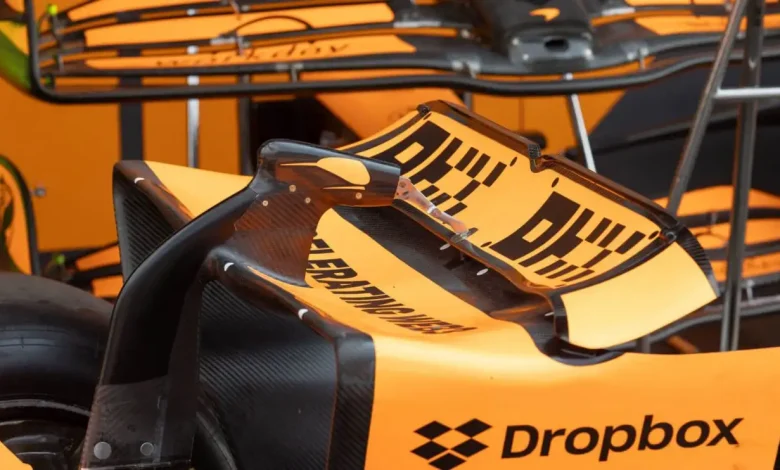
DRS as we know it is no longer needed and has been, in effect, banned – When the chequered flag falls at the 2025 Abu Dhabi Grand Prix, it will mark more than just the end of the season: it will also close the final chapter of one of Formula 1’s most influential and hotly debated inventions, the Drag Reduction System (DRS). For 15 years, DRS has shaped the way drivers plot overtakes, how teams strategise and how fans debate the authenticity of racing. After Yas Marina, the familiar flap on the rear wing will fall silent forever.
The timing is no coincidence. From 2026 onwards, Formula 1 is stepping into a drastically redesigned future. With smaller cars, far greater electrification, active aerodynamics, and a fundamentally different approach to how races should unfold, the championship is attempting to solve the overtaking equation at source, rather than relying on artificial aids. The era that began with Fernando Alonso stuck behind Vitaly Petrov in 2010 and saw triple-digit overtaking figures by 2011 will therefore give way to a new philosophy of how cars should behave in battle.
The Rise and Fall of the DRS Era
When DRS was introduced at the 2011 Spanish Grand Prix, it solved a problem that the sport had struggled with for decades: the aerodynamic wake. Cars had become so dependent on downforce that following another car closely was almost impossible. The result was processional racing, where track position was almost absolute.
The system was simple yet profoundly effective. A movable flap on the rear wing opened to reduce drag, giving the chasing driver an extra 10–12 km/h on the straights. For the first time in years, overtaking felt possible again. The numbers reflected this: the final season without DRS (2010) saw 547 overtakes, whereas the first season with it saw almost 1,500.
However, the system had its limitations, and criticism grew louder as cars became more aerodynamically sensitive. In some races, overtaking looked too easy, ‘DRS trains’ formed when multiple cars had access to the system, and fans increasingly described its effect as ‘push-button passing’.
It seems that Formula 1 has come full circle: racing wasn’t close enough without DRS, yet DRS was too powerful when activated.
Indeed, some have claimed that the latest 2022 aero rules have been a failure, evidenced by DRS. Ross Brawn, the advocate and primary lead in the big strategy to make overtaking easier around the mid-2010s, declared that DRS would likely be removed entirely once Formula 1 cars prioritise underbody ‘ground effect’ to gain downforce.
History thought otherwise, however, with DRS being retained throughout. ground effect era.
Why Abu Dhabi 2025 is the final goodbye
The 2025 finale has been deliberately positioned as the last race to feature the current system, as the 2026 technical regulations will render it obsolete. Formula 1 is not eliminating DRS without a replacement; it is replacing it with something far more integrated: Active aerodynamics and hybrid power deployment are designed into the car from day one.
Put simply, DRS was a temporary fix. The 2026 rules aim to make overtaking a natural consequence of car design.
What’s Really Going On With Red Bull’s Driver Decisions for 2026
2026: A New Vision for Racing Without DRS
The 2026 car represents the biggest change in philosophy since the hybrid era began in 2014. Nearly every aspect of the car is being reimagined, including size, weight, aerodynamics, the power unit, tyres and how drivers will initiate an attack.
The goal is clear. F1 wants sustainable racing, closer pack behaviour and more ‘authentic overtaking’ without relying on a rear wing flap.
Shrink the cars, grow the racing
One of the biggest contributors to poor racing has been the sheer bulk of modern F1 cars, along with the turbulent air generated, creating downforce loss for any following cars. The 2026 regulations shrink them dramatically:
– 200 mm shorter wheelbase
– 100 mm narrower overall width
– 150 mm narrower floor
– Around 30 kg lighter
For the first time in years, F1 cars will feel nimble again. Reduced size means reduced turbulence and tyre scrubbing, as well as a greater ability to change direction, key ingredients for better wheel-to-wheel action.
The return of a partially flat floor and a less aggressive diffuser also puts an end to the dependency on ground effect that caused porpoising and forced drivers to maintain larger following distances. The aerodynamic wake becomes cleaner, thus solving the very problem that DRS was invented to address.
Active Aero: X-Mode and Z-Mode replace the rear-wing flap
Rather than a simple on/off flap, the 2026 cars will feature fully adjustable front and rear wings. These are integrated systems designed to reshape the entire aerodynamic profile of the car.
Two main modes define the new setup:
X-Mode: low-drag layout for straights of more than three seconds.
Z-Mode: maximum downforce for cornering and braking zones.
X-Mode: low-drag layout for straights of more than three seconds.
Switching between these modes can dramatically alter drag by up to 55% and reduce downforce by around 30%. The effect is noticeable, but not unnatural. Both the attacking and defending cars have access to the system, which eliminates the ‘sitting duck’ phenomenon caused by DRS.
This represents a significant philosophical shift: overtaking will depend on how drivers time their aero mode transitions rather than on whether they happen to be within a detection zone.
More Electrification, More Strategy
Alongside the aerodynamic changes comes a new power unit architecture with almost 50% electric power, up from 20% currently.
Key changes include:
– MGU-K output has tripled to 350 kW (475 hp).
– Energy recovery has increased fourfold.
– MGU-H has been removed entirely
– Battery capped at 4 MJ state of charge
– Total power exceeds 1,000 hp.
This hybrid boost is not just a gimmick — it is fundamental to how the 2026 car attacks and defends.
Enter Manual Override Mode (MOM), essentially the new ‘push-to-pass’ trigger. When a driver is within one second of the car in front, they can access a short burst of additional electric power. FIA MATLAB simulations suggest that MOM will enable overtaking, but it will be hard-earned without the ‘drive-by’ ease associated with DRS.
Vasseur blames Pirelli for abject Qatar performance
Cleaner Air, Longer Braking Zones, and Real Battles
By reducing downforce, shrinking the cars and cutting drag, the 2026 regulations extend braking zones by a few metres — small differences that add up dramatically in terms of racecraft. Longer braking zones enable drivers to manoeuvre for overtaking manoeuvres that were previously impossible, such as dives, switchbacks and opportunistic attacks.
Tyre changes, from narrower front and rear widths to new compounds, should also help stabilise race pace and widen the performance window for different strategies.
For the first time in years, F1 is confident that it can generate natural overtaking without resorting to shortcuts.
Which car does the Yas Marina circuit favour? RB21 v MCL39
A New Philosophy: Fix the Problem, Not the Symptom
DRS began as a clever solution to a structural flaw in Formula 1’s aerodynamic landscape. For many years, it delivered exactly what the sport needed, but it always felt like an artificial crutch.
The 2026 regulations represent a shift towards a much more holistic approach. Rather than applying a quick fix to the issue of overtaking, the FIA and teams have redesigned the cars so that DRS is unnecessary.
By the time the final rear wing flap snaps shut in Abu Dhabi in 2025, Formula 1 will be ready to move forward. The next era will be defined not by a button on the steering wheel, but by smarter aerodynamics, balanced powertrains, sustainable fuels and an engineering approach that allows racing to breathe naturally.
For the first time since 2011, Formula 1 believes that it can stand on its own again, with no artificial aids required. Time will tell if the right decisions have been made.
READ MORE – The craziness of Red Bull’s 2026 driver lineup
Despite the drivers’ title race reaching a climax with Max Verstappen, Lando Norris and Oscar Piastri all in contention, the Formula One headlines continue to be dominated by Ferrari.
Having secured the services of seven times champion Lewis Hamilton for an eye wateringly expensive number of Euros, the Scuderia have suffered their worst season under the leadership of Fred Vasseur.
Lewis Hamilton described his maiden year with the iconic Italian racers as the “worst” in his eighteen year career at the pinnacle of motorsport and come Sunday night in Abu Dhabi he will almost certainly have completed his first year in F1 without a podium finish.
Ferrari had the quickest car six races out in 2024
Yet this season of disappointment was never inevitable, given Charles Leclerc and Carlos Sainz had the quickest car on the grid across the closing races of 2024. With six race weekends remaining, Ferrari trailed McLaren by 74 points yet such was the pace of the upgraded SF-24 the team and their drivers hunted down the papaya squad to finish just 14 points shy of their first championship since 2008.
Then came the bombshell announcement at the Maranello festive bash. Ferrari had decided in the final year of this set of car design regulations to build a completely new car concept.
The Italian media representatives in attendance had bellies full of mulled Chianti and and festive roast bird failed to spot this announcement, as Fred Vasseur proclaimed: “We are in the fourth year of applying these regulations and we know our previous project very well. That is why the 2025 car will be completely new.”
Whether this was muttered to a select few behind a glass of prosecco or announced to the room at large, nobody knows, but the stunned silence at TJ13 HQ was reflected in a number opinion based editorials…READ MORE ON THIS STORY
Stanton is a London-based journalist specialising in sports business and sponsorship. With a degree in economics and years reporting for business-focused publications, Stanton translates F1’s complex financial world into clear, compelling narratives.