The entire front row is filled with World Cup winners. The most-capped Springbok of all time is found in the second row. South Africa’s most renowned athlete from any sport roams just behind.
And that’s just the pack. The backline is similarly stacked with Test veterans. Two Boks compete for the 9 jersey. All three outside backs have sung their nation’s anthem before the start of a game. And even with the recent departure of Lukhanyo Am the midfield is just as formidable.
On paper, the Sharks should be one of rugby’s great clubs. But the game is famously not played on paper. Despite all that experience, all that nous, all that first-hand knowledge of what it means to conquer the world, this franchise has fallen well short of expectations.
“It’s strange, to say the least, because there are a lot of world-class players at the Sharks and we know we are underperforming,” says loose forward Vincent Tshituka, who personally has had a remarkable year, winning his first Test cap, but has struggled in his capacity as co-captain of his club side.
“It’s a little bit weird, if I’m honest. It’s also so difficult because it’s not a simple fix. If it was just black and white we’d have solved it by now and we’d be playing to our potential. I can’t just say, ‘if we fix this or that then things will get better’. So yeah, strange is the word I’d use.”
Despite their star studded squad the Sharks have been inconsistent and less than the sum of their parts (Photo Shaun Roy/Getty Images)
For all their present-day star power, the Sharks have never built a dynasty. They reached four Super Rugby finals (1996, 2001, 2007, 2012) and lost all of them. In the Currie Cup they fared better, but even there, periods of dominance were punctuated by sudden drops in performance or dramatic defeats. Through it all, they cultivated one of the country’s most passionate supporter bases: Kings Park packed to the rafters, the Shark Tank faithful roaring behind a team that felt as much like a cultural identity as sporting institution.
When South Africa’s franchises joined the United Rugby Championship in 2021, the Sharks entered the new era not as the proven serial winners but as a sleeping giant armed with fresh capital and ambition. That year the American consortium MVM Holdings acquired a controlling 51% stake in the franchise – valuing the Sharks north of R400 million – and immediately injected unprecedented financial firepower. The wage bill skyrocketed. Household Springbok names arrived in waves. The club expanded its international footprint, targeting the US market, upgrading facilities, and positioning itself as SA rugby’s commercial superclub. And yet, for reasons that now confound even the players themselves, the performances have not matched the investment.
“As players, we are the most disappointed in ourselves,” says Aphelele Fassi, the Springbok fullback who has been sidelined with an ankle injury he picked up against the All Blacks in September.
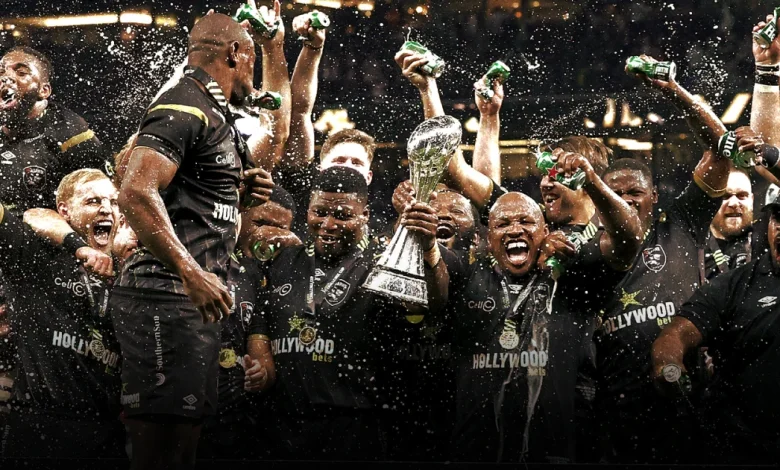
A first ever European trophy for a South African side is now an awkward piece of evidence of their regression. That same season the Sharks won just four URC games to finish 14th on the 16-team table
“It hurts. One hundred percent, it hurts. Everyone’s asking questions about the Sharks and none of them are good questions. We’re not doing our job. We’re not making ourselves or our fans proud. We’ve not been up to the standard of where we need to be.”
In the first URC season, the Sharks finished a respectable fifth and were narrowly beaten away to the Bulls in the quarterfinals. The next year they slipped to eighth before taking a hiding to Leinster in the knockouts. But three group-stage wins and a 50–35 beating of Munster in the Champions Cup round of 16 proved instructional: when things clicked, they had the firepower to beat Europe’s best. It suggested that with a settled squad, a consistent plan, and the Springboks available, the Sharks were capable of becoming a genuine heavyweight in both hemispheres. Their Challenge Cup triumph in 2024 was heralded as a breakthrough, a moment that confirmed their direction of travel while justifying the financial muscle behind the project.
Instead, a first ever European trophy for a South African side is now an awkward piece of evidence of their regression. That same season the Sharks won just four URC games to finish 14th on the 16-team table. Last year saw improvement, but they misfired in their semi-final defeat to the Bulls and failed to advance in the Champions Cup. Their sorry start to this URC season now appears alarmingly normal.
Vincent Tshituka says the power to improve lies with the squad to be more consistent (Photo Tyler Miller/Getty Images)
For Tshituka, the puzzle is as emotional as it is technical. A player who has broken into the Springboks and emerged as one of the franchise’s leaders, he speaks about the situation with a mixture of pride, responsibility and quiet frustration. “I love the Sharks,” he says. “It breaks my heart.” He has grown into a leadership role he never expected, and one he still feels he is learning on the job. “What comes naturally to me is to be a soldier, to support. But I’m growing, and I’ve earned the respect of the coaches. It’s a massive honour for me. Still, I can’t lose myself in all the learning. I can’t lose Vince.”
His honesty cuts through the noise that has swirled around the franchise for 18 months. Where some supporters and pundits have pointed toward cliques, coaching turnover or a squad overloaded with Springbok voices, Tshituka rejects the easy answers. “It’s not black or white,” he says again. “You can’t fix it as an island. You need the buy-in from everyone and you’re not going to get that if people are picking their own battles publicly.” His belief, repeated several times, is that the solution must come from inside the changeroom. “We are the fix. When it’s good, you take it. When it’s bad, you take it.”
Fassi, watching all of this unfold from the sidelines, sees the picture from a different angle. “I’m not someone who talks by mouth only,” he tells me. “I’m a person that wants to do something by my actions.” Being injured, he says, has left him feeling the weight of responsibility more acutely, not less. “The Sharks are my family. I can see how much everyone is hurting. There might be this perception that we don’t care because we’re Springboks and have other things on our mind. I promise you, this means everything to us. We really, really want to get this right.”
There is the issue of identity: the team still doesn’t look like it knows what kind of rugby it wants to play. They are often guilty of playing one extra pass, of trying to stitch together a miracle off-load.
Now this group – bruised, talented, searching for itself – confronts what is arguably the toughest assignment in club rugby: beating Toulouse on their own patch. The Sharks’ opponents in the opening round of this year’s Champions Cup embody everything the Sharks aspire to be. A clear identity. A hierarchy that makes sense. A culture that outlasts coaches and contracts. Toulouse are stacked with internationals too, yet their stars seem to shine more brightly together than they do apart. They resemble what the Sharks would look like if all their moving parts finally clicked.
To understand why that hasn’t happened yet, you have to start with John Plumtree’s second era in Durban. The criticism hasn’t been personal, but structural. First, there is the issue of identity: the team still doesn’t look like it knows what kind of rugby it wants to play. They are often guilty of playing one extra pass, of trying to stitch together a miracle off-load. Even experienced Springboks, who are so disciplined when wearing green, are loose in black.
Aphelele Fassi sees the Sharks as family and is desperate to kick on with a period of success that fits the talent within the squad (Photo David Rogers/Getty Images)
A second reason given focuses on a lack of cohesion. That constant rotation, national-duty disruptions and injury cycles have fractured combinations before they’ve taken shape. There is some truth to that. While the Sharks were getting taught a lesson by Connacht in a 44-17 defeat on Sunday, the likes of Siya Kolisi, Eben Etzebeth, Bongi Mbonambi and Ethan Hooker were putting on an exhibition in Cardiff. But that excuse doesn’t wash, especially when Marvin Orie, Jaden Hendrikse, Makazole Mapimpi and Grant Williams were on the field in Galway.
The third charge is harder to measure but louder than ever: culture. Former Springbok flank Schalk Burger has described them as “frustrating to watch” and repeatedly highlighted the “lack of a clear playing identity” at the heart of their problems. Robbie Fleck has questioned whether the Sharks have any real connection to their fans, asking pointedly: “What are the Sharks standing for at the moment?” and describing it as “a struggling environment.” Jean de Villiers put it even more bluntly: “The Sharks have fantastic individuals. It is not a team.”
Those outside assessments echoed what the franchise itself eventually admitted. In a statement released last month as part of a broader review of their rugby department, Sharks management conceded that the problem was “multi-faceted” and that long-term success would require tackling issues “across the organisation rather than relying on simple fixes.” As a consequence, Plumtree will step aside as head coach whether or not he turns things around by the end of the season.
That frustration – that the answers don’t lie in the coaches’ box – leads naturally into one of the more delicate issues inside the Sharks: the sheer weight of seniority in the room.
Whoever replaces him will be the team’s fifth coach in five years. Perhaps the problem lies not with the hands who are steering the ship, but with those who are pulling the oars. As Kolisi said this week, “With the squad we have at the Sharks, we shouldn’t be where we are. It’s really embarrassing for me as a player, to be honest. You can blame coaches all you want. Coaches can just do so much.”
That frustration – that the answers don’t lie in the coaches’ box – leads naturally into one of the more delicate issues inside the Sharks: the sheer weight of seniority in the room. Tshituka doesn’t shy away from this reality either. In fact, he calls it out more honestly than anyone. “I’m not a guy that believes there should be many chiefs,” he says. “There needs to be a chief or two or three… but we need more soldiers.”
Coming from a co-captain surrounded by double World Cup winners, that is not a throwaway line. It’s an acknowledgement of what everyone can see but few inside the camp have said aloud: the Sharks have an abundance of leaders, but not necessarily a leadership structure. “I can be a chief,” Tshituka explains, “but when Siya’s captain, I’m a soldier because you can’t oppose the guy entrusted with the team.” In a squad filled with players who have captained their country, steered Test sides, and carried franchises on their backs, hierarchy becomes blurred, roles overlap, and the team identity – the “Sharks way” he speaks of – gets diluted.
Whatever happens this season, it seems like John Plumtree will be moving on after failing to get the Sharks singing on the field (Photo Tyler Miller/Getty Images)
Tshituka pauses. He apologises as he asks for a moment to compose himself. He cares deeply about this franchise. He cares deeply for the people of Durban, for the coaches who have given him an opportunity to live his dream, for “the best fans in the country”, for his teammates who have helped him become a Springbok.
“I want this to work,” he says, the emotion in his voice palpable. “I try to give as much to the team as I can. Whatever I can bring to help the boat go faster, I bring. Whatever that role looks like for me, that’s the role I want to take,” he continues. “If I need to speak, I’ll speak. If I need to keep quiet and work, I’ll keep quiet and work. But no man can do this alone. This is a team sport. We need the buy-in.”
Culture isn’t created by strategy decks or glossy signing announcements. It is lived daily, in standards and habits, in small sacrifices and shared purpose. Toulouse have built that over decades.
It is here, perhaps more than anywhere else, that the heart of the Sharks’ problem – and the possibility of their solution – becomes visible. Culture isn’t created by strategy decks or glossy signing announcements. It is lived daily, in standards and habits, in small sacrifices and shared purpose. Toulouse have built that over decades. The Bulls and Stormers rebuilt it quickly once their internal alignment crystallised. The Sharks, for all their wealth and star quality, are still trying to find it.
Tshituka believes they will. Not through slogans or platitudes, but through something much harder and more personal. “We are the fix,” he repeats, as if those four words are seared into his consciousness. They are both a diagnosis, and a promise.