Open this photo in gallery:
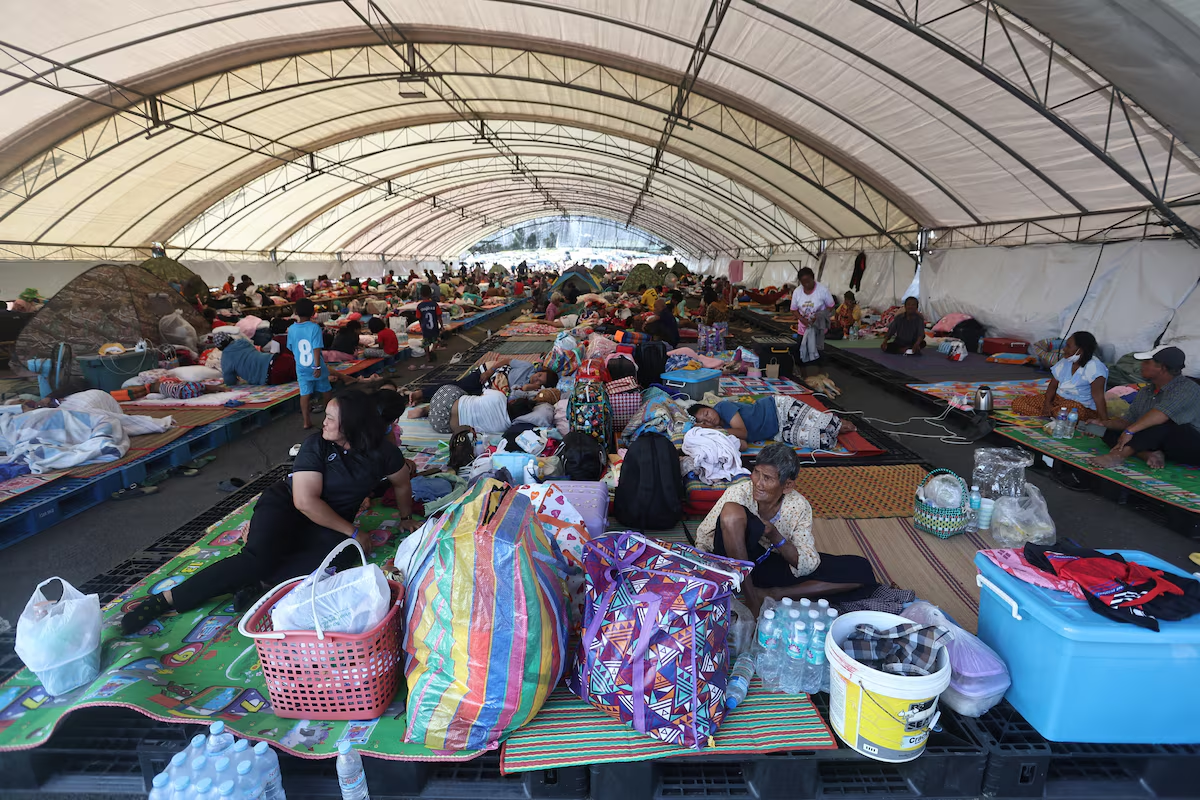
Thai residents who fled following clashes between Thai and Cambodian soldiers rest at an evacuation center in Buriram province, Thailand, on Monday.Sopa Saelee/The Associated Press
Thousands of civilians have fled villages along the disputed Thai-Cambodia border after Thailand launched air strikes against its Southeast Asian neighbour Monday, as both Bangkok and Phnom Penh accused the other side of breaching a ceasefire brokered by U.S. President Donald Trump.
The Thai Air Force said it launched the strikes in response to a buildup of artillery and troops on the Cambodian side of the frontier. At least one Thai soldier was killed and eight wounded in the subsequent clashes.
“Cambodia had mobilized heavy weaponry, repositioned combat units and prepared fire-support elements – activities that could escalate military operations and pose a threat to the Thai border area,” the air force said in a statement.
Cambodia’s Ministry of National Defense denied this, accusing Thailand of putting out “false information.” It said Monday’s attack followed “numerous provocative actions for many days” by Thai border forces.
“Cambodia calls on the international community to strongly condemn Thailand’s violations of the Joint Declaration and its repeated unlawful activities, as well as demands that Thailand take full responsibility for such brazen acts of aggression,” said defence spokeswoman Lieutenant-General Maly Socheata.
Open this photo in gallery:
An injured soldier is transferred to a hospital.Royal Thai Army/Reuters
“Cambodia is firmly committed to respecting and implementing the terms of the Ceasefire Agreement, the Joint Declaration between Cambodia and Thailand, as well as all agreements previously reached by both parties with the highest sense of responsibility and goodwill.”
On social media, Cambodia’s autocratic former leader Hun Sen, father of current premier Hun Manet, also accused Thailand of being the aggressor, and said its actions had crossed a “red line.”
At a press briefing Monday, Thai Prime Minister Anutin Charnvirakul said his country has “never wanted violence” but was responding to Cambodian aggression.
“We insist that Thailand has never initiated the clashes or encroached whatsoever,” he said. “But Thailand will not stand for its sovereignty being violated and will proceed with appropriate measures.”
Open this photo in gallery:
Cambodian villagers flee from their homes in Preah Vihear province, Cambodia, Monday.The Associated Press
Fighting first broke out between Cambodia and Thailand in July, displacing hundreds of thousands of people and leaving several dozen dead. A ceasefire was brokered by Mr. Trump in phone calls with both leaders, and later signed at an in-person ceremony with the U.S. president at a meeting of the Association of Southeast Asian Nations in Malaysia in October.
Malaysian Prime Minister Anwar Ibrahim, who currently holds the bloc’s rotating chairmanship, said Monday he was “deeply concerned by reports of armed clashes between Cambodian and Thai forces.”
“The renewed fighting risks unravelling the careful work that has gone into stabilizing relations between the two neighbours,” Mr. Ibrahim wrote in a statement.
Thailand and Cambodia have contested points of their more than 800 kilometre-long border for more than a century, with the dispute exploding into outright conflict at several points, most recently in 2011, when both sides exchanged artillery fire.
When Mr. Anutin and Mr. Hun signed the October ceasefire alongside Mr. Ibrahim and Mr. Trump, the White House hailed it as a “historic peace declaration ending border tensions between Thailand and Cambodia.”
“This is a landmark achievement for international diplomacy that only President Trump could accomplish,” a statement added.
Just as with a similar deal between Rwanda and the Democratic Republic of Congo, however – which Mr. Trump has cited as part of his campaign to win the Nobel Peace Prize – the Thai-Cambodian agreement appeared to be unravelling within weeks.
Last month, Thailand said it was unilaterally halting implementation of the truce after one of its soldiers was injured in a land mine, which Bangkok said Cambodia was continuing to lay along the frontier, in violation of the peace agreement.
July’s fighting too was sparked by a land mine explosion, after which both sides exchanged artillery fire. Those clashes largely ended after Thailand deployed U.S.-made F-16 fighter jets for the first time since a war with Laos in the late 1980s.
The Thai Air Force said F-16s had bombed military positions along the border on Monday “in order to suppress Cambodian fire-support positions.”
Cambodia lacks a comparable airforce and is massively outgunned by the well-equipped Royal Thai Army, though the mountainous and heavily-mined border region would make any outright invasion extremely difficult.
With files from Reuters