Ethan Hawke on receiving the Coolidge Award, his work with Linklater, and acting with Denzel Washington

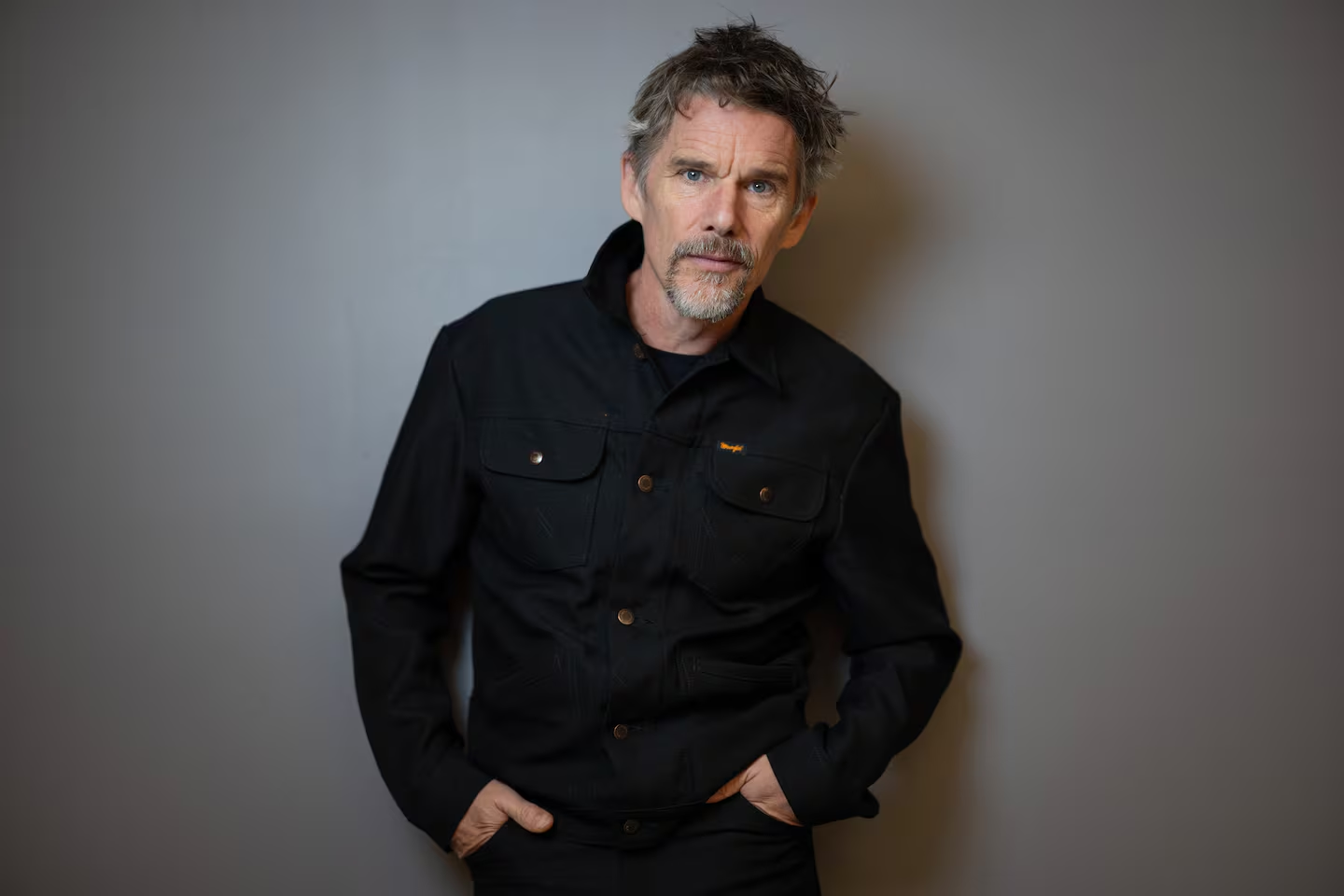
Q. Congratulations on your Coolidge Award. You join some prestigious company: Ruth E. Carter, Meryl Streep, John Waters.
Get Starting Point
A. I love the Coolidge. It’s one of my favorite theaters in America. So, I feel quite honored and thrilled.
Q. Your portrayal of Lorenz Hart gave me the impression that he was in love with the idea of adoring someone and being adored in return. Would you say there’s some truth in that?
A. Oh, of course. One of my favorite lines in the movie is when Lorenz Hart says, “Tell your mother that Lorenz Hart is drunk — and italicize the word ‘drunk’ — with beauty.” And his passion for love and life keeps making him bump up against disappointment.
Ethan Hawke as Lorenz Hart in “Blue Moon.”sabrina lantos
Q. “Blue Moon” is a movie about divorce — it’s a professional divorce, but it’s no less painful than a marital one.
A. There are a lot of films about romantic breakups, but not a lot about artistic breakups and that kind of intimacy. I mean, 25 years of writing together. Over a thousand songs. That’s a lot of late nights, a lot of sharing intimate thoughts. Their whole self-image was wrapped up with each other in the same way a married couple does. They didn’t know who they were without each other.
Hart was destroying himself, and Rodgers had to save himself. Andrew [Scott, who played Rodgers] and I talked for hours and hours about that. We had this unique challenge of trying to feel this entire relationship through the last conversation these people had with each other.
Q. You’re much taller than Hart. To achieve the effect of everyone towering over Hart, did they reverse-Alan Ladd you? Were you in a trench?
A. The history of cinema has expended a tremendous amount of energy making small, diminutive men look large and powerful. We had to invert the equation. Any [non-CGI] trick you can think of — trenches, camera angles — it’s all stagecraft. But it had to be in service to the character.
Ethan Hawke on Oct. 16, 2025 in London. Gareth Cattermole/Gareth Cattermole/Getty Images for BFI
Q. I have to tell you that you’re one of the great movie talkers of our generation. But it’s more than just you monologuing that keeps us riveted. It’s the joy of watching you in conversation with the other actors. Do you favor roles that allow you to conquer reams of dialogue?
A. I definitely see the interplay of dialogue as an essential element of cinema, and a lot of people don’t. My experience on “Before Sunrise” with Richard Linklater was discovering how much of life can be unveiled through dialogue. And I’m really glad you mentioned the other actors. My favorite part of it all is the dance, how my scene partner makes me different. And giving others the chance to excel is thrilling.
Q. Speaking of Linklater, you’ve done several movies with your fellow Texas native. Do you two have a shorthand now when you work together?
A. My relationship with Rick — we’ve been friends for 30 years — I kind of liken it to riding a bike. If you think too much about it, you fall over. [Working together] is just something we enjoy. As for a shorthand — well, I know whether a take is bad, good, great, or terrific just by his glance. And we’re both changing from film to film, so it’s new enough every time. He’s worked with great actors — Billy Bob Thornton, Jack Black, Cate Blanchett — and they impacted the way he thinks about acting.
What was so hard about the Rodgers and Hart relationship was that they didn’t work with anyone else. Rick and I have this advantage where we’re bouncing off of each other after working [separately]. A couple of years will go by, and we’ll write together. We just have a tremendous amount of fun.
Denzel Washington and Ethan Hawke in “Training Day.”ROBERT ZUCKERMAN
Q. You’ve also worked with Antoine Fuqua multiple times. Your collaborations are more action-oriented, like “Training Day” (2001) and “The Magnificent Seven” (2016). Does that make for a different kind of shorthand?
A. Antoine is deeply poetic with the camera, so your relationship to the camera when you’re acting for him is different. There’s something musical about the way Antoine moves the camera. He’s like a great athletic coach. When a coach really understands you and believes in you and puts you in situations where you can excel — that’s what great directors do.
One of the things I learned in my career is that there’s really no right way to make a movie. There are definitely some wrong ways. But the directors I worked with: Sidney Lumet, Alfonso Cuarón, Pawel Pawlikowski, Richard Linklater, Antoine Fuqua, Kore-eda, Peter Weir — their sets are all different. The ways in which you’re asked to prepare are different. I think that’s why actors make good directors. We’ve had the chance to absorb all these different styles.
Q. If I recall correctly, Sidney Lumet started out as an actor.
A. That’s what made Lumet so wonderful to talk to. He really knew how to speak to actors, because he thought like an actor.
Ethan Hawke arrives at a special screening of “Black Phone 2” on Oct. 8, 2025.Richard Shotwell/Richard Shotwell/Invision/AP
Q. Part of your flexibility is that you’re not afraid to do a genre film like the Black Phone horror movies, or a sci-fi flick like “GATTACA.”
A. My first real teacher was Joe Dante, who came up with Roger Corman. He really believed in the value of genre filmmaking and the blurring of the line between what is high and low art.
The value as an actor is when you bounce into different genres, you’re expanding yourself. There’s a different geometry to a film like “Sinister” than there is to “Before Sunset,” so I almost feel like a mathematician.
Q. It’s like solving a word problem in high school algebra class.
A. That’s how I look at it. I see screenplays as math equations. You can see patterns in storytelling. And in those patterns, it’s also easy to see the mistakes.
Ethan Hawke and Kaniehtiio Horn in “The Lowdown.”Shane Brown/FX
Q. Looking at “Before the Devil Knows You’re Dead,” which is quintessential neo-noir, “GATTACA,” which is like a sci-fi noir, and your current series, “The Lowdown” (FX), I sense a trend in your roles that leans toward noir. Are you a big Noirista?
A. Well, noir certainly influenced why I wanted to do “The Lowdown.” [Show creator] Sterlin Harjo wanted to do a Tulsa noir. What if we made “Chinatown” in Tulsa? What’s great about noir is, like horror, you can infuse so much into the thesis of the film and still have it be fun! There’s so much in “The Lowdown” that’s political while still being a whodunit. I love that ability to Trojan horse themes without being pretentious.
Q. My mother will kill me if I don’t ask this question: Is Denzel Washington as intense as he seems to be in his movies?
A. He’s twice as intense. You don’t survive 30 years at the absolute pinnacle of any profession without talent, fortitude, and intensity.
Interview was edited and condensed for clarity.
The Coolidge Award presentation is at 7 p.m. on Dec. 3. Tickets are sold out.
Odie Henderson is the Boston Globe’s film critic.